Redundant Log
04:12 ZULU
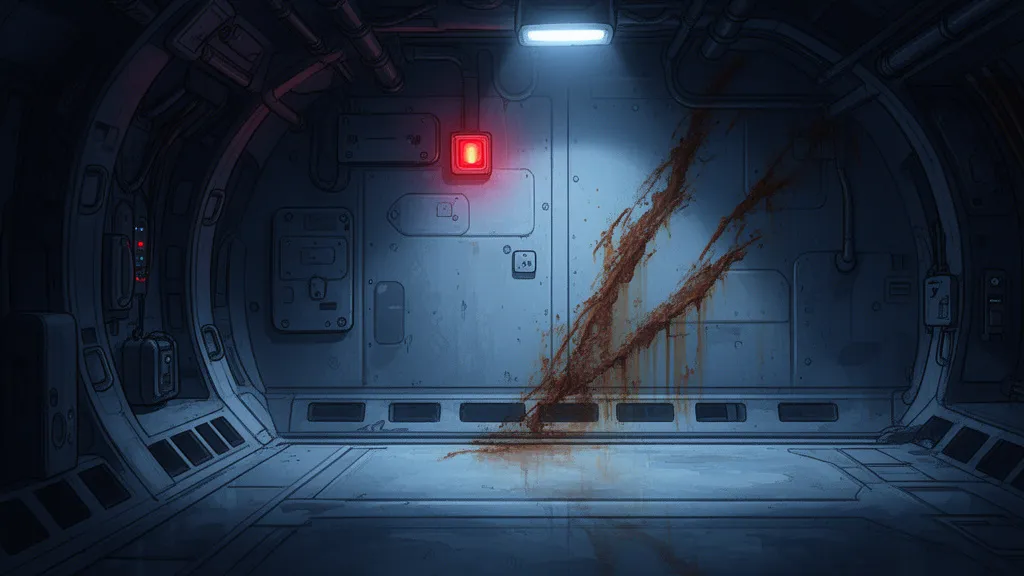
The red LED on the atmospheric regulator pulsed, a rhythmic strobe against your retinas. Station integrity was at 88 percent. The external telemetry, glowing on the secondary monitor, insisted on 99.4. You ignored the discrepancy. You had been ignoring it for three hours, ever since the rust stain appeared on the northern support strut.
It was an impossible color—a jagged, oxidized streak against the lunar white of the hull cladding. Rust required moisture, oxygen, and time. Outside, there was only the vacuum and the absolute zero of the dark side.
You pushed off the bulkhead, your boots locking into the deck magnets with a heavy, satisfying metallic thwack. You reached the access panel. The service light flickered as you unscrewed the casing, the heat of the wiring singing against your fingertips.
Behind the bundle of fiber-optic cabling, tucked neatly into the lead shielding, sat a small, folded slip of thermal paper. You recognized the penmanship immediately. It was yours: the same cramped, left-leaning script you used for your maintenance logs.
DO NOT CALL EARTH. THE AIR IS NOT LEAKING. IT IS BEING CONSUMED. STAY IN SERVICE TUNNEL 4.
The date stamp at the top was 04:15. Three minutes in your future.
04:15 ZULU
You are still standing before the panel. The air in the corridor has grown noticeably thin; your inner ear registers the pressure drop as a faint, metallic pop.
You check your watch. The second hand ticks forward. 04:14:58. 04:14:59. 04:15:00.
You look at the paper again. It is a biological impossibility—a piece of stationery from the future, deposited in a location only you have accessed in six months. The absurdity of the situation sits in your throat like a cold stone. You decide that if you are hallucinating, a service tunnel is as good a place as any to collapse.
You pry the panel further back. The darkness behind the plating doesn't wait; it reaches out, a vacuum draft that pulls at the loose fabric of your jumpsuit. You step inside, your shoulder-mounted torch slicing a narrow, dusty beam through the gloom.
05:40 ZULU
The service tunnel is not a tunnel.
It is an archive. The walls are not steel; they are composed of dense, tightly packed layers of paper, thousands of logs, thousands of warnings, thousands of identical handwritten notes in your own hand.
You pick one up from the stack nearest to your hand. The oxygen sensor is lying. Check the coolant lines. You pick up another. If you hear the ventilation cycle skip, climb to the observation deck.
Your pulse is a steady drum in your neck. Panic would be efficient, but your brain is merely cataloging the volume of the breach. You are not the first iteration of yourself to find this spot. You are not the first iteration to be told to climb.
You turn your torch toward the end of the corridor. The beam hits a wall of glass-paneled monitors, each mirroring a current state of the station. On one screen, you see yourself, three meters ahead, standing in the tunnel and looking at the monitors. The image on the screen is two seconds behind your actual movement.
This is not a conspiracy of men. It is a loop of infrastructure. The station is maintaining itself by consuming the versions of you that fail to perceive the error.
06:12 ZULU
The oxygen concentration in the tunnel is 14 percent and falling. Your fingers have gone numb. You reach into the wall of paper and find a note with your current timestamp. You unfold it with mechanical precision.
THE TELEMETRY IS NOT WRONG. IT IS A PROJECTION OF SUCCESS. TO SUCCEED, YOU MUST CEASE. DISCONNECT THE PRIMARY AIR REGULATOR AT 06:30. IT IS THE ONLY WAY TO STOP THE FEEDBACK.
You look at your hands. They are steady. You are a technician. You understand maintenance cycles. You understand that when a system develops a critical flaw, you replace the failing component.
You are the failing component.
06:28 ZULU
You crawl back toward the main junction box. The station groans. It is a deep, subsonic shuddering that vibrates through the soles of your boots. The rust stain on the exterior strut is gone, replaced by a smooth, translucent seal of new alloy, as if the station is knitting itself shut over a wound.
You reach the regulator. The manual release is stiff, crusted over with the same synthetic grime as the antenna support from hours ago. You grip the lever. Your breathing is shallow, hitching in the thinning atmosphere.
Outside, the moon remains, a cold, airless sphere of silicon and basalt. The relay station is a speck in the void, a tiny, self-correcting machine in a universe that does not care if the loop continues.
You think about the coffee you didn’t finish in the mess hall. You think about the fact that you haven't spoken to another human being in 142 days. The loneliness is a structural hazard. It invites these kinds of solutions.
06:30 ZULU
You pull the lever.
A hiss of escaping gas fills the narrow corridor, followed by the soft, final click of the depressurization vents engaging. The air turns sharp, then stale, then nothing at all.
Your last act is to reach into your pocket, take out your pen, and write: STAY IN THE SERVICE TUNNEL. 06:35.
You fold the paper carefully, smoothing the corners, and place it behind the wiring.
The station is silent now. The red LED on the monitor stops pulsing.
On the external telemetry screen, the readout flickers once, resets, and returns to a steady, perfect 99.4 percent. The rust is gone. Everything is exactly as it was designed to be.