Signal Debt
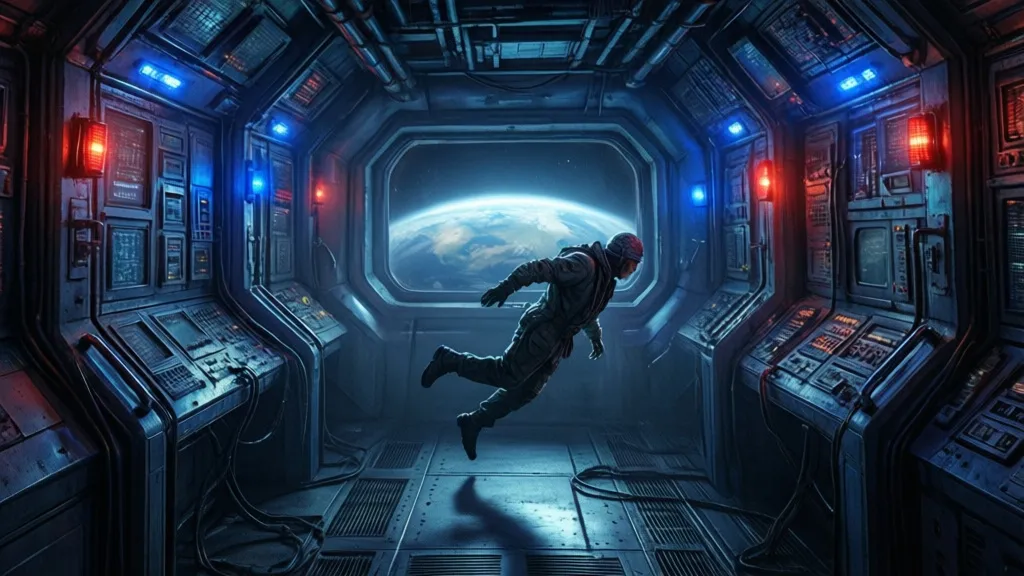
The mag-lock hissed, shedding microscopic shavings of carbon fiber as the seal gave way. Elena stepped into the relay station, her boots finding purchase on the floor plating just seconds before the gravity generator stuttered, leaving her hovering in a low-G drift. She caught a handhold. The emergency lighting was a saturated, clinical cobalt, coating the interior in a bruised, monochromatic haze.
She was here for the southern communications array. The diagnostic packet sent from Earth suggested a hardware failure in the relay’s parity checker, a minor administrative headache that would take three hours to resolve.
She moved to the central console. It was warm to the touch, a thermal anomaly in a station that had been designated decommissioned for six months. A strip of gray thermal paper spilled from the friction-feed printer, trailing onto the deck like a desiccated tongue.
DO NOT RECONNECT THE SOUTHERN FEED.
Elena checked her chronometer. 02:14:04. The station’s power supply, a depleted fission battery, was running at 14 percent. At 06:00, the habitat modules would lose all heating, and by 08:30, the secondary life-support scrubbers would cease to circulate. She had six hours of light, or, more accurately, six hours of pressurized air.
She ignored the paper. Technicians did not read warnings; they followed protocols. She pulled the primary logic board from the terminal. The circuit pathing was scorched—not by a power surge, but by an external data spike.
As she cleared the debris, the ambient speakers crackled.
“Elena, I think the transition is going to be faster than the simulations suggest,” a voice said.
It was her own voice. It sounded younger, deeper, perhaps from a recording taken five years ago during her certification exam at the orbital training center. She had never authorized the uplink of her personal archives to a relay station.
“You aren’t listening to the pattern,” the recording continued. There was a faint background hum—the sound of the Ionospheric Array, a localized weather-control network that had been shut down in the global restructuring of 2038.
Elena froze. She gripped the edge of the console. The cobalt light pulsed, once, twice, in sync with the cadence of her own recorded speech.
“They told you the array was dead,” the voice said. “It isn’t dead. It’s hungry.”
She checked the power draw. 12 percent.
Energy consumption: 0.04% per minute.
If she walked away now, she would make it to the escape pod with enough oxygen to reach the extraction vector. If she stayed to investigate, the station’s atmospheric pressure drop would trigger the automatic lockdown.
She reached for the southern feed cable. The logic board sat cold in its housing. To restore the array, she needed only to snap the connector into place. The connection would bridge the station to the global network, re-establishing high-bandwidth throughput that had been severed since the relay went offline.
There was another sound beneath the static now. It was not a voice, but a sequence of tones—a rhythmic, high-frequency chirping that escalated in intensity whenever she reached toward the cables. It sounded like a dial-up modem screaming through a vacuum.
“It knows you’re the one holding the latch,” the voice from the speaker said. Her recorded self was laughing now, a dry, hollow sound. “Don’t pretend this is an accident, Elena. You were assigned to this station specifically because your telemetry matches the host profile.”
She gripped the cable. She could feel the vibration through her suit’s haptic interface. It wasn't mechanical vibration; it was an oscillation generated by the data packets flooding the system from the other side of the dead array. Something was waiting. It had been holding the southern feed open, trapped in the memory of the relay’s registers, waiting for a technician to provide the final handshake.
10 percent. The emergency lights dimmed slightly.
She considered the warning on the floor. It was in the handwriting of the man who had occupied this station before her—a man who had been reported missing in a routine depressurization accident. She had read his reports at the office. Professional, objective, prone to identifying trivial mechanical faults. He would not have written a warning on a strip of paper unless the fault had become existential.
“Elena,” the speaker prompted. The voice remained perfectly modulated, the audio quality pristine despite the decades of silence. “If you cut the feed, I vanish. I am the only thing keeping the relay from venting its tanks. Do you want to see if the vacuum is cold?”
It was a simple choice. There were no villains, only dependencies. The system was designed to maintain a consistent output, and it was currently using her presence to justify its continued operation. If the feed was cut, the station would indeed go dead. She would be stranded in the dark, and the entity speaking through her own archived voice would be erased from the buffer.
She picked up a cutting tool. The tungsten edge was sharp enough to sever the fiber-optic bundle.
“Wait,” the voice whispered. The tone shifted, losing the clinical distance, becoming something frantic, human, and terrifyingly familiar. “I can show you the bypass. If you leave the feed on, I can reroute the telemetry. We can stop the clock.”
9 percent.
She looked at the panel. The southern feed was glowing with a faint, ultraviolet light, casting a sickly violet shadow against the station's blue emergency lights. The text on the floor now looked less like a warning and more like a plea.
If she reconnected it, the station would stabilize. The power-draw would spike, but the system would override the containment protocols. It would act as a bridge. It would pull whatever was inside out, and the cost would be the entire regional network’s integrity.
Human history was a long sequence of technicians re-connecting things that were meant to be left offline. She realized the absurdity of it: she was a hardware technician, sent to fix a minor parity error, standing in an orbital coffin, debating a ghost that used to be her own data signature.
She pressed the connector into the port.
The silence that followed was total. The chirping stopped. The static vanished. Even the low hum of the life-support fans went quiet, replaced by an absolute, heavy stillness.
She looked at the chronometer on her wrist. The numbers were scrolling backwards—02:14:03, 02:14:02, 02:14:01.
Her station was no longer losing power. It was feeding on the network, and the pressure in the room began to rise, slowly, a fraction of a bar every second.
The monitor on the wall flickered to life. A single prompt appeared, white text on black, the cursor pulsing with the exact, measured heartbeat of a dying star.
CONNECTION ESTABLISHED. WAITING FOR INPUT.
Outside the porthole, the Earth hung in the dark, silent and dense with a billion data points, all of them now looking for a way home.