Stale Transit
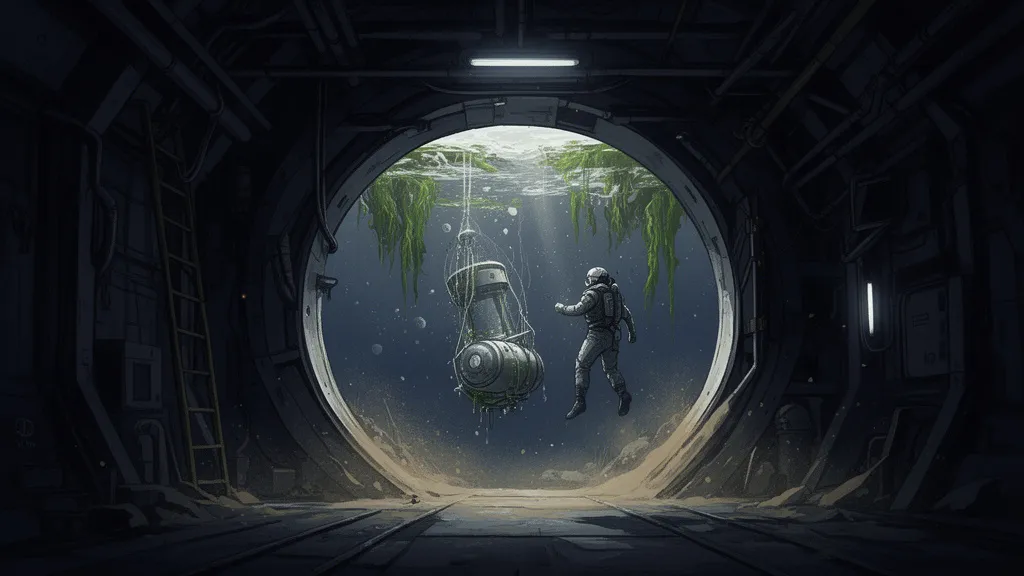
- 03:17 ZULU. The pressure differential across the Intake-9 gate was four hundred psi. Elias felt the vibration in his teeth before he saw the obstruction. He adjusted the external lights of his suit, the beam cutting through the suspended silt of the lunar algae slurry. The intake grate was warped, bowing inward under the weight of a cylindrical mass that didn't belong to the station’s plumbing.
It was a transport pod, Model-7, its surface a dull, matte gray pitted by micro-meteorites. The heat dissipation fins along the hull were still radiating a faint, residual warmth against his gauntlet. A corporate serial number, CC-990-B8, was etched into the casing, the paint faded to a ghost of its original safety-orange.
Elias cycled his comms to the localized frequency. “Control, I have a fouled intake at Gate 9. It’s a closed-cycle transport unit. Requesting heavy retrieval winch.”
“Copy, Gate 9,” the dispatcher’s voice was flat, rhythmic. “Retrieval team dispatched. Estimated arrival 04:45. Maintain position.”
Elias moved closer. The circular viewport of the pod was fogged with internal condensation. He wiped the glass with his reinforced glove. Inside, a woman sat strapped into the harness. She wasn't dead. Her eyes followed the arc of his light with a methodical, predatory focus. She pressed a hand against the inside of the glass. Her lips moved, though the internal audio relay of the pod had clearly been severed years ago.
He watched her fingers trace the seal release lever. He bypassed the safety, the hatch hissed, and the smell of ozone and stale, preserved air rushed out, displacing the scent of processed algae.
“How long?” he asked.
“Eleven years, four months, six days,” she said. Her voice sounded like parchment sliding over stone. “And may I have a glass of salt water? Nothing scrubbed. Just the raw mix.”
- 03:42 ZULU. Elias kept her in the auxiliary pump room, wrapped in a thermal blanket that hummed with recycled heat. She sat on a crate labeled Compressor Gasket Refurbished, watching the station clock on the bulkhead. Every hour, the display flickered, the numbers lagging for a brief, silent interval.
“The station clock is drifting,” she said, not looking at him.
Elias wiped brine from his neck seal. “It’s localized electromagnetic interference from the intake blockage. The system is recalibrating.”
“The system is eating the time,” she corrected. “It’s hungry.”
As if to verify her claim, the digital readout jumped from 03:59 directly to 03:51. Nine minutes had simply ceased to be. In that missing window, the static in the room deepened. A rack of wrenches on the magnetic wall fell, not hitting the floor, but shattering into fine, crystalline dust upon impact. The metal had aged a century in a heartbeat.
Elias stared at the grey powder. “What are you?”
“I am a logistical error,” she said. She held out her hand. Her skin was translucent, the veins beneath appearing as fine, ink-drawn maps. “The registry will categorize me as a hazard. They’ll see the time-bleed, the localized decomposition, and they'll vent the entire sector to save the, quote, 'operational integrity' of the grid.”
Elias looked at the door. He could press the alarm. He could hand her to the Medical-Security detail, let them put her in a stasis field, and go back to scrubbing algae. It was the procedure. It was how stations survived.
“If you report me,” she said, “the registry won't just stop at me. The intake vent is already synced to this drift. The nine minutes are a debt, Elias. And it’s not finished collecting.”
- 04:15 ZULU. The hallway floor began to ripple. Not like water, but like a low-frequency hum vibrating through the steel plates. Elias tapped his wrist computer. The biometric feed for the entire station was fluctuating. Heart rates were spiking, then flatlining, then syncing into a rhythmic, terrifying chorus of collective respiration.
“Why me?” he asked, his voice steady. He was surprised at how little his pulse moved.
“You found me,” she said. “Probability is a cruel architecture.”
She stood up. She walked to the wall panel, her movements jerky, as if she were stepping through a series of frozen frames. She pressed her palm against the wiring interface. Sparks jumped, but they didn't dissipate; they hung in the air like glowing insects, frozen.
“The intake pump isn't the problem,” she said, her eyes vacant. “The station was built on a temporal fault. They needed the constant flux for the high-speed data calculations, a kind of clock-cycle exploitation. But the clock-cycle exceeded the structural tolerance of human presence.”
She looked at him. “They don't care about the people, Elias. They care about the dividend of every lost second. They have an investment in your death.”
Elias looked at his own hand. The skin of his knuckles was wrinkling rapidly. He checked the clock again. 04:18. It had only been three minutes of real-time, but he felt the weight of a decade pressing against his joints.
- 04:30 ZULU. The station began to groan. It wasn't the sound of metal failing; it was the sound of the station attempting to exist in two places at once. The light fixtures in the hallway dimmed, then flared into blinding white, then back to nothing.
Elias looked at the pump room door. He could see the transport pod still sitting at the intake, its metal casing now stripped to a skeletal frame by the rapid aging.
“We have to reach the manual shunt,” Elias said. “If we force the intake to purge, we dump the current drift back into the lunar vacuum.”
“And I go with it,” she said.
Elias didn't answer. He picked up a manual override key from the bulkhead tool-chest. The key was warm, pulsing with the same rhythm as the woman’s skin. He looked at her one last time. There was no terror in her eyes, just a clinical understanding of the physics involved. She was a woman who had lived eleven years in a container, waiting for the exact moment the debt became due.
“I need that glass of water first,” she said.
Elias looked at the container marked Potable Supply. It was dry. He tipped the valve, catching a few drops of grey, mineral-heavy runoff in his palm. He held it out. She drank it with intense, focused precision. It was the most human thing he had ever seen, and it changed nothing.
- 04:41 ZULU. Elias triggered the shunt.
A vacuum roar filled the corridor, pulling at his suit, pulling at his very marrow. The woman stood before the open intake, her form dissolving into the same white dust that had consumed the wrenches. She looked toward the station clock, which had stopped precisely at 04:41.00.
He watched as the intake gate blew open, flushing the entire mess of the transport pod, the woman, and the accumulated years out into the dark, indifferent lunar surface. The station stabilized instantly. The lights settled into their standard, sterile yellow.
Elias sat on the floor of the pump room. He looked at his hands. They were smooth, young, empty. He check his watch. 05:00 ZULU.
He had lost nineteen minutes.
The duty log would show he spent the time clearing a minor blockage at Gate 9. It would be flagged as a routine maintenance event. The report would be processed by an AI, filed by a clerk four hundred thousand kilometers away, and archived in a database that would never be accessed again.
He watched the sediment on the floor. It was settling in a perfect, geometric pattern, a layer of fine, grey, human-derived silt that caught the light, gleaming like crushed diamonds against the industrial steel. "