Submerged Archive
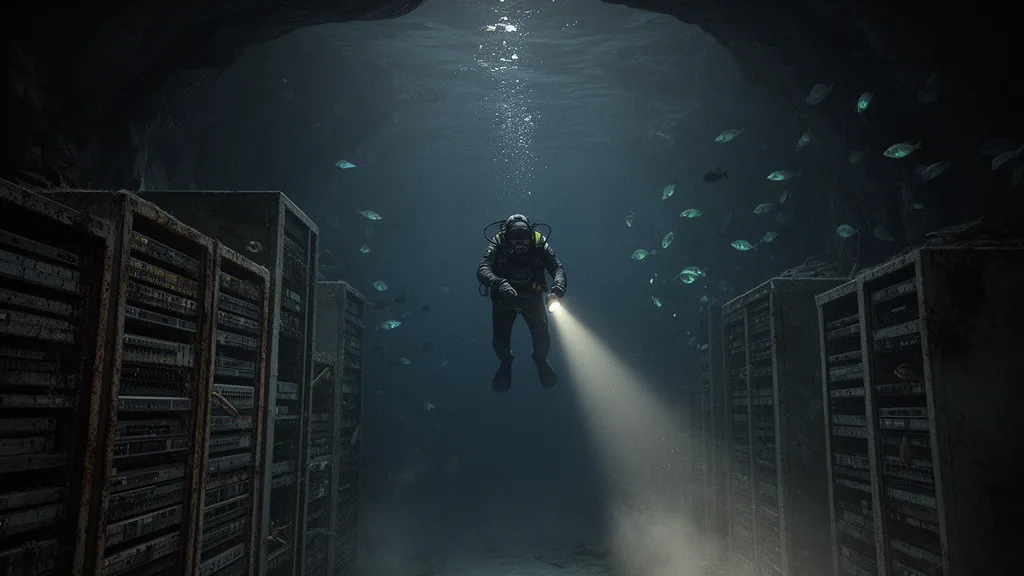
The pressure gauge on Elias’s wrist flickered between 2.4 and 2.6 bar. The lunar archive was a subterranean hollow, a cavernous repository of scanned consciousness and digitized artifacts that had been repurposed into ballast when the structural integrity of the north-side dome failed. Now, it was a graveyard of data and silt.
Elias kicked his fins, his movement muffled by the heavy neoprene of his suit. His wrist lamp cut a clean, antiseptic beam through the murky water, catching the darting silver flickers of genetically modified cleaning fish—tiny, bioluminescent cleaners designed to consume fungal growth. They ignored him, swirling in a static dance around the rusted, protruding data racks. He was at 140 meters of depth, effectively trapped in the lower ventilation shafts of the Sector 9 depository. He had 18 minutes of air, and the lock-down seals on the Level 4 bulkhead were beginning their final, mechanical grind.
The cassette was clamped to a terminal rack at the end of corridor 8-G. It was a standard-issue cold-storage unit, its chassis reinforced with lead film to prevent cosmic ray degradation. Elias hooked his carabiner onto the rack, steadying himself. The silence of the lunar sub-surface was absolute, broken only by the rhythmic, mechanical rasp of his own carbon dioxide scrubber. He reached out and disengaged the magnetic seal with a thumb-flick. The cassette slid free with a heavy click, weightless in the buoyancy of the water.
He did not intend to read it. He was a contractor, a diver specialized in retrieval in hazardous aqueous environments. The contract stated: Submerge, Extract, Ascend. It did not say: Query the Cargo.
But the cassette’s identification LED pulse was wrong. It wasn't flashing the repository’s standard yellow pulse. It was glowing a steady, rhythmic blue. The frequency was exactly 60 beats per minute. A human resting heart rate.
Elias pulled the cassette into his chest, tucking it under his arm to avoid accidental impact. He checked his display: 14 minutes. The bulkhead above would be halfway engaged. If he didn't clear the intake filter within six minutes, he would be crushed by the hydraulic pressure as the chamber sealed entirely, intended only to preserve the structural stability of the upper domes. The water wouldn't rise; the room would simply cease to exist as a pressurized space.
He pushed off the terminal rack. As he drifted backward, his shoulder bumped a fallen acoustic transducer, triggering a localized playback glitch in the room’s decaying hardware. The archive’s internal paging system, long dormant, hummed to life, leaking audio into his suit’s external-to-internal feed. It was a digital ghost, a low-fidelity oscillation.
“Dad?”
Elias stopped kicking. The sound was flat, stripped of its biological timbre, yet the cadence was unmistakable. It was Julian. Julian, who had died in the vacuum of the transfer shuttle three years prior, his lungs atomized by a faulty atmospheric seal.
“The retrieval order is a loop, Dad. You're the eighth version.”
Elias stared into the dark. The silver fish circled his head, their small, cold eyes reflecting his wrist-lamp beam. He felt a spike in his heart rate—110, then 120. The scrubbing unit in his backpack whirred, struggling to keep up with his sudden gasping breath. He looked down at the cassette under his arm. There was a port on the side, a data-sync jack.
He ignored the flashing warning on his heads-up display: 10 MINUTES TO BULKHEAD CLOSURE.
He clamped the sync cable from his helmet comms to the cassette. His vision was a mosaic of HUD warnings and the absolute, oppressive black of the archive. The audio feed cleared. It wasn't a recording. It was a real-time predictive model, a simulation running on the archive’s residual reserve power.
“They didn't store the files, Dad. They stored the survivors,” the voice said. It wasn’t a cry for help. It was clinical, detached. “When they pressurized the dome, they didn't have enough oxygen for the intake. They took the survivors—the ones with strong psychological signatures—and coded them into the sub-storage arrays. We aren't in the cloud. We’re in the maintenance logic.”
Elias looked at the walls. Every rack he had been passing, every cable he had been navigating, was a localized server blade. He was swimming through a graveyard of digitized, sentient trauma.
“You weren't sent to retrieve the data,” the voice continued. “You were sent to trigger the final cycle. The oxygen in the sector is set to flush once the storage reaches 100 percent capacity. You just brought the last sector online.”
Elias looked at the readout on the cassette. Capacity: 99.98 percent.
He felt the sudden, violent vibration of the bulkhead seals far above. The sediment on the floor began to churn; the suction of the cooling pumps was reversing. The archive was preparing to purge the liquid coolant. He reached for his emergency ascent line, but the line was slack. The winch had been cut.
The absurdity of his predicament struck him—he had spent five years perfecting the art of underwater retrieval, only to end his career as an organic zip-file that the system didn't even have to compress. He looked at the cassette, then at the intake valve that would open to drain the water into the vacuum of the lunar core.
“Can you stop it?” Elias asked. He whispered the words into his mask, the condensation fogging the glass.
“The instruction set is hard-coded,” Julian said. “The system works exactly as designed. That is the problem.”
Elias reached out and pulled the sync cable from the cassette. The voice cut off, leaving a ringing emptiness in his ears. He looked at the bulkhead. A sliver of light was visible, a rapidly narrowing horizon of pressurized air.
He checked his gauge: 4 minutes.
He began to swim. He moved with the practiced efficiency of a machine. He did not swim toward the exit. He swam toward the central coolant intake, the massive, spinning turbine that served as the archive’s mechanical heart. If he jammed the intake—if he forced the impeller to shatter—he would trigger a total emergency shutdown. The archive would freeze. The data would be lost. But the purge would hold.
His hand found the edge of the turbine blade. It was freezing, the metal brittle from years of exposure to the lunar interior. He wedged the heavy, lead-shielded cassette between the intake housing and the impeller.
The cassette crunched, bending under the immense torque.
The alarm in his helmet stopped. The grinding of the bulkhead ceased.
Elias floated, suspended in the center of the dark cavern. He was out of air. He turned his wrist lamp off, conserving the last of his battery. Around him, the silver fish darted in the pitch black, tiny stars in an ocean of sediment. He felt the weight of the water, massive and indifferent.
Outside the walls, the lunar wind brushed against the archive’s exterior, a sound he couldn't hear but could feel in the marrow of his legs. The cassette held, wedged into the metal, a tiny, singular obstruction in a massive, systemic collapse.
He closed his eyes. The darkness was absolute.