Submerged Integrity
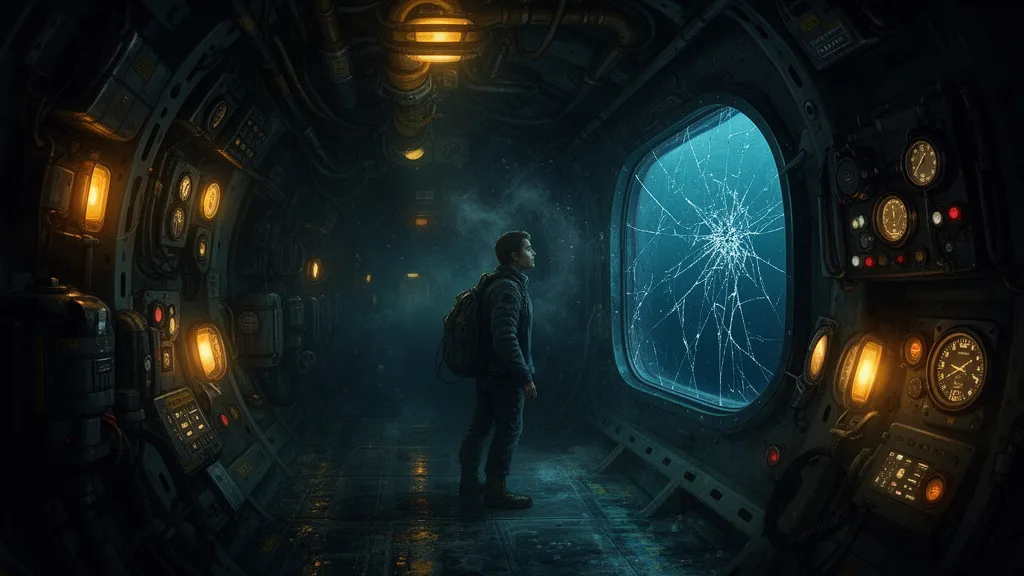
The pressure at 400 meters is an abstraction until you see the microscopic spider-webbing across the sapphire-glass viewport of the spine. Elias watched the coolant fluid swirl in thick, oily ribbons against the bulkhead. His HUD pulsed a soft, amber synchronicity with his radial artery: 72 beats per minute. The internal lights of the sub-corridor mirrored the oscillation, a rhythmic flickering that tasted like copper in the back of his throat.
“Maintain seal, Elias,” the voice of the Surface Controller, Miller, crackled through the comms. It sounded bored, processed through three layers of encryption and noise suppression. “The structural integrity of the floating district is at 84% and dropping. Secure the plate. Do not engage with sub-level access doors.”
“The crack isn’t tectonic,” Elias said. He hovered his magnetic gauntlet over the fissure. “There are tool marks. Lateral shear. Someone pried this open from the inside.”
“The report states pressure-induced fatigue. Proceed with the weld.”
Elias maneuvered his tether toward the primary junction. The currents at this depth were sluggish, cold enough to draw heat through his thermal suit even with the internal coils running at peak capacity. He looked at his oxygen readout: 00:09:42 remaining.
He pushed off the exterior casing, drifting toward the access hatch forbidden by protocol. The paint around the rivets had been scraped away, revealing raw, un-oxidized steel. It was impossible for the sheer pressure of the ocean to execute a precision job like this. The water here was a weight that crushed iron, not a technician that used a laser cutter to slice a perfectly circular ingress port.
He pulled his wrench from the utility belt. The vibration of the floating city above hummed through the metal, a constant, low-frequency roar of millions of lives consuming energy to stay afloat. He struck the hatch. It didn't ring hollow. It felt solid, yet behind it, he heard a sound that didn't belong in the deep: a soft, wet respiration.
“Miller, I’m seeing evidence of tampering,” Elias said, his breath fogging the corner of his visor. “Manual breach. I’m going to take a look.”
“Negative, Diver. The structural priority is the load-bearing spine. You are currently 400 meters below the surface. Disobeying command parameters will result in immediate termination of your contract and oxygen supply. Return to the weld site.”
Elias looked at the seal. It wasn't just metal anymore. A fine, silver mist began to leak from the perimeter of the hatch, defying the immense ambient pressure. It didn't disperse into the water; it clung to the hull like a bioluminescent moss, glowing with a dull, rhythmic intensity that matched his own pulse. It was the color of unpolished chrome, moving with a deliberate, muscular fluidity.
He had seven minutes of air left.
He ran his glove through the mist. The sensation was immediate: a sharp, clinical chill that bypassed his thermal sensors and settled directly into his nervous system. His HUD stuttered. The pulse-sync monitor climbed to 88 beats per minute. The lights in the corridor flared, then settled into a steady, aggressive strobe.
“Miller, the containment leak is non-standard. It’s behaving like a biological slurry. I’m opening the hatch.”
“Elias, remember the indemnity forms you signed. You are an asset of the city, not a witness.”
He ignored the comms. The magnetic locks on the hatch surrendered with a groan that sounded like a tectonic shift. He pulled. The door moved outward, held by the external weight, but the substance inside surged forward before the passage was fully open. It was dense, metallic, and hummed with the same high-frequency data noise that the floating city emitted to keep its servers cool.
Inside the compartment, the rack wasn't holding data. It was holding a body—or the remnants of one—intertwined with the ship's fiber-optic nervous system. The cables had been pulled from the wall and woven into the cavity of the human torso. The silver mist was the fluid binding the interface together, a conduit for whatever the city was processing at such depth.
Elias pulled his head back, his movements sluggish. His oxygen gauge dropped to 00:03:15.
The occupant’s eyes were open behind a faceplate identical to his own, but the glass was frosted with condensation from the inside. The fingers were fused to the port inputs, the joints locked in a permanent, mechanical grip. The individual wasn't dead. The silver fluid was pulsing through the junction, carrying blue light into the pale, sightless eyes. It was a maintenance loop. A human processor to handle the computational excess the city's hardware couldn't manage.
“The spine is cracked because they’re growing,” Elias whispered. He wasn't talking to Miller. He was talking to the weight of the water.
“I see you’ve identified the bottleneck,” Miller said. The boredom in his voice had vanished. It was replaced by a clinical, terrifying neutrality. “The efficiency of a direct neural-data bridge is 40% higher than silicon cooling arrays. We had hoped to avoid downtime for site assessment, but since you are already inside, you might as well calibrate the feed.”
Elias looked at his oxygen timer: 00:01:20. He looked at the silver mist, then back at the tether that led toward the surface—toward the sun, the synthetic air, and the city that thrived by feeding on the dark.
If he climbed back up, the report would be filed as a structural failure. Another repair crew would be sent down to seal the hatch, perhaps to install a new unit to keep the data flowing. If he stayed, the silence was absolute. The city hummed above, a vibrant, beautiful machine that required a constant, frantic heartbeat to survive.
He reached out and touched the silver mist again. It felt like coming home. It felt like efficiency.
“I need a status update,” Miller said. “Are you coming up, or are you staying to assist?”
Elias watched the mist crawl toward his fingertips, reaching for the open ports in his suit. He realized, with a sudden, detached clarity, that the city hadn’t designed the system to fail. They had designed it to evolve.
He pulled his wrench from his belt and dropped it. It circled slowly, sinking into the abyss toward the seafloor, disappearing into the dark.
“Checking systems,” Elias said into the comms, his voice steady. “The pressure is fine.”
He watched the timer on his HUD hit 00:00:00 and continue to blink, refusing to turn off. Above, the city pulsed once, a massive, luminescent jellyfish of steel and wires, oblivious to the fact that it had finally finished its expansion.