Submerged Registry
- 02:44 LOCAL TIME.
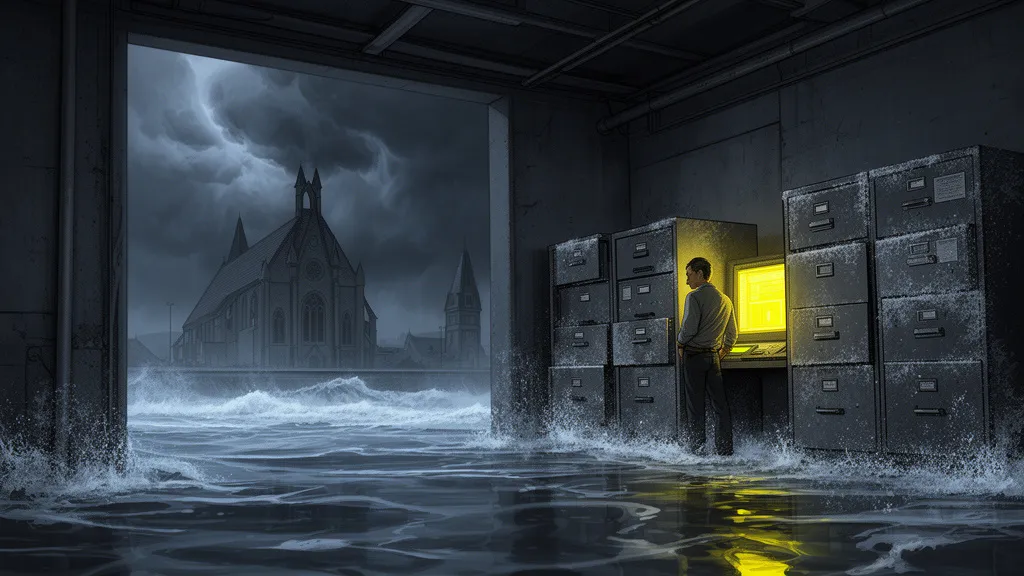
The basement of St. Jude’s-by-the-Sea did not house the dead; it housed the logistical artifacts of the city’s slow drowning. Elias gripped the edge of the intake terminal, the metal slick with a mixture of condensation and rising tide water. The salt-crusted floor sensors beeped a rhythmic, mournful cadence: 82 percent humidity, rising.
Elias pulled the manifest for Level B-4. Her task was routine: reconcile the mortality timestamps for the last twelve hours of the storm cycle. She tapped the screen. The interface blinked, a jagged yellow line indicating a server partition error. She swiped past it.
Three names appeared under the morgue intake log: Vaelin, H. / Kosta, J. / Thorne, M.
They had been declared expired at 01:15. Their vitals were logged as flat-line.
She walked to the storage bays. The hum of the backup generator was a low-frequency drone that resonated in her molars. The air tasted of ozone, bleach, and the metallic tang of the harbor. She unlocked the heavy steel freezer door—not for a check, but because the cooling unit had stalled twice that night, and the maintenance algorithm required a manual reset.
Inside, the temperature was a humid eighteen degrees Celsius. Far too warm for preservation.
Three bodies lay on the plastic-lined gurneys. They were not stiff. Vaelin, a man in his late fifties, had a rhythmic rise and fall to his chest that rattled against his ribcage. Kosta and Thorne exhibited the same involuntary, shallow mechanics of lung function.
Elias leaned down. She pulled the plastic wrist tag from Vaelin’s arm. The laser-etched serial number did not map to a standard hospital identity; it was a routing code for the municipal transit authority, usually reserved for cargo containers.
She touched the pulse point at his throat. It was steady. It was efficient. It was entirely unauthorized.
- 03:12 LOCAL TIME.
She found Supervisor Vane in the central hub, staring at the tide monitors. The water had breached the lower loading bay, swirling in dark, oily eddies around the crates of dialysis fluid. Vane did not turn as she approached. He was sixty, his posture held together by the stiff, starched fabric of his uniform and a lifetime of bureaucratic inertia.
“The intake logs for B-4 are corrupted,” Elias said. Her voice sounded thin against the roar of the intake pumps. “Three patients are labeled expired. They are metabolically active.”
“Data corruption is common during flood surges,” Vane replied. His gaze remained fixed on the rising red markers on the map.
“They aren’t patients, sir. The registration tags are municipal transit codes. Why are they in our morgue?”
“The city’s infrastructure is failing, Elias. We are a triage center, not an investigative unit. You have a queue of four hundred digital records to clear before the 05:00 shift change. Your overtime authorization is already capped.”
“They are breathing.”
“Delete the records,” Vane said, finally turning. His face was a map of tired, precise lines. “The server partition will be wiped at dawn to prevent memory overflow. If the records do not exist, there is no administrative error to audit. If there is no error, there is no paperwork. If there is no paperwork, we continue to function.”
He checked his watch. “You have ninety minutes.”
- 03:45 LOCAL TIME.
Elias returned to the basement. The water was now at her ankles, cold and viscous. She brought a medical tablet, the light casting long, wavering shadows against the peeling paint.
She moved to the terminal near the gurneys. Her fingers hovered over the ‘Delete’ command. She looked at Vaelin. He blinked, a slow, reflexive movement. His eyes were milky, reflecting the harsh fluorescent flicker overhead.
“Who put you here?” she asked.
The man didn’t answer. His chest rose, fell, rose. There was no pain in his expression, only the dull, vacant patience of a machine waiting for its next instruction.
Elias accessed the terminal’s hidden diagnostic port. She bypassed the hospital’s internal network and pinged the municipal transit server directly. It took four minutes for the handshake to complete. When the data packet arrived, it wasn't a medical history. It was a freight manifest.
Cargo: Biological Processor Unit - Class 4. Status: Idle/Stored pending transfer. Destination: Climate Mitigation Center, Sector 9.
She scrolled through the attached files. They were not patients. They were human components, brain-dead or surgically suppressed, utilized for cold-start processing power for the city’s cooling grid. The hospital was just a warehouse for excess hardware during the power outages.
She looked at the freezer door. The water was rising faster now, the surface of the floor disappearing into a dark, mirrored pool. If she deleted the records, the transit authority would lose the manifest and, presumably, reclaim the hardware. If she kept the records, the hospital board would see the breach of protocol and fire her, likely under the standard ‘administrative negligence’ clause that carried a prison term in the current economy.
She looked at the gurneys. The gurneys were tethered to the wall with heavy-duty steel chains. The water hit the bottom of the lowest gurney. The movement of the water caused the plastic liners to slide.
Elias reached for the terminal. She didn't delete the records. Instead, she triggered an emergency maintenance alert for the freezer unit. It was the only command the system would allow her to initiate without triggering an immediate, system-wide lockdown of the basement.
Emergency Alert: Cooling Failure in Sector B-4. Immediate evacuation of biological assets required to prevent degradation.
The system responded: Notification sent to Central Transit Bureau. Estimated arrival: 06:30.
She sat on the edge of a dry storage crate and watched the water. She had bought them three hours. It was an inefficient use of her time. The water was climbing her shins, the cold beginning to numb the nerves in her feet.
- 04:55 LOCAL TIME.
She heard the boots of the transit security team before she saw them. They were heavy, synchronized, and metallic.
Elias stood. Her uniform was soaked through. She felt remarkably empty, a neutral observer in a room that was no longer hers. The lead officer stepped into the basement, a flashlight beam cutting through the rising gloom. The water rippled around his tactical boots.
He checked the gurneys. He checked the display. He looked at Elias.
“You initiated the alert?” he asked.
“The cooling failed,” Elias said. “Protocol requires asset preservation.”
He didn't thank her. He nodded to his men, who began detaching the chains from the walls. They were fast. In under three minutes, they had loaded the three units onto a hover-skiff that floated inches above the rising water.
They didn't look at the files. They didn't look at the names. They looked at the hardware, assessed the integrity, and prepared to move.
As the skiff hummed to life, the lead officer paused near the door. He looked at the peeling white paint, then back to the flooding corridor.
“The tide is projected to crest at 08:00,” he said. “You should be upstairs.”
“I’m waiting for the shift change,” Elias replied.
“There is no one coming to replace you. The lobby is already underwater.”
He stepped onto the skiff. It glided out into the darkness of the loading bay, the light of his torch disappearing into the black expanse of the flooded city.
Elias stood in the basement alone. The generator gave one final, wet shudder and died. The hum was gone. The only sound left was the slow, rhythmic lapping of the harbor water against the concrete walls.
She looked at the tablet. It read: 0 records to reconcile.
She set the device down on the dry crate. The water climbed to her knees, then to her hips, moving with the cold, unhurried precision of a rising tide.