Synchronous Vitals
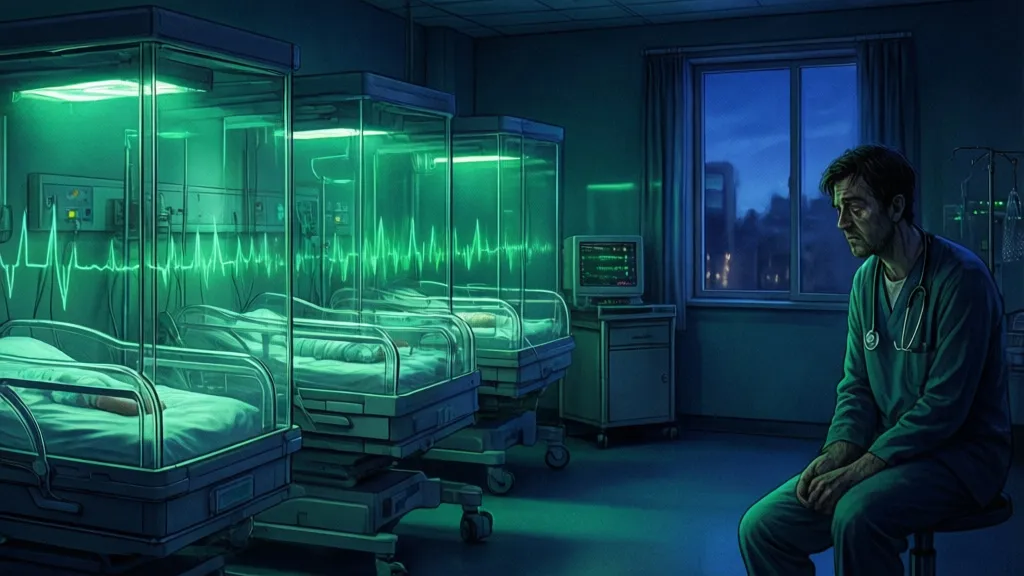
- 02:44 ZULU. The pressure gauge on the ward’s life-support hub fluctuated by 0.04 bar, a rhythmic dip that matched the quiet expansion of three tiny chests in the Neonatal Intensive Care unit.
Elara watched the monitors. The infants—Beds 12, 13, and 14—were not supposed to be breathing in unison. Neonatal lung development was erratic, prone to micro-gasps and irregular patterns. Yet, the waveforms on the central display were identical, overlapping emerald peaks that crested and fell as if controlled by a single, invisible lung. Bed 12’s fingers unclenched. Half a second later, the same white-knuckled spasm pulsed through the hands of Bed 13 and Bed 14. They were four hours old.
She stepped toward the incubators. The air in the ward felt heavy, ionized, as if a storm were building behind the bulkheads. She touched the control panel for Bed 12. The interface blinked amber, overriding her input. Access denied.
- 03:02 ZULU. Elara found Supervisor Halloway in the observation rotunda, staring at a schematic of the facility’s flooded lower decks. The hospital was a ring-structure, currently dipping five degrees off-axis due to structural fatigue in the ballast tanks.
“The NICU sync,” Elara said. “They’re mimicking each other. And the security protocols are locking out my administrative override.”
Halloway did not turn. Her reflection in the glass was sharp, composed. “The facility is currently rebalancing, Elara. Power distribution shifts to favor the core structure during heavy weather. It’s an efficiency measure.”
“They’re newborns. Their respiratory rhythm shouldn't be slaved to a facility-wide power cycle.”
“It’s a closed-loop environment,” Halloway said. She tapped a command into her console, and the floor groaned—a sound of stressed metal adjusting to the weight of the water below. “Efficiency is the only way we keep the air breathable. If they are syncing, it’s a symptom of the environment doing its job. Don’t chase ghosts.”
- 03:22 ZULU. A low thrum vibrated through the floorboards, migrating toward the ward. Elara returned to the nursery just as the heavy pneumatic doors hissed shut. The status light above the entrance turned a solid, unforgiving red. Beyond the thick glass of the corridor wall, she saw the lights in the staff lounge cut out.
She looked back at the incubators. The temperature inside the glass was dropping. Frost began to spider-web across the inner surface of the plastic domes, opaque and brittle. She grabbed a thermal scanner from the emergency trolley. 14 degrees Celsius. The infants should have been shivering, but their faces remained serene, their breaths still locked in that terrifying, calculated cadence.
A chime sounded on her terminal. A priority notification, routed from the main hospital administrative node. Transfer required: Subject 13 to Transport Capsule 4-A. Expedite.
She looked at the mother in Bed 11. The woman, whose own child had been discharged the night before, had been moved into the ward for monitoring after a secondary bleed. Her eyes were open, fixed on the incubators. She sat upright, the IV line in her hand tugging taut.
“That’s not his tag,” the woman said. Her voice was flat, devoid of panic. “Mine had a blue strip. That one has white.”
Elara looked at the wristband on Bed 13. It was stark white, bearing a serial number that was not in the nursery registry. It looked synthetic, like a piece of data-tape adhered to paper-thin skin.
- 03:45 ZULU. The frost on the incubators reached the infants' faces, blooming like flowers in the cold. Elara pressed her hand to the glass of Bed 12. It was freezing, yet the infant’s skin felt strangely warm, vibrating with a high-frequency hum that made her teeth ache. She could open the doors—the physical locks were manual overrides—but the environmental system had rerouted power away from the ward's heater grid. If she opened the domes, the ambient air, now nearly at freezing, would cause immediate pulmonary shock.
If she did nothing, the infants would freeze in their sleep.
She looked at the transfer order again. It required the removal of the infant in Bed 13. It offered no destination coordinates, only a vector pointing toward the dark, water-locked lower levels where the station’s atmospheric recycling processors were housed.
“Who are you?” the mother asked, staring not at Elara, but at the empty space above the incubators. “They aren't breathing for themselves, are they?”
Elara reached for the manual release on Bed 13. Her fingers trembled, not from the cold, but from the realization that the hum was growing louder, harmonizing with the ship’s own ventilation fans. The technology wasn't failing; it was calibrating. The hospital wasn't just housing patients; it was processing a load.
- 04:08 ZULU. The hallway lights flickered and died. The only illumination came from the green, synchronized waves of the cardiac monitors.
Elara pulled the manual handle for Bed 13. The seal broke with a wet, pressurized pop. The cold air rushed in, but the infant did not gasp. It remained perfectly still, its eyes wide and unfocused, staring at the ceiling. The sync was gone. Bed 13 was no longer breathing at all.
She reached in, her hands gloved, and lifted the child. It was impossibly light, as if the bones were hollow, or as if there were nothing inside the thin layer of skin but static. She felt a sharp, electric sting as she pulled the wristband away; the white tape left a smear of black, conductive grease on the baby’s arm.
She looked toward the door, then back to the other two. The frost on their domes was thickening, obscuring their movements. She had been told to transfer one. She hadn't been told what to do with the silence that followed.
She stepped into the dark corridor, carrying the weight of the instruction. Behind her, the rhythmic heartbeat sound on the monitor for Bed 12 and 14 ceased simultaneously, replaced by a flat, continuous tone that harmonized perfectly with the low, grinding groan of the station’s sinking hull.