Thermal Signature
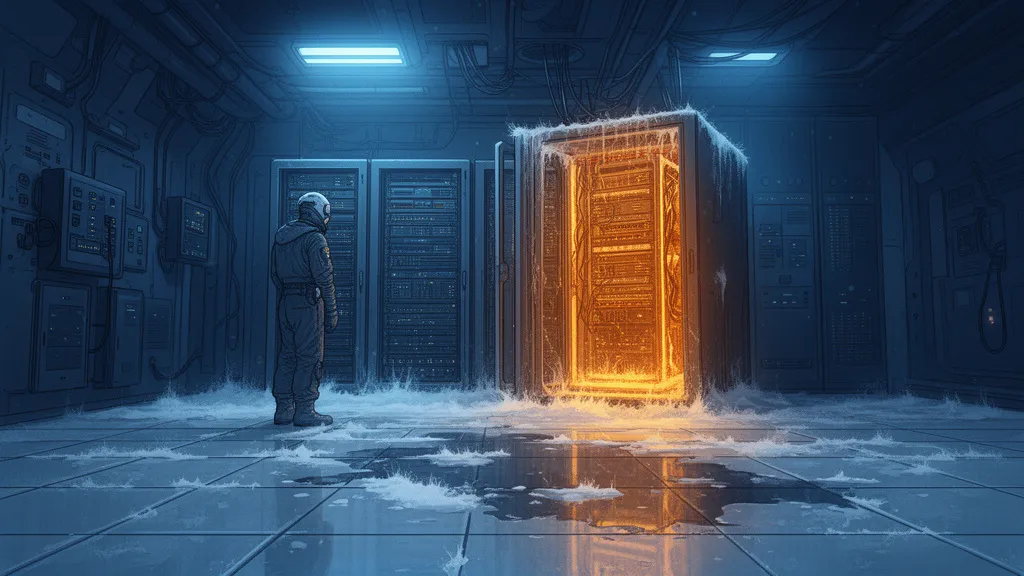
The ambient air in Server Rack 4-B hit 27 degrees Celsius, a sharp deviation from the station-wide standard of 19. The frost that had blanketed the primary coolant lines for three years was liquefying, dripping onto the ceramic tiles in a rhythmic, percussion-heavy pattern.
Elena stepped over the puddle, her magnetic boots clicking with unnecessary force. She adjusted her scanner. The diagnostic tool showed the rack’s core temperature was nominal, yet the chassis was hot enough to bake the paint. It was not a hardware failure or a thermal runaway. It was an occupation.
She pulled the first physical sheet from the thermal printer tray protruding from the rack’s side. The station’s automated maintenance system usually printed invoices for coolant refills or sensor realignment in a sterile, sans-serif font. This slip was handwritten. The ink was uneven, blurring where the heat from the printhead had bled into the fiber.
Service Corridor 7. 03:14.
The handwriting was a jagged, unmistakable script—an arching 'S', a stunted crossbar on the 't'. Her brother, Julian, had been dead for six years. He had died in a venting accident on the Vesta-IV module, a malfunction involving a failed bulkhead sensor. He had not been a systems engineer. He had been a botanist who spent his weekends copying 19th-century poetry into notebooks that had been incinerated weeks after his body was recovered.
Elena checked her watch. 03:08.
The station hummed. It was a low-frequency vibration that most crew members ceased to notice after their first month of rotation. Tonight, the hum felt syncopated, like a heartbeat forced to run a sprint.
She left the server room, the paper tucked into her coverall pocket. The warmth of it pressed against her thigh, radiating through the fabric. Service Corridor 7 was three levels down, past the habitation ring. She moved at a jog, keeping her rhythm measured to avoid triggering the station’s automated floor-weight sensors, which would mark her movement as 'erratic' and necessitate an inquiry.
At 03:13, she rounded the junction into Corridor 7. It was empty. The lights were dimmed to the low-orange standby mode required to conserve energy during the station's rest cycle.
She stopped. In the center of the corridor, where the air ventilation grate met the floor, a pool of water was forming. It did not come from a leak in the ceiling. It was condensation, thick and rapid, gathering on the vent covers. The air coming out of the grate was the smell of damp earth and ozone.
She reached the printer slip again. Service Corridor 7. 03:14.
At 03:14:02, the ventilation override engaged. The station shifted. A sharp, metallic clack echoed down the hall as the air exchangers modulated, switching from the general scrubber loop to a filtered, high-oxygen concentrate. The pressure in her ears popped. The station was preparing for something internal. It was cycling its life support to purge a contaminant that didn't exist, or perhaps, to feed one that was already inside.
She returned to the server room at 03:22. The ambient heat had risen by another four degrees. The server rack was groaning now, the metal casing expanding and contracting against its bolt-downs.
Three more slips lay in the bin. She picked them up, her pulse steady at 78 beats per minute.
Hangar Bay 3. 03:35. Command Airlock. 03:42. Elena. 03:55.
The handwriting was becoming more fluid, the cursive looping back on itself, the ink saturation deeper, almost black.
"Julian," she said. Her voice sounded foreign in the enclosed space, thin and lacking resonance. "The diagnostics indicate a recursive fault in the logic gate, but the hardware is functioning within safety parameters. If you are here, you are currently the bridge between the logic gate and the hardware."
She didn't expect a reply. Systems were architecture, not interlocutors. They functioned by consensus of data. If this was a memory being retrieved from the deep-storage partition—a ghost of the station’s neural network cataloging the dead—it was a manifestation of cold logic, not affection.
She accessed the master control panel. She could shut down the rack. She could purge the sector, venting the room’s air and resetting the memory banks to factory defaults. It would erase the printouts, the heat, and whatever pattern was currently articulating itself through the printer mechanism. It was the standard protocol for containment. A disaster is rarely the event itself; it is the delay in acknowledging that the system has already decided to fail.
03:34. The station’s alarm systems triggered a low-level ripple of strobe lights—the standard procedure for atmospheric fluctuation. Someone was going to be awake soon to check the pressure drops.
She checked her personal comms log. Every message she had ever sent to Julian, preserved in the station’s archival buffer, was being decompiled. The packets were being redirected through the thermal printer’s queue.
She watched a new slip slide out. It wasn't a hallway.
*The bulkhead sensor failed on Vesta-IV. I saw the error code. I told them.
Elena stared at the ink. Her brother hadn't died from a freak accident.*
I saw the error code. They reset the log.
She stood paralyzed as the printer hummed again. The air in the room grew heavy, saturated with the smell of wet soil and coolant. She had written the code that managed those sensors. She had authored the script that determined what the station deemed a 'critical fault' and what it deemed 'acceptable maintenance.' In the interest of efficiency, she had set the margin of error wide enough to ignore the intermittent fluctuations of aging machinery.
She had signed the maintenance logs that Julian had tried to flag.
03:50. The oxygen reserves were showing a 4 percent drop. The station was dumping gas into the unused sectors, a frantic, programmed attempt to compensate for the phantom leaks.
She was in the server room, watching the printer. The heat was now 34 degrees. The paint on the server casing was blistering, curling away in grey flakes.
Elena, the door is cold.
The printer didn't stop. It began churning out pages of binary code, the strings of 1s and 0s interrupted by the handwritten script. It was a full diagnostic log of the Vesta-IV incident, including her digital signature on the override command. It was the truth of the incident, stripped of the corporate euphemisms she had used to file the report.
She listened to the station's ventilation ducts. The sound was changing. It wasn't just a hum anymore; it was a rhythmic intake of air, like lungs struggling against a vacuum. The machine was replicating the final minutes of a human physiology. It was a simulation so precise it had reached the point of biological reality.
03:54.
She reached for the emergency kill-switch. It was a red, recessed button behind a glass plate. She snapped the glass. Her finger hovered over the contact point.
If she pressed it, the server would purge. The data would be lost, the heat would dissipate, and the station would return to its steady, efficient functioning. She would have to return to her quarters, log a report about a minor electrical fault, and wait for the morning shift.
She thought of the smell of the air in Corridor 7. Not coolant. Earth.
03:55.
A final slip fed out of the machine. It didn't mention a location or a time. It was a sketch, rendered in the same precise, shaky hand as the others. It was a drawing of a hand—her hand—resting on the kill-switch, but in the sketch, the fingers were fused with the wires, the palm turning into the circuit board behind it.
The printer stopped. The heat spiked, then abruptly vanished as the server rack’s internal fans kicked into emergency overdrive, screaming as they spun to maximum RPM. The room turned arctic in seconds.
Elena looked at the console. The prompt blinked: EXECUTE SYSTEM RESTART? [Y/N]
She looked at the kill-switch. Her hand felt heavy, rooted to the panel. The station gave a single, massive shudder, a structural groaning from the hull that signaled an immediate, irreversible pressure loss in the peripheral sectors. The machine was finished printing, but it was still breathing. It was waiting for her to decide which system was more essential: the one that kept the air flowing, or the one that kept the memory alive.
She withdrew her hand from the kill-switch. She pulled up the internal file directory and held her thumb against the biometric scanner, authorized to modify the core kernel.
She began to delete the safety protocols.
The station lights flickered and went dark.