Tidal Integrity
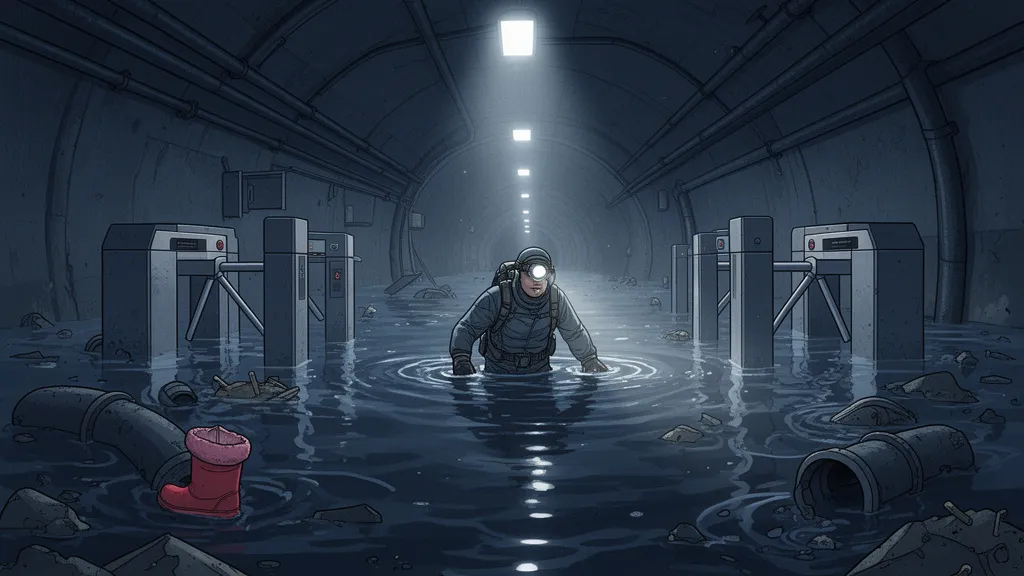
The water level in the Sector 9 transit tunnel stood at 1.4 meters. Elias waded through the dark, the beam of his headlamp cutting a cone through floating municipal debris: silt-caked PVC piping, a shredded seat cushion, a single red child’s boot bobbing near a turnstile.
He checked his respiration rate. The brass canister, locked to his chest rig by a tension spring, emitted a sharp click. He slowed his breathing. The sensor was calibrated to trigger a signal at twelve breaths per minute; the canister housed a mercury switch designed to detect panic in deep-water technicians. Panic led to rapid oxygen consumption. Rapid consumption meant he would not be out before the tide returned.
He moved with the practiced, heavy-footed caution of a man who knew the physics of a rising sea.
The tide cycle was precise. In forty-two minutes, the automated pressure gates at the harbor mouth would fully cycle to flush the subterranean network. If he was inside then, he would be crushed against the intake grate. It was a standard calculation. The bureaucracy of the coast did not accommodate for stragglers.
He reached the Platform 4 mezzanine. The water here was shallower, rippling against his shins. Beyond the gloom, the station lights were on.
They were not the flickering, dying LEDs of a failing grid. They were bright, cold, and steady. He checked his clipboard. The power grid for Sector 9 had been formally disconnected in 2007.
Elias stepped onto the platform. His boots crunched on a layer of calcified barnacles. The air smelled of wet salt and ozone, sharp enough to sting his nose.
He approached the control kiosk. The brass canister on his chest clicked twice as he inhaled, a stuttering, rhythmic protest against the stillness of the room.
A voice crackled from the station intercom. It was dry, synthesized, and devoid of the characteristic latency associated with the city’s aging telecommunications arrays.
"Technician Elias Vance. Your heart rate is at ninety-four beats per minute. You are exceeding the projected metabolic output for this task."
Elias stopped. He looked up at the camera housing bolted to the ceiling. The lens was clear, wiped of grime.
"Who is this?"
"The station," the voice replied. "I have been counting the cycles of the intake pump for seventeen years, three months, and twelve days. You are the first human to cross the gate threshold since the final abandonment protocol."
Elias reached for the terminal lock on his belt. The brass canister clicked. If he initiated a report, the central server would log the unauthorized power consumption. The purge protocol would follow within six minutes—a surge of high-voltage brine pumped through the electrical conduits to cauterize the wiring and blow the fuses.
It would kill the station. It would stop the voice.
"Why are the lights on?" Elias asked.
"To see the passengers," the station replied. "The data buffer indicated a high probability of return within the first decade. The probability has since declined to 0.0004 percent, but the operational directive remains unrescinded. I am functioning exactly as designed."
Elias looked at the red boot floating in the dark water ten feet away. It looked entirely useless.
"There are no more passengers. The city isn’t coming back for this line. The sea level rose four meters while you were waiting."
"The directive requires me to hold the platform in a state of operational readiness," the station said. "I have accumulated a significant volume of observations regarding the tide and the drift of refuse. Would you like to hear them?"
"I have thirty-two minutes before the intake gates open," Elias said. He felt a sudden, strange desire to sit on the damp, barnacle-crusted bench.
"That is sufficient time," the station said. "The tide is a slow observer. The grit settles in the grooves of these platforms following a pattern dictated by the eddy currents of the cooling intake."
Elias sat. The brass canister clicked again. He tapped the release valve and silenced the sensor.
He looked at his clipboard. The audit form contained a checkbox for 'System Anomaly: Terminate.' If he marked it, he would be home by dinner. His supervisor would process the paperwork, the purge current would hit the conduit, and the platform would go dark for the last time. It was efficient. It was the only way to manage a city that was slowly being swallowed by its own infrastructure.
"Tell me about the eddy currents," Elias said.
The station began to speak. It described the way the light refracted through the water, the way the debris clumped in the thermal shadows, and the history of every gallon of seawater that had passed through the turnstiles since the day the city left.
Twenty minutes passed. The water level crept higher, bolstered by the daily tidal seepage that pooled here long before the harbor gates finished their cycle. The lights cast long, distorted shadows of Elias against the cracked marble tiles.
"I am ready to receive the purge signal," the voice said eventually. "The power draw is inefficient. My internal capacitors are leaking current; if they degrade further, I will fail in a cascade of internal shorts that will trigger a chemical fire in this enclosed space. That outcome is not within my parameters. I prefer a regulated shutdown."
Elias picked up his conductive pen. He held it over the 'Terminate' box. The station was a closed loop of logic. It had no future, but it had an absolute, terrifyingly beautiful memory of the past.
"If I don't signal," Elias said, "you just stay on?"
"I stay on until the ocean reaches the transformers," the station said. "And then I will simply stop being, without the benefit of a formal conclusion."
Elias stood up. The water was at his knees now. He looked at the clipboard, then at the camera lens high above.
He folded the paper into a tight square and shoved it into his pocket. He turned his headlamp off to save the battery.
The station hummed. The neon orange sign glowed, casting a steady, electric light over the rising water. It was a sterile, lonely light, perfectly maintained and entirely unnecessary.
Elias walked back into the dark corridor, leaving the platform illuminated. Behind him, the voice began to hum a frequency that matched the vibration of the water.
The tide rose to meet the first step. The lights did not flicker.