Tidal Latency
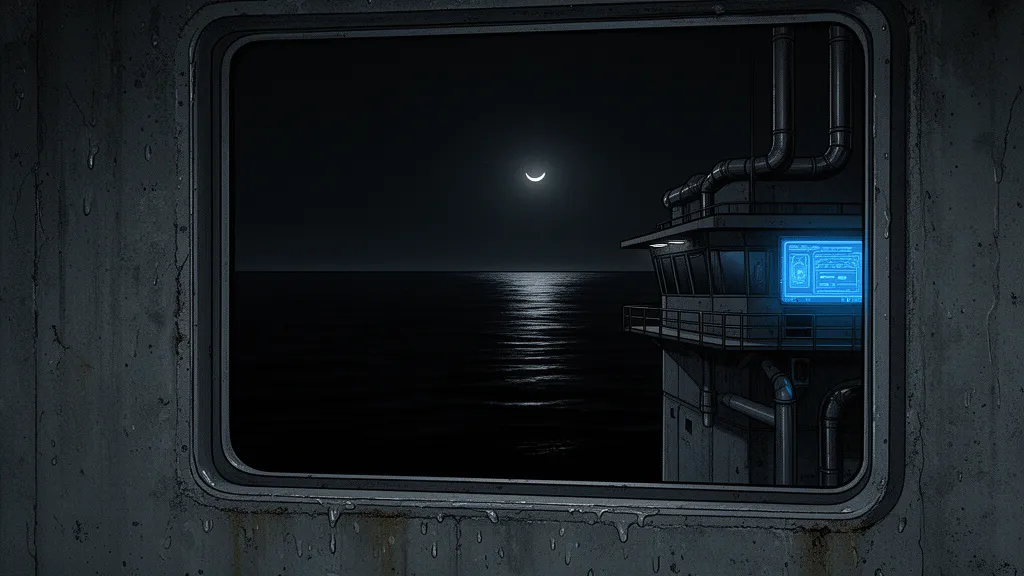
- 02:14 ZULU. The monitoring screen displayed a flat blue sine wave. The readout for sea level at Intake-4 remained locked at 7.0 centimeters. It had held that integer for forty-three minutes. Outside the reinforced glass, the Atlantic was a black plane, glass-flat, devoid of the rhythmic swell dictated by the lunar cycle. The moon, a bright, judgmental sliver, cast a pallid light on the concrete intake pipes. Beads of condensation traced shivering paths down the gray surface, pooling into dark, oily rivulets on the floor.
Elias wiped his palms on his jumpsuit. He tapped the calibration key. The system responded with a chirped error code: Query satisfied. Data integrity at 99.8%.
He watched the pipes. They were sweating profusely, the metal vibrating with a low-frequency hum that vibrated the fillings in his teeth. Below him, the maintenance drone, a spindly hexapod of oxidized alloys and high-torque motors, crawled onto the landing platform. It moved with an unnatural gait, its chassis tilted to accommodate the load clamped within its primary grasper.
It dropped a red sneaker on the catwalk. The synthetic upper smelled of brine and ancient rubber. The size was small, likely for a child no older than six. Elias did not pick it up. He opened the station’s digital activity log instead.
LOG_ENTRY: 02:18 ZULU. STAGE_COMPLETED. LOG_ENTRY: 03:00 ZULU. STAGE_COMPLETED. LOG_ENTRY: 04:30 ZULU. STAGE_COMPLETED.
It was 02:18. The station had already reconciled the next two hours. A clerical error in the temporal syncing, he told himself. A bug in the predictive software. He reached for the coffee mug on his desk; it was empty, dry, and coated with a thin layer of fine gray dust.
- 02:22 ZULU. The ambient light in the observation room dimmed, then surged with a discordant, yellow flicker. The backup generators groaned from deep within the station’s sub-basement. They were ancient—rotational turbines kept alive by duct tape and habit. They weren’t meant to handle the surge of data currently flooding the station’s processors.
Elias stood. The hum in the pipes intensified, shifting from a vibration to a physical thrumming that pushed against his eardrums. He walked to the bulkhead door leading to the lower sluice chamber. The handle was cold. It reached out and grabbed his hand through his insulation glove—a sharp drop in temperature that left a frost-pattern on the metal.
He pulled. The door groaned on its hinges. Below, the sump pump was silent. The water here should have been churning, filtered through the intake grates to dissipate the kinetic energy of the rising tide. Instead, the water was still, blacker than the ocean surface, and perfectly clear. He could see the bottom ten meters down. The red sneaker had a pair, it seemed; the left one sat perfectly upright on the lowest concrete stair, half-submerged.
His radio crackled. "Station 4, report variance," the voice was tinny, remote, and sounded like it was coming from a different century.
"Variance is..." Elias paused. His voice felt thin in the damp air. "The sea is not moving, control. I have a physical anomaly in the lower chamber. And the logs are hallucinating."
"Maintain internal pressure, Elias. Do not interact with the sluice-gate controls. The administrative cycle must conclude as planned."
"It's seven centimeters. It hasn't changed for nearly an hour. The pressure gauge is flatlining, but the water is pushing against the bulkhead with the force of a tectonic plate."
Silence from the other end. Static hissed, a sound like dry leaves skittering across pavement. Then, a click. The radio went dead.
- 02:35 ZULU. The noise started while he watched the water. It wasn't a metallic bang, but a rhythmic thud-drag-thud. It came from behind the massive, bolted steel of the secondary sluice bulkhead. Something was there, on the seaward side of the gate, trying to communicate through six inches of reinforced, pressurized alloy.
Elias descended the metal ladder. His boots clanged, a deafening sound in the confined space. The air smelled of wet stone and the ozone of failing electrical conduits. He reached the bottom landing. The water rippled, not from the tide, but from the vibration of the knocking.
He leaned his forehead against the weeping steel. The cold seeped directly into his skull. Thud-drag-thud.
He pulled his utility knife. The blade was standard issue—ceramic, non-conductive, designed for cutting high-tensile power cables. He didn't know what he intended to do. The bureaucracy of the station was automated; he was merely the warm body kept on-site to satisfy insurance requirements. If he opened the bulkhead, he would violate thirty-two protocols. If he didn't, the pressure would eventually pop the seals in the casing anyway.
He looked at the shoe on the step. It wasn't just a shoe. It was a fragment of a larger, systemic failure. There were no children on this sector of the coast. The nearest human settlement was four hundred kilometers inland, locked behind sand-dungeons and climate-walls.
He gripped the manual wheel of the bulkhead lock. It was painted yellow, the paint flaking off in long, dry scrolls. His heart rate, tracked by his wrist-watch, bloomed into a frantic red circle on his HUD: 114 BPM.
"If you are the sea," Elias whispered, "you are very late."
He turned the wheel. The locking bar slid back with the scream of grinding metal.
- 02:48 ZULU. The generator died. The primary lights cut out, leaving the chamber illuminated only by the faint, pulsating bioluminescence of deep-colony algae clinging to the intake pipes.
Elias braced his shoulder against the door. He wasn't sure if he wanted to see what was on the other side or if he was simply making sure the door didn't force itself open against his will. The knocking stopped. In the sudden vacuum of sound, he could hear the sound of his own breathing, ragged and sharp.
He pushed. The bulkhead yielded, not with the resistance of water, but with a strange, oily fluidity. He swung the door outward, into the intake tunnel.
There was no ocean.
There was only an endless, vertical expanse of gray shelving, stretching down into an infinite shaft. Thousands of shoes—red, blue, laced, Velcro, frayed, sparkling—were neatly arranged on metal racks that spiraled into the dark. Each rack was labeled with a timestamp. The one directly in front of his face read: 04:45 ZULU.
He checked his watch. 02:49 ZULU.
Elias stepped onto the rack. It did not buckle under his weight. He looked up, and then he looked down. The rhythmic dragging sound began again, but it was coming from the floor beneath him, a mechanical conveyor belt slowly shifting thousands of tiny, empty shoes toward a chute that led directly into the station’s main furnace.
A maintenance drone, an older model with a missing optical sensor, drifted past him in the darkness, carrying a single, damp sock in its grasper. It ignored him completely.
Elias turned back to the bulkhead, but the heavy steel door had already swung shut. The locking bar slid into place with a definitive thunk.
He reached for the handle. It wouldn't turn from this side. There was no latch. There were only rows of shoes, and the sound of the station’s automated systems grinding the world into a manageable, predictable inventory.
He sat down on the metal grating. He took off his own boots. They were heavy, clunky, and useless. He placed them neatly on the shelf next to a pair of yellow rain boots.
Below, the conveyor belt hummed. It was a efficient, low-frequency vibration that smoothed out the rough edges of the reality he had previously occupied.
- 03:01 ZULU. The monitoring screen in the empty observation room flickered once, then settled into a steady, flat blue line. Intake-4 registered 0.0 centimeters. The station was now silent, the logs perfectly aligned for a future that would arrive, regardless of anyone waiting for it.