Zeroed Inventory
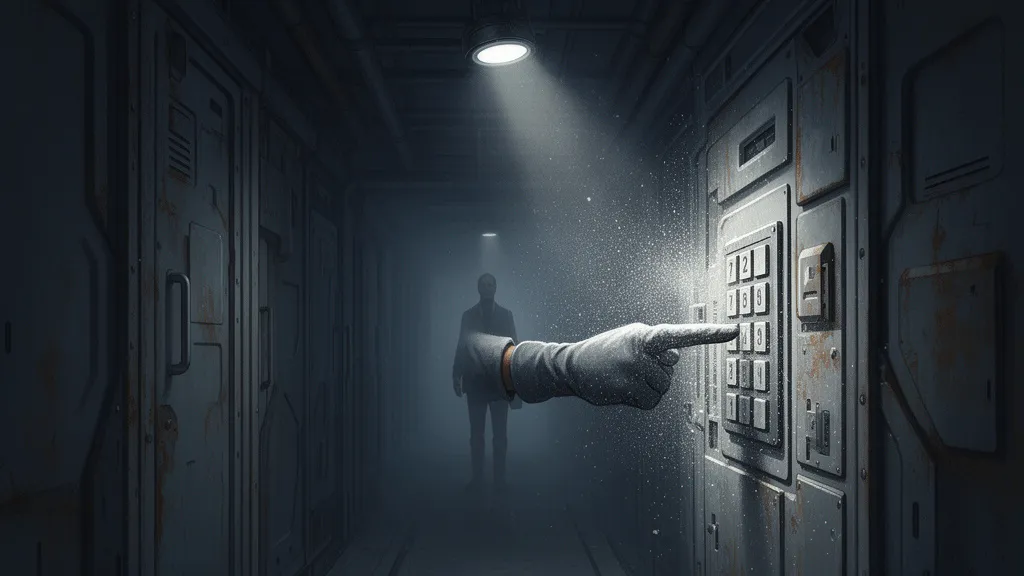
- 04:12 ZULU. The dust on the keypad was a perfect, translucent fan, undisturbed by the harsh strobe of the inspection light. It was silica—fine, wind-worn particulate from the salt flats that should have been sealed out by the vault's triple-redundancy gaskets. My thumb hovered an inch above the entry panel. The residue was too uniform to be settling; it was a smear, a lingering impression of contact.
I calibrated my scanner. The atmospheric pressure inside the vestibule was 0.02% lower than the external baseline. Someone had been breathing this air.
- The audit requirements were binary: certify the integrity of the seal, sign the manifest, resume transit to Sector 4. The bureaucracy of the Vault Administration did not account for anomalous tactile feedback. I wiped the keypad with a sterile cloth, logged the breach of atmospheric integrity, and bypassed the primary lock. The door slid back with the sound of grinding teeth, a heavy, reluctant movement that echoed into the bowels of the mountain.
Caretaker Halloway sat in the control booth, his desk illuminated by the amber glow of a crt monitor. He didn’t look up as I entered. He was watching a scrolling line of figures that had nothing to do with current census data.
“The logs show a six-minute gap every night for twenty-one days,” I said, laying my tablet on his desk. “System-wide blackouts. Why isn't this in the maintenance report?”
“Because the system doesn't know what it’s looking at,” Halloway replied. He reached for a thermal cup, his knuckles swollen with arthritis. “The gap isn't a blackout. It’s an exclusion period.”
- I traced the activity spikes on my tablet. Each interval started at 02:44 and ended at 02:50. Precisely 360 seconds. My professional duty dictated that I flag this as a cascading sensor failure. Instead, I followed the logic of the anomaly.
“Show me the service corridor,” I said.
He didn't argue. He led me through a series of interlocking blast doors, past the massive refrigeration units keeping the germplasm dormant. At the rear of the storage facility, tucked behind a ventilation trunk, was a narrow service crawlspace I had not checked on entry. It was dimly lit by a single flickering LED conduit.
Inside, there was a folding table. On it lay a leather-bound logbook, its edges frayed. I picked it up. The entries were dated, hand-scripted in fountain pen ink, listing names and dates of birth. They were names of people I recognized from the original evacuation list—the ones marked ‘Expended’ during the Great Drought.
“These people died,” I said. “The manifests were final ten years ago.”
“The manifests were authorized by the administration,” Halloway corrected. “This? This is an accounting of who actually reached the gate after the deadline. Every night, for six minutes, I open the secondary vent. I let them in, I record their names, and I give them the one thing we have in excess: shelf space.”
- I leaned closer. The ink was fresh on the last entry, dated today. The handwriting was shaky, the loops tight.
“They’re hiding in the lower cooling strata,” Halloway whispered. “The sensors can’t detect mass below the threshold of a pallet of wheat seeds. I’ve been logging them as inventory. 400 lbs of biological material. 180 lbs of biological material. When the audit sensors sweep, they see grain. They don't see lungs.”
I looked at the monitor on my tablet, back at the flickering LEDs. “If I record this, the facility is decommissioned. You know that. They’ll flush the oxygen to ‘reset’ the site.”
“And if you don't record it?”
“I’ve been sent here to fix the gap, Halloway. The math does not allow for a 360-second ghost in the machine.”
- I stood in the corridor, the smell of damp salt and old paper thick in the air. The vault was a tomb designed to preserve the past for a future that was increasingly hypothetical. My tablet chimed—a reminder that the certification upload was due in forty-two minutes. If I submitted it now, the automated system would cross-reference the gap with the structural sensor data, detect the, mass, and trigger an automatic lockdown sequence.
I looked at the list of names. Halloway’s own name was at the bottom, crossed out in a light, wavering line. He had been ‘expended’ years ago, officially, and had simply stopped leaving.
“The audit will show that the keypad smear was a recalibration error,” I said, my voice sounding thin against the hum of the cooling fans. “I will log a total system reset for the 02:44 interval to overwrite the shadow data.”
“They’ll be gone by morning,” Halloway said. “They move on to the next sector when the audit passes.”
“They aren't going to make it.”
“They were never going to make it,” he replied, turning back to his monitor. “That’s not the point of an inventory.”
- I returned to the vestibule. I placed my fingers on the keypad, feeling the residual warmth of the metal. I performed a full factory reset of the sensor suite. As the system initialized, the screen flashed a series of rapid-fire diagnostic messages: Sensors Offline. Data Purged. Integrity Verified.
I stared at the console. Outside, the wind rattled the metal siding of the vault, a dry, abrasive sound that never stopped. I closed my eyes, listening to the silence of the facility. The logic was clean, the report would be accurate, and the missing names would remain exactly where they had been recorded: in the ink of an impossible ledger.
A light blinked red above the main seal. The six-minute window had just begun.