Apricot Afternoon
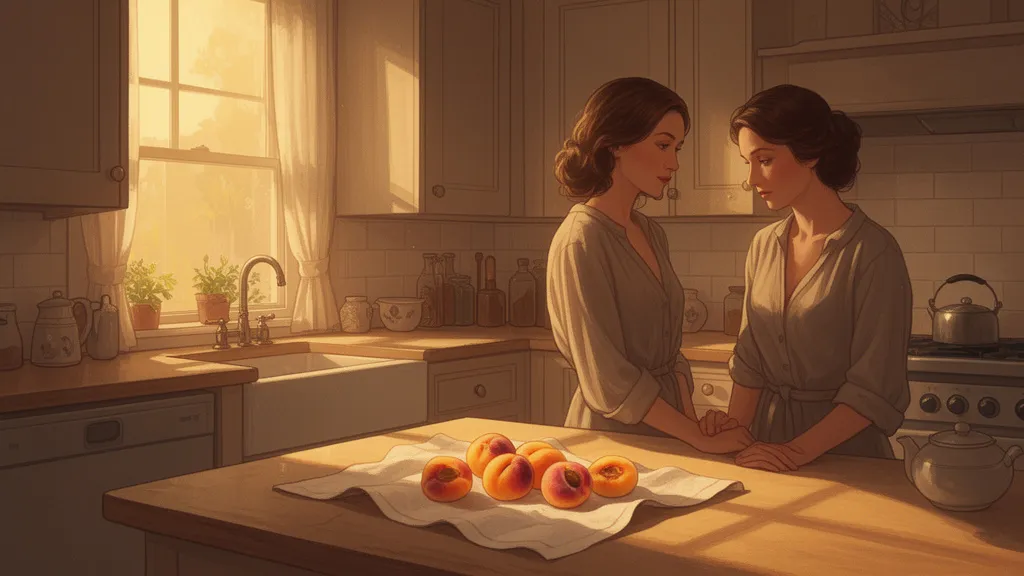
As she stepped into the kitchen, the warm glow of the afternoon sun caught her attention, illuminating the small, everyday details that seemed to hold a different kind of significance now. Her eyes landed on the figure standing by the counter, sleeves rolled up, peeling an orchard crate of bruised apricots onto a linen towel. The scene was so familiar, so comforting, that for a moment, she forgot they were supposed to be apart.
The smell of ripe apricots and warm skin filled the air, transporting her back to summers spent together, to laughter and tears and all the moments in between. But the reality of their situation slowly seeped back in, like water filling a hollowed-out space. They were supposed to be signing papers, finalizing the end of their marriage, not peeling apricots as if nothing had changed.
The unsigned divorce papers sat on the table between them, a stark reminder of the distance they'd created. Yet, here they were, in the same kitchen, surrounded by the same memories, with the same look of quiet determination on her wife's face. The woman's eyes met hers, a flicker of uncertainty passing between them before her wife looked away, focusing on the task at hand.
'I brought something with me,' her wife said, the sound of her voice after so long a welcomed ache. She set a small, brass key on the counter, next to the apricots. 'The key to our old apartment. I found it when I was packing up the last of our things from storage. I couldn't bear to throw it away.'
The mention of the apartment, of the key, brought back a flood of memories. Memories of laughter, of tears, of promises made and dreams shared. It was as if no time had passed at all, and yet, everything had changed. The weight of what lay unspoken between them was palpable, a physical presence that filled the room.
She walked closer, her movements slow, as if approaching something fragile. The apricots, the kitchen, the entire scene felt like a precipice, a point of no return. Her wife's hands, so deft and sure, continued their work, the peeling of the apricots a rhythmic backdrop to the unasked questions and unspoken words.
As she reached out, her fingers brushed against the cool metal of the key lying on the counter. It was a small thing, insignificant to anyone else, but to them, it was a tangible piece of their past. A past they had shared, loved, and lost.
'Why did you bring it?' she asked, her voice barely above a whisper, the question hanging in the air like the scent of the apricots.
Her wife's hands paused, the half-peeled apricot suspended in mid-air. The sound of the clock ticking in the hallway seemed to grow louder, marking the seconds as they passed, each one a reminder that time was moving, even if they were not.
'I don't know,' her wife admitted finally, the simplicity of the statement a stark contrast to the complexity of their emotions. 'I just couldn't let it go. It felt like letting go of us.'
The apricots, once firm and full of promise, were beginning to soften, their edges turning brown as the heat of the afternoon bore down on them. It was a small, inevitable change, a reminder that everything, no matter how hard one tried to preserve it, would eventually succumb to time.
In that kitchen, surrounded by the remnants of their life together, they stood at a crossroads. The pressure was not whether they could forgive each other; it was whether they could speak honestly, before the apricots, like their love, turned into a memory. The key, the apricots, the unsigned papers – all were symbols of what they had, what they lost, and what they might still salvage.
As the sun began its lazy descent, casting long shadows across the kitchen, they faced each other. The air was thick with unspoken words, with promises and betrayals, with love and loss. And in that moment, they both knew that their story was far from over. The question was, what would they do with the time they had left, with the love that still lingered, warm and inviting, like the smell of ripe apricots on a summer afternoon?
In a move that was both familiar and foreign, she reached out, her hand covering her wife's. The touch sparked a jolt of emotion, a mingling of pain and joy that seemed to encompass everything they had been through.
The warmth of their intertwined hands was a beacon, a reminder of the love that had once been the cornerstone of their relationship. As they stood there, the world around them melted away, leaving only the two of them, suspended in a moment of raw honesty.
'It's not about forgiveness,' she said, her voice filled with a newfound realization. 'It's about us, about who we are, and what we want.'
Her wife's eyes locked onto hers, a deep well of emotion reflected back. 'I want us,' she whispered, the words hanging in the air like a challenge, a promise.
As the apricots continued their inevitable journey towards decay, they stood at the edge of something new, something unexplored. The key, once a symbol of what they had lost, now seemed like a possibility – a key to unlocking the future, to rediscovering each other, to finding their way back to the love that had always been there, buried beneath the hurt and the anger.
And as they embraced, the warmth of their bodies, the smell of the apricots, and the promise of a new beginning enveloped them, reminding them that even in the darkest moments, there is always a way forward, always a chance to rediscover love in the unlikeliest of places – in the midst of decay, in the heat of an apricot afternoon.