Beyond the Photograph
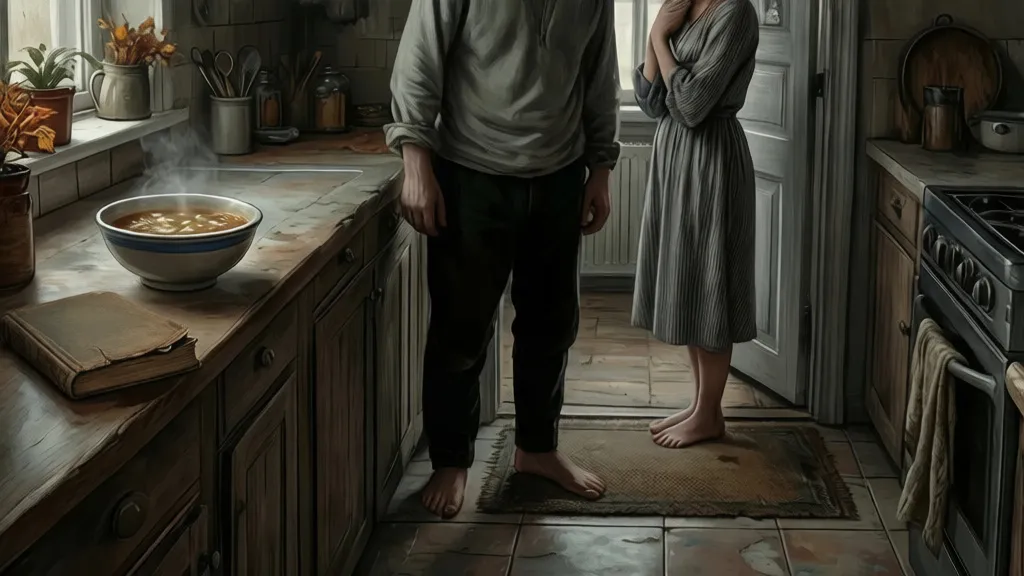
As she stepped into the kitchen, the chill of the autumn air still clinging to her damp cuffs, she was met with a sight she had not anticipated. Standing barefoot on the tile, his toes curled over the edge of a faded mat, was the man who had once proposed to her with a ring hidden in a battered copy of Wuthering Heights. The surprise of seeing him there, in her space, was tempered only by the exhaustion that had been her constant companion since the funeral. She had thought to spend the day alone, making soup and avoiding her brother's insistent calls, not confronting the ghost of her past.
The bouquet of supermarket chrysanthemums, limp from the damp air, seemed a meager defense against the tide of memories that threatened to overwhelm her. She set them down on the counter, the gesture a distraction from the man who now stood before her, a box at his feet.
I brought some of your mother's things, he said, his voice low and hesitant. I thought you might want them. I was a friend of hers, towards the end. We'd talk about you, and she'd share stories.
She nodded, the movement a mere tilt of her head, as she tried to process his presence here, now, in this moment of her greatest vulnerability. The box, unadorned and unassuming, seemed to hold within it the power to dismantle the careful life she had constructed.
She moved towards the box, her footsteps echoing in the silence, and lifted the lid. Inside, nestled among the familiar contours of her mother's belongings, was a photograph she had never seen. A wedding picture, the black and white tones glowing with a soft, ethereal light, depicted a couple she did not recognize. Or, rather, she recognized the man, but the woman... The woman was her mother, yet not as she had known her. The smile, the posture, the very essence of her seemed different, as if this photograph had captured a moment from a life parallel to the one she had lived.
As she turned the photograph over, a signature on the back made her heart stumble. It was not the name she had expected, not the man she had believed her mother to have loved and lost. This name, this person, was a stranger, a mystery that unravelled everything she thought she knew about her family's past.
The man, sensing her distress, took a step closer, but she raised a hand, a barrier against the invasion of her space, her memories. What do you know about this? she asked, the words barely above a whisper.
He hesitated, the pause stretching out like the silence between two notes of music. I think we should talk about it, he said finally, his voice a gentle prodding against the walls she had built around herself.
But she was not ready to talk, not yet. The revelation still swirled within her, a maelstrom of emotions and questions. She turned away, seeking refuge in the mundane tasks that had been her solace. Make some tea, she said, the command a deterrent against further conversation.
As he busied himself with the tea, the kettle whistling in the silence, the boiler, which had been a reliable constant in her life, chose that moment to fail, plunging the house into a cold that seemed to seep from the very bones of the walls. The tea, left to steep, grew cold and forgotten on the counter.
It was then, as they huddled in the small room that served as both living and dining space, that the pressure began to build. Not the pressure to forgive, for forgiveness was a concept that seemed too simplistic for the complexities of their past. But the pressure to ask, to seek out the truth that had been hidden for so long.
Do you remember, he asked, his voice low and husky, the way the sunlight used to filter through the blinds in your mother's kitchen?
She nodded, the memory rising to the surface like a bubble in a stagnant pool. It was moments like these, small and insignificant to the outside world, that held the power to undo her. To undo the careful life she had built, the defenses she had constructed around her heart.
The question she had been avoiding, the one that could change everything, pressed against her lips. But to ask it would be to invite chaos into her ordered world, to risk losing the fragile sense of self she had so painstakingly constructed.
As the night deepened, the cold seeping into their bones, she found herself drawn to him, to the shared history that bound them together like the threads of a tapestry. And in that moment, she understood that the choice was not whether to ask, but whether to embrace the uncertainty that had always lain at the heart of their connection.
With a quiet resolve, she turned to him, the words spilling out like a confession. What happened? she asked, the simplicity of the question belied by the complexity of emotions that underpinned it.
The answer, when it came, was a revelation of a summer her mother had spent in France, of a love affair with a man named Alexandre, and a choice that had been made to leave him, to return to a life that was already in motion. The photograph, he explained, was from their wedding, a ceremony that had been secret, known only to a handful of people. Her mother had kept it hidden, a reminder of a love that had been real, but not meant to be.
As the night wore on, the darkness outside illuminated only by the faint glow of the streetlights, she felt the walls she had built around herself begin to crumble. It was a dissolution that was both painful and liberating, a recognition that the careful life she had constructed was not a prison, but a parenthesis, a pause in the ongoing narrative of her existence.
And when, finally, the first light of dawn crept over the horizon, casting the world in a pale, ethereal glow, she knew that she was ready. Ready to face the uncertainties of her future, to embrace the complexities of her past. Ready, once more, to love.