Love in the Attic
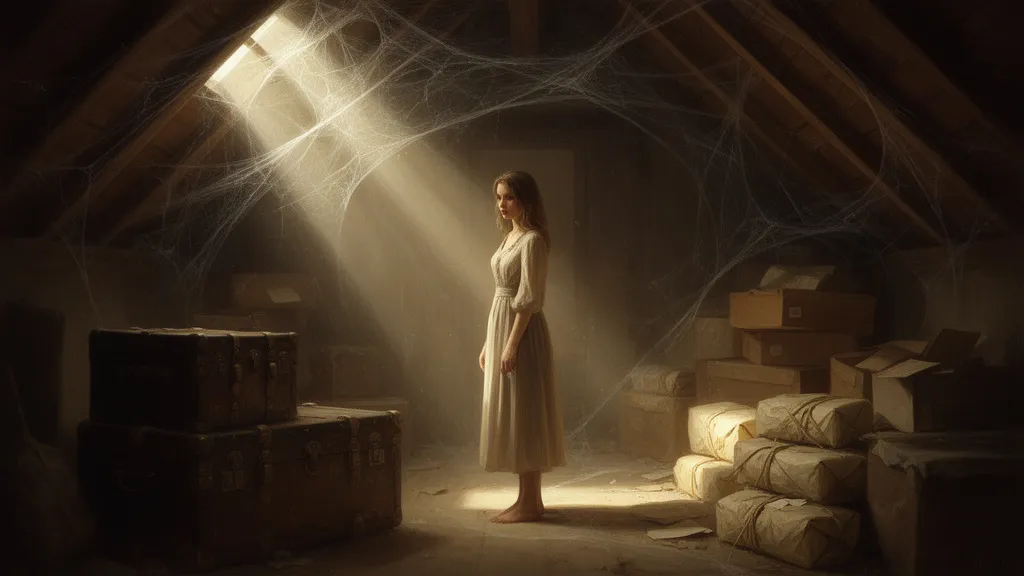
As she climbed the creaky stairs to the attic, Emily felt a thrill of excitement mixed with a hint of trepidation. The old house, with its worn wooden floors and musty smell, was a treasure trove of secrets and stories waiting to be uncovered. She had only just moved in, but already she felt a deep connection to the place, as if the walls were whispering tales of the past in her ear. The attic, with its trunks, boxes, and mysterious bundles, was the ultimate treasure hunt. Emily's fingers itched to dig in and uncover the secrets that lay hidden beneath the dust and cobwebs.
She began to sift through the trunks, lifting out yellowed linens, faded photographs, and old books. But it was a small, leather-bound box that caught her attention. The lid was locked, but the key was tucked into a small pocket on the side. As she opened the box, a faint scent of lavender wafted out, and Emily's heart skipped a beat. Inside, she found a cache of old love letters, tied with a faded ribbon. The letters were addressed to a woman named Elizabeth, and the postmarks dated back to the 1940s, a time when the world was at war and love letters were a lifeline to those separated by distance and uncertainty. As Emily untied the ribbon and began to read, she felt the words transport her to a different era, one of rationing and air raid drills, yet also of profound longing and romance. The letters spoke of stolen moments in train stations, of whispers in darkened cinemas, and of the ache of waiting for a loved one to return. Emily's eyes wandered to the old trunk in the corner, adorned with a faded label that read "Elizabeth," and she wondered about the woman who had received these letters, and the man who had written them with such passion and devotion.
Emily held one letter a little longer than the others. It had been written in the winter of 1948, and the paper still carried the faint scent of lavender and smoke. Elizabeth had underlined one sentence twice: If the world asks me to forget you, I will simply become someone the world does not recognize. Emily read it again and again, and the attic seemed to grow quieter around her, as if even the house were listening.
She noticed that the final envelope in the stack had never been opened. The seal, though brittle, was unbroken. She sat cross-legged beneath the slanted roof, breathed once, and slid a letter opener through the fold. Inside was a single page in a steadier hand than the others. Theo wrote that he had been offered work in Vienna and would leave within a week. He asked Elizabeth to meet him at the station at dawn on the first Sunday in March, and if she could not come, he would understand and never write again. There was no letter after that date. No answer. No goodbye.
For days, Emily could think of little else. She visited the municipal archive, then the cemetery records, then a retired neighbor who still remembered the house when it had a blue gate and pear trees along the wall. Piece by piece, the outline returned: Elizabeth had waited too long for permission from a family that did not approve. Theo had left. She had stayed. She married no one. She lived in these rooms until her final year, keeping the letters in the attic as if preserving a language only she still spoke.
On Sunday morning, Emily carried the ribbon-tied bundle down to the kitchen table and wrote one final note in careful ink. She did not pretend to be Elizabeth, and she did not pretend to answer for Theo. She wrote as a witness: that their words had outlived shame, silence, and decades of dust; that somebody had read them with reverence; that the love they had made in sentences was still, unmistakably, alive. She folded the note into the top envelope, returned the letters to their box, and placed it back beneath the old trunk. Then she opened every window in the house and let the first mild wind of March move through the rooms.