Sunday Legacy
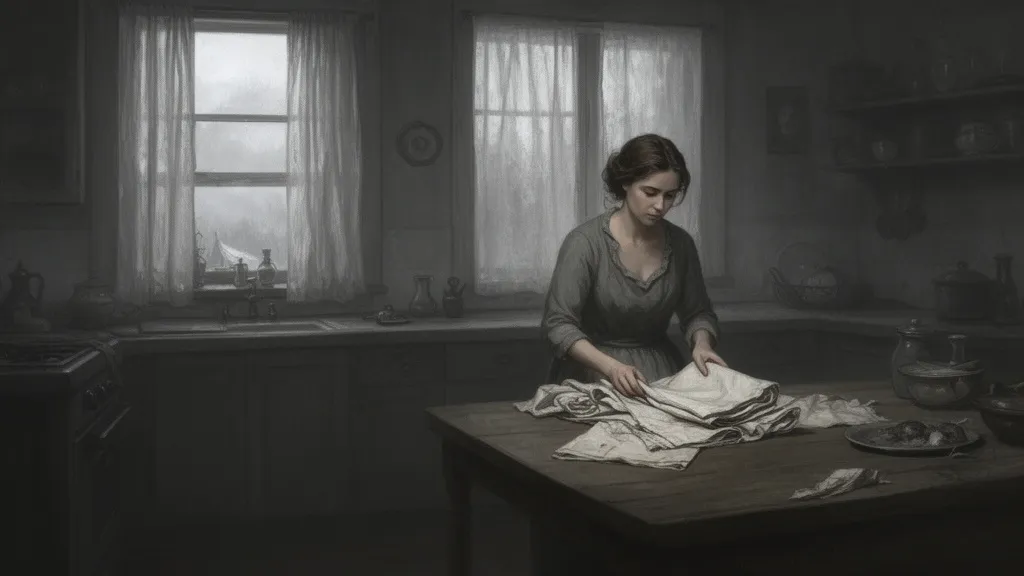
As she stood in the dimly lit kitchen, the soft, grey light of an overcast afternoon peeking through the curtains, Emilia's hands moved with a quiet reverence, folding her late mother's linen napkins with the precision of a ritual. The fabric, soft and worn from years of use, carried the scent of fresh laundry and memories of Sundays past. Halfway through the task, her thoughts began to wander, not to the grief that still lingered, but to the peculiar sense of disconnection she felt from the life she was living now.
The knock at the door, light and hesitant, broke the spell of her reverie. Emilia's heart quickened slightly as she recognized the pattern of the knock—the neighbor, Mr. Jenkins, who had been trying to catch her attention for weeks. She had been avoiding him, not out of malice, but out of a desire to sort through her own emotions without the added complexity of his well-meaning but intrusive kindness.
She made her way to the door, the sound of rain pattering against the windows filling the brief silence. Upon opening it, she was greeted by the sight of Mr. Jenkins, drenched and holding a copper cake tin, its surface still warm and adorned with tiny droplets of water.
"I brought back your mother's cake tin," he said, his voice laced with a politeness that seemed to carry an unspoken weight. "I hope you don't mind, but I used it for a little something I was baking. It seemed a shame to let it sit idle." As he handed her the tin, Emilia noticed a small, forgotten recipe card tucked inside, protected from the rain. Her heart skipped a beat. That card—one of her mother's oldest and most beloved recipes, thought to be lost in the chaos of moving and mourning—seemed to shimmer with a light of its own, as if beckoning her back to a part of herself she had been neglecting.
"Please, come in," she found herself saying, the words surprising her as much as the sudden urge to step aside and let him enter. The kitchen, once a space filled with the promise of solitude and reflection, was now about to become a stage for a conversation she had been postponing.
As Mr. Jenkins entered, shaking the rain off his coat, the kitchen was filled with the smell of wet wool and the faint hint of lemon peel from the cake tin. Emilia gestured for him to sit, the movement feeling both gracious and guarded. The cake tin, now the focal point on the kitchen table, seemed to radiate a warmth that was not just from its recent use but from the memories it evoked.
"I see you've been baking," Emilia said, trying to fill the silence with something light, yet her eyes kept drifting back to the recipe card.
"Yes, I have. Your mother's recipes... they're a treasure. I was hoping, perhaps, we could discuss... the future of them," Mr. Jenkins said, his voice tinged with a careful consideration that made Emilia's guard rise slightly. Emilia understood his concern; he had grown close to her mother through their shared love of baking, and the recipes were a connection to her and to the community.
"The future of them," Emilia repeated, her thoughts unfolding. She looked at Mr. Jenkins, then at the recipe card, now lying on the table. "I think... I'd like to keep them, to continue baking and sharing them with the community. It's what my mother would have wanted, and it feels like the right way to honor her memory." Mr. Jenkins nodded, a smile of understanding on his face. "I couldn't agree more. Perhaps we could even start a small baking group, using your mother's recipes as a foundation? It would be a wonderful way to keep her legacy alive and to bring the community together." Emilia's heart warmed at the idea, seeing it as a way not just to preserve her mother's recipes but to reconnect with her own past and to forge new bonds.
The conversation that unfolded was a dance of questions and revelations, each step uncovering desires and fears she had not acknowledged. Mr. Jenkins spoke of his own losses, of how her mother's baking had been a beacon of warmth and connection in his life. Emilia found herself sharing stories of her mother, of the Sundays spent learning the intricacies of traditional baking, and of the silence that had followed her passing.
"Sometimes," Emilia said, her voice barely above a whisper, "I feel like I've lost my way. Like I'm becoming someone I don't recognize, and the baking... it feels like the last string to who I used to be."
Mr. Jenkins listened, his eyes filled with a deep understanding. "Perhaps," he said, "you're not losing yourself, but finding a new way to honor what's been passed down to you. The recipes, they're not just about the baking; they're about the love and the connection they bring."
As the rain outside began to clear, Emilia felt a shift within her. It was as if the conversation, the return of the recipe card, and the warmth of the cake tin had all conspired to bring her back to a realization—that love and legacy are not static entities but evolving, living things that adapt and grow with us.
In the end, Emilia and Mr. Jenkins decided to start a small baking group, using her mother's recipes as a foundation. It was an act of connection, a bridge between past and present, between her old life and the new one she was embracing. As she walked Mr. Jenkins back to the door, the copper cake tin, now empty but full of promise, sat on the kitchen table, a symbol of the Sundays to come—filled with the warmth of baking, the comfort of community, and the quiet, enduring love that made every recipe a story of its own.