The Altered Log
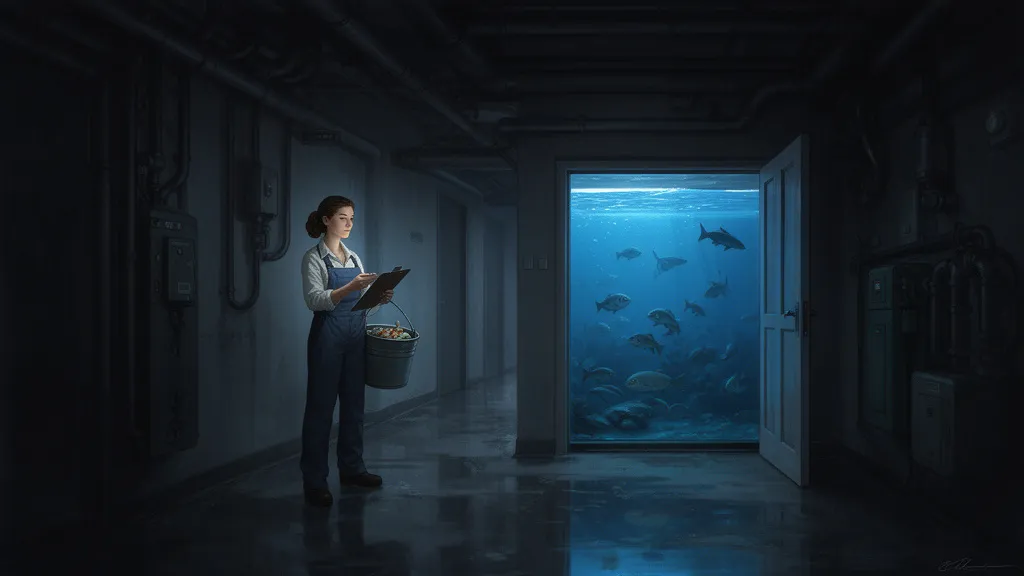
Mizuki Arai noticed the changed line because she was looking for something else.
She had come back along the service corridor with a bucket of thawing mackerel against her hip and the evening clipboard tucked under one arm, moving faster than was sensible on the damp rubber flooring. The public lights were down. Beyond the painted door to the pelagic hall, the aquarium had entered its nocturnal life: pumps throbbed inside the walls, filters sighed, and the great tanks kept their own blue weather. At eight-forty on a Wednesday in June, closed to visitors for more than an hour, the building felt less like a workplace than a machine pretending to be the sea.
She pushed through into the prep room, set down the bucket, and reached for the feeding log to check whether Kanda had remembered to note the stingray supplements. He never remembered. He believed, with the confidence of the habitually forgiven, that memory itself was a filing system.
The clipboard lay on the metal table under the wall clock. Her own handwriting ran down most of the page in neat black columns: 18:00 reef tank, 18:20 river exhibit, 18:45 touch pool. At the bottom, under Midnight pre-load / shark rotation, the line had been changed.
Originally, she knew, she had written 2 kg horse mackerel, vitamins added, key returned. Now it read 1 kg horse mackerel, no supplements, key returned 23:40.
The hand was hers.
Not merely similar. Hers. The small loop in the g of kg closed too tightly. The y in key leaned left. The figure four had the open top she had acquired from an economics teacher in high school and never lost. Even the pressure looked right, heavier on the downstrokes when she was tired.
Mizuki stood still long enough for the wall clock to click twice.
Then she looked at the ink.
Her entries above it were dull with drying. The altered line shone slightly under the fluorescent strip, as if the room had not yet made up its mind to absorb it.
She set a finger near the words without touching them. Fresh enough. Not minutes old, perhaps, but not written at six-thirty when she had filled in the pre-load before going to the cephalopod lecture for the volunteer guides.
Someone had copied her hand.
She heard a door strike softly somewhere down the corridor.
The aquarium employed nineteen full-time staff, six part-time attendants, two elderly volunteers who resented one another on principle, and a chef from the café who wandered into restricted areas with the innocent confidence of a seal. After closing, the place contracted into a smaller society. Voices carried. Odd habits became landmarks. There was Daigo from maintenance, whose knees announced him before he spoke; senior curator Tomobe, who cleared his throat in little academic footnotes; and Reina Kuroe, education officer, who wore perfume that managed to smell expensive and marine at once.
Now there was only the pumps, and under them, a faint chemical note she had not noticed while carrying fish.
Bleach.
It came and went with the corridor air.
Mizuki put down the clipboard and went out into the hall.
The shark tank occupied the centre of the pelagic gallery, a dark oval wall of acrylic under low blue lamps. Sandbar sharks moved through it with the grave indifference of priests. Smaller fish stitched silver lines behind them. The smell was stronger here, not enough to belong to a mop bucket, not enough to make a scene of itself, but wrong all the same. Bleach was used in housekeeping storage on the other side of the building and in careful dilution in quarantine. Not near the display systems. Never near the display systems.
She crouched beside the service gate built into the decorative rockwork and touched the concrete lip below it. Damp.
Not seawater. Seawater dried tacky and left a faint crust. This had a cleaner finish.
Her stomach tightened.
The midnight pre-load was for the rotating feed box above the shark tank, prepared in advance so the night watchman only had to release it if there was an emergency delay with morning husbandry. The salt-room locker key was kept on a labelled board in the prep room, because the vitamin supplements and frozen reserves were stored under controlled humidity. If the log had been altered and the key had been moved, then someone had done more than forge a line on paper. Someone had gone into the salt room, or wanted it to appear so.
She went back to the prep room and checked the key board.
The hook marked SALT-RM 2 was empty.
She looked at the margin of the log where she had, very distinctly, written key returned as part of the pre-load note at six-thirty because she had in fact returned it. She remembered hanging it there while Kanda argued with a bucket lid. She remembered because he had said, with deep seriousness, that lids were evolving.
Mizuki shut her eyes for one breath.
At nine tomorrow a school tour from Midorigaoka Elementary would arrive, seventy-three children if the faxed booking was to be believed. There would be a shark talk. There would be parents. There would be, if she reported a discrepancy now, senior curator Tomobe with his sorrowful spectacles and his gift for making uncertainty sound like negligence. She was twenty-seven, on a one-year contract, eight months in. An altered log in her own hand was the kind of fact institutions developed simple opinions about.
The proper thing was to report it immediately.
The practical thing was to know one more fact first.
She took the emergency torch from the wall and went to the salt room.
The salt room sat behind husbandry prep, half pantry and half shrine. Sacks of marine salt were stacked in pale blocks against one wall. Supplements, labelled tubs, reserve medicines, and the controlled-feed lockers occupied the other. The air was dry enough to roughen the throat. Mizuki unlocked the outer door with her staff pass, then stopped. The inner locker door stood very slightly ajar.
She had closed it at six-thirty. She closed everything. It was not virtue. It was the only defense against Kanda, who opened cupboards as though he expected applause.
She pulled the locker wider. Inside, the upper shelf held vitamin jars in a strict row. The lower shelf should have held three wrapped reserve packs of horse mackerel.
There were two.
One pack missing. One kilogram, if it had been the standard wrap.
She looked at the floor. White grains of salt lay undisturbed except near the threshold, where a shoe had blurred a crescent through them. The print was partial and useless except for one point: the sole had a narrow heel.
Most of the husbandry staff wore rubber boots or broad kitchen clogs. Narrow heels belonged to office shoes, volunteer shoes, or the sort of fashionable black loafers Reina wore to educational outreach because she refused, on principle, to look as if children had surprised her into employment.
Mizuki disliked the direction of her own thought at once. Reina was vain, exact, and intolerant of forms completed in the wrong pen. She was also kind to octopus-touching children who bit their own sleeves from excitement, and she had once stayed three hours late to sew a torn cap for the mascot costume because the summer intern had cried over it. It was possible to suspect someone without enjoying it.
On the top shelf, beside the vitamin jar, stood the bleach dilution bottle used for tray sanitising. Its cap was on crooked.
Mizuki picked it up and smelled it. Bleach, sharp and domestic.
The bottle should not have been here at all. Sanitising supplies belonged in the wash alcove outside.
Someone had brought it in, or put it back carelessly, and had enough other things in mind to miss the cap.
She heard voices in the corridor.
One was Kanda's, carrying the cheerful fatigue of a man who had made peace with incompetence by redistributing it among others.
The other was lower, drier. Tomobe.
Mizuki set the bottle down exactly where she had found it, shut the locker, and stepped out before she could be caught peering into a room she was fully entitled to enter, which would somehow have felt furtive all the same.
Kanda came around the corner first, tall and loose-limbed in his waterproof apron, carrying a tray of squid. Tomobe followed with his jacket folded over one arm despite the humidity, his tie still perfectly centred because he believed disorder was a moral contagion.
"Arai," said Tomobe. "You are still here. Good. The guide scripts for tomorrow—"
"Has the salt-room key been taken?" she asked.
Kanda blinked. Tomobe paused.
"Taken by whom?" Tomobe said.
"It is missing from the board. The midnight feeding log has also been altered after I filled it in."
There was a small silence in which Kanda looked from one to the other with the expression of a dog deciding whether rain counted as a personal insult.
Tomobe held out his hand. "Show me."
They went to the prep room. Mizuki gave him the clipboard. He adjusted his spectacles and examined the line without hurry.
"This appears to be your handwriting," he said.
"Yes. It is not my entry."
"That is an interesting distinction."
Kanda, to his credit, winced.
Mizuki said, "The ink is newer. One reserve pack is missing from the salt locker. The bleach bottle was in the locker. There is bleach smell near the shark service gate."
Tomobe looked up properly at that. "Bleach?"
"Faintly."
Kanda put down his squid. "Why would anybody bleach a shark?"
No one answered him. This happened often enough that he no longer took offense.
Tomobe said, "Come."
They walked to the pelagic hall together. Tomobe bent with more effort than grace to inspect the damp patch by the service gate. Kanda sniffed the air with dramatic sincerity.
"I get it," he said. "That is definitely bleach. Unless a very clean ghost died here."
"Thank you," said Tomobe.
It was difficult to tell whether he meant it.
He straightened. "We cannot open tomorrow with uncertainty around the shark feed. Kanda, check all reserve stores and the prep freezer. Arai, with me."
He did not say report, which told Mizuki he was now thinking in terms of damage control rather than procedure. Institutions, she had noticed, became flexible where embarrassment threatened.
He walked her back to the prep room, then stopped by the staff kettle. "Tea?" he said absently, already filling it.
It was an odd moment for hospitality, but Tomobe performed tension through beverages. Mizuki, who never succeeded in meeting tea at the correct temperature, said yes before considering.
He looked again at the log. "Who had access between your entry and now?"
"Most staff still in the building. Husbandry, education, maintenance, cleaning. Volunteers had left by seven-thirty."
"Who can imitate your hand?"
This was almost insulting in its precision. "I don't know. Anyone who has seen enough forms."
"Who has seen enough forms?"
She thought of Reina correcting captions beside her in the office, of Kanda borrowing checklists and returning them decorated with apologetic arrows, of Tomobe initialling reports with a pen that seemed to judge the page.
"Most of us," she said.
The kettle clicked off. Tomobe poured. The tea was, by some administrative miracle, instantly too hot.
He said, "Did you tell anyone what you had written in the pre-load note?"
"No."
"Then the person either opened the log and copied your script from the same page, or knew your habits well enough to reproduce them. The second is intimate. The first is simpler. We should prefer simple things until they stop working."
Mizuki held the cup by its rim and did not drink.
Kanda returned with a reserve inventory sheet, breathing as if numbers had chased him. "Prep freezer normal. Reserve stores normal except one missing standard wrap from salt room, like Arai said. Night watch says he hasn’t touched the shark pre-load. Also, Umemoto from cleaning is furious because somebody borrowed her bleach bottle and put tap water back in the bucket. She says this with evidence." He held up a white rag that smelled profoundly of municipal indignation.
Tomobe took the sheet. "Who was cleaning this wing?"
"Umemoto until eight. Then education office and front hall. She said she left the bottle on the wash cart outside husbandry around seven-fifty."
Mizuki looked at the log again.
Seven-fifty. The altered ink looked later than that, but that could deceive under fluorescent light. The key detail was different. If someone had taken the bleach from the wash cart, then entered the salt room, then changed the log, the sequence implied thought. Not panic. Not random meddling. Enough thought to stage one thing as another.
And the changed line reduced the feed amount from two kilograms to one.
If someone had stolen a standard reserve pack of one kilogram, the new total would match what remained.
She said, very quietly, "The person wanted the inventory to balance."
Tomobe looked at her. "Explain."
"If one reserve pack was taken, then the original note saying two kilograms with supplements would make tomorrow's count wrong. Changing it to one kilogram makes the missing pack look used for the pre-load. The added return time makes it sound more official. If this were about harming the tank, there would be no reason to make the paperwork smaller."
Kanda frowned with earnest effort. "So they stole fish and then did stationery about it?"
"Yes," said Mizuki.
"That is much sadder than bleaching a shark."
It was, and that was the useful part. Grand motives made noise. Small motives tidied up after themselves.
Tomobe said, "Who would steal one kilogram of horse mackerel?"
"Someone who needed fish quickly," Mizuki said. "Not for themselves. And not from the main freezer, because that would be noticed by husbandry. The reserve locker looks more official."
She thought of the smell of bleach near the shark gate. Of the narrow heel print in the salt room. Of the educational office adjoining the pelagic hall by a side door used for school materials. Of Reina's perfume, marine and expensive, disguising cleaner scents if one was not looking for them.
And of one thing more: at six-thirty, while Mizuki had been filling the log, Reina had come into prep to borrow a marker for tomorrow's school placards. She had stood by the clipboard long enough to chat about jellyfish fonts. She had admired, with that amused exactness of hers, Mizuki's "beautiful prison-warden handwriting."
A compliment, at the time.
Now an inventory of features.
Mizuki set down the untouched tea. It had become merely dangerous rather than impossible.
"Where is Kuroe-san?" she asked.
They found Reina in the education office making paper badges for the school tour because she distrusted adhesive labels and, perhaps, many human beings. She sat at the low table under a mobile of cardboard sardines, cutting blue card into neat rectangles with silver scissors. Her black loafers stood beside the chair. She had changed into indoor slippers, narrow and heeled at the back.
On the windowsill lay a plastic tank with a handwritten sign: Temporary Resident — Do Not Tap. Inside, under a sheet of damp cloth, a small cuttlefish pulsed pale brown in shallow water.
Mizuki understood before Tomobe spoke.
Reina looked up, saw all three of them, and closed the scissors. Her face did not alter much. It became still in a more deliberate way.
"Well," she said. "That was quicker than I hoped."
Tomobe's voice went formal. "Kuroe-san, why is there a live cuttlefish in your office?"
"Because if I left her in quarantine until morning, she would almost certainly die," Reina said. "And if I submitted the proper transfer request, she would certainly die after a meeting."
Kanda made a small sound of sympathy that might have been intended for the cuttlefish or for paperwork.
Reina folded her hands. "She arrived in the afternoon with the local fisheries donation. Very young. Ink-sac irritation, stress response, poor color. The quarantine tank was being sanitised, and Daigo promised me he would reconnect the auxiliary aeration in an hour. He did not. I checked at eight and found her lying on her side. So I took one reserve fish pack for feeding lure, borrowed bleach to clean this tank because the interns had been breeding civilizations in it, and used the shark service sink because it was closest. I spilled some on the concrete lip at the service gate when I set the tank down to open it, then rinsed badly because I was carrying the cuttlefish in the other hand."
"The log?" said Tomobe.
"Yes," said Reina. "Because once I had taken the fish, the count would fail in the morning, and if Arai-san was blamed for losing a key over one dying cuttlefish, I would have to listen to your department discuss accountability until winter. I thought it better to alter the amount. I overdid the return time. That was vanity."
She said it as if discussing an unfortunate choice of earrings.
Tomobe took off his spectacles and pinched the bridge of his nose.
Mizuki looked at the little tank. The cuttlefish drifted, then changed color in a shy wash from brown to pearl. It was alive. Barely, perhaps, but with intent.
"You copied my handwriting," she said.
Reina met her eyes. "Yes. You have very memorable gs. Also, you press harder when annoyed. I regret the necessity and not the method."
This was, Mizuki thought, more honest than many apologies.
"Why not ask me?" she said.
A pause.
Reina glanced down at the tank. "Because you would have followed procedure. And because I was trying not to ask favors from someone I had no right to ask them of."
It was a peculiar sentence, exact and evasive at once. Kanda looked interested at once, in the way some people recognised emotional weather faster than facts. Mizuki did not look at him.
Tomobe said, "This is unacceptable on six levels. Possibly seven. You do not alter husbandry records. You do not remove controlled feed without authorisation. You do not sanitise educational tanks with undiluted bleach in a service area."
"Diluted," said Reina.
"That is not the useful part of the sentence."
He put his spectacles back on. His irritation was real, but under it lay something else: relief, perhaps, that the matter was ridiculous rather than catastrophic. The deadliest things in institutions were often those with minutes attached.
Mizuki said, "The salt-room key?"
Reina opened a drawer and produced it at once. "I intended to return it before anyone noticed. Obviously, this plan was not durable."
Kanda said, with subdued admiration, "You forged a log for a cuttlefish."
"Please don't make it sound romantic," Reina said.
He considered. "Administrative, then."
That, strangely, nearly made Mizuki laugh.
Tomobe accepted the key. "The record will be corrected. I will decide in the morning how this is reported. For now, the animal goes to quarantine once the aeration is working. Kanda, find Daigo and drag him by whatever part of him has warranty left. Arai, rewrite the log in my presence. Kuroe-san—sit there and do not improve anything."
Reina inclined her head. "As you wish."
By ten-thirty the practical crisis had been reduced to forms.
Daigo had repaired the aeration with the expression of a man personally wronged by screws. The cuttlefish had been moved, with solemn escort, to a proper tank. The bleach smell dissipated under ventilation and two pointed memos. Mizuki rewrote the midnight feeding entry on a fresh sheet: original amount, reserve pack removed by education officer without authorisation, supplements not added, key recovered. Tomobe initialled it in strokes severe enough to terrify the paper.
When at last the others dispersed, the pelagic hall was empty again.
Mizuki sat on the low bench facing the shark tank with a paper cup of tea from the machine because the kettle version had long since turned undrinkably cold, and machine tea had at least the merit of being predictably bad. It was lukewarm. She drank it anyway.
The sharks passed in their unhurried circuit. In the glass, her reflection hovered over them: dark ponytail, work jacket, fatigue making a gentler shape around the mouth than youth preferred. Behind the reflection, the school-tour placards for tomorrow leaned against the wall where Reina had left them. Each badge had been cut exactly. Each child's name was written in the same beautiful hand.
She heard soft steps and did not turn at once.
Reina sat at the other end of the bench, leaving a proper amount of space and then, after a moment, an improper amount by shifting slightly closer. She had brought no tea. This suggested seriousness.
"I did mean to tell you before morning," she said.
"No, you didn't," Mizuki said.
Reina considered. "No. I meant to want to."
That was probably true.
For a while they watched the tank.
"You should have asked me," Mizuki said.
"Yes."
"I might still have said no."
"I know."
"And then?"
Reina folded her hands in her lap. "Then I would have done exactly what I did, but with the discourtesy of advance notice."
Mizuki let the corner of her mouth move. "That is at least consistent."
"I value consistency. Not in records, apparently. In other things."
Another shark passed, pale underside briefly catching the light.
Reina said, without looking