The Archive Route
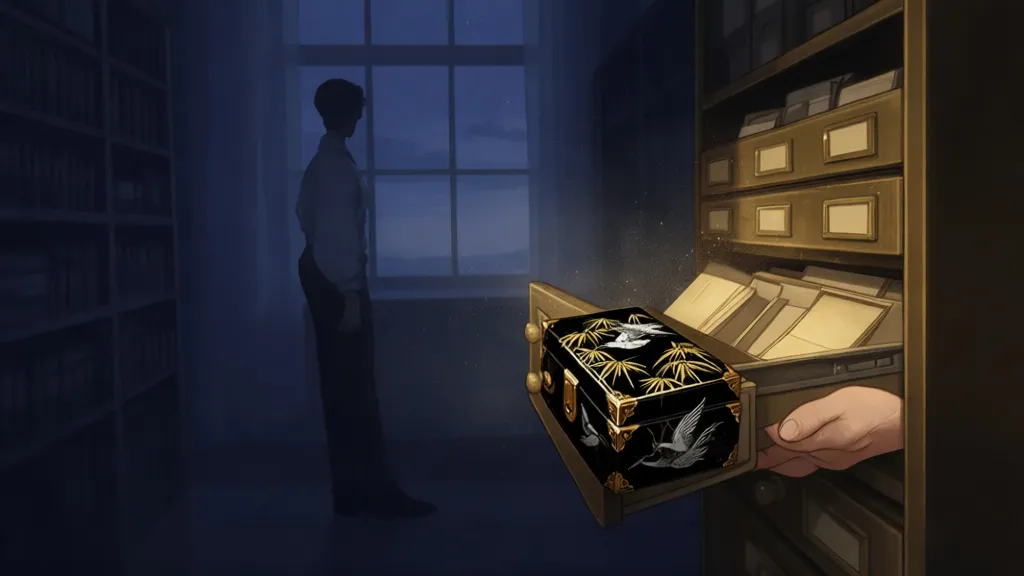
At three twenty in the afternoon, Kuroda Aya opened drawer C-14 and found a lacquered puzzle box where the accession cards should have been.
She stopped with one hand still on the brass pull. The drawer was shallow and long, divided into neat channels for cards sorted by acquisition number. She knew this one well enough to notice a single card turned half a degree wrong. There should not, under any circumstances, have been a box in it.
It was black, square, and small enough to sit in both palms. A pattern of gold reeds ran across the lid, interrupted by tiny inlaid silver birds. It had no keyhole. Its surface was warm.
Aya held it a moment longer than was sensible. The archive room was cool. The rain had not yet started, but the air had been pressing all day against the skylights over the upper corridor, waiting. Warmth meant recent hands.
She looked back along the compact shelving. No one.
The Museum of Municipal History had a public face all polished restraint and educational panels. Behind that lay a set of corridors and workrooms whose plan had grown by compromise over forty years. The archive sat between textile storage and the old west staircase, which no visitors used and half the staff pretended not to know about. If someone had come into her room, they had either passed her desk or used a door that should have remained locked.
Aya set the box on the table beneath the finding aids. Beside it sat a mug of tea she had poured twenty minutes earlier and already forgotten. It was now exactly between hot and cold in a way she disliked more than either extreme.
She drank it anyway, because delay was another form of curiosity.
Then she picked up the box again and tested it.
A puzzle box announced itself by resistance. This one gave a little under her thumbs, then not at all. She slid the top panel left; it stopped. Pressed the lower edge; something within clicked. The gold reeds no longer aligned quite as they had. Another panel moved under her fingernail. A hidden seam appeared.
Aya had once spent a winter cataloguing tea caddies with false bottoms donated by an enthusiast who believed concealment was a branch of aesthetics. She had learned patience from objects that wished to be admired before they were understood.
A final pressure at one corner released the lid.
Inside lay a brass key on a cotton pad faded to the colour of old bones, and beneath it a railway receipt, folded twice.
Aya did not touch the key first. She took the receipt and unfolded it on the table.
It was brittle with age but not enough to crack. The paper bore the stamp of Shin-Tenma Station, date half obscured by the clerk’s hand. Shin-Tenma had been closed before Aya was born. The line had been diverted after the river works in the 1970s. She knew that because there was a file on the closure in municipal transport records, box 6-B, second shelf from the bottom.
Only then did she look properly at the key.
It was tagged with a rectangle of ivory card: West Gallery 4, inner grille.
Aya stood so quickly her chair rolled back into the map cabinet.
West Gallery 4 had been sealed for six days.
The grille key had gone missing the previous Thursday during the installation turnover for Rivers of the City, an exhibition made up largely of maps, flood marks, bridge models, and one temperamental folding screen on loan from Kobe. The outer doors to the gallery could still be shut and alarmed at night, but the decorative iron grille inside them, which protected the central cases, could not be locked. Since the exhibition was due to open in two days, everyone had become politely frantic. Keys, Aya had observed, inspired moral language in people who mislaid them.
She took the key and the receipt, put both into a document envelope, and went first to the archive door.
The corridor beyond was empty. From the conservation room came the low hum of dehumidifiers and someone laughing too loudly at a joke they had plainly told before. Aya crossed to the old west staircase door.
It was closed.
She tried the handle. Locked, as it should have been.
She crouched and looked at the gap beneath it. No light, only the thin drift of dust that gathered because cleaners had no love for dead stairs. Yet on the threshold itself a grainy crescent had been disturbed, as if a sole had turned there recently.
Aya straightened. She was not alarmed, exactly. Archivists who spent time among records of thefts, fires and municipal incompetence developed a practical scale of emotion. This was above annoyance and below panic. It sat somewhere near interesting.
She went downstairs to find the registrar.
Matsuda Reiko was in temporary command of the loading bay office, signing forms with the severe concentration of a person who enjoyed signatures. She wore a navy suit and a string of pearls at four in the afternoon in a museum that smelled faintly of plaster. Her relationship with the deputy director was one of the institution’s more stable ambiguities. They lunched together every Tuesday and fought in meeting minutes.
“Aya,” she said, without looking up. “If this is about the courier for the ship models, I have already regretted everything available to regret.”
Aya put the envelope on the desk. “I found the missing key.”
That made Reiko look.
Two minutes later they were in West Gallery 4 with the head of security, a junior curator named Nonomiya who had lost the key in the first place and was suffering visibly, and a guard called Fujita who smelled of damp tobacco and rain not yet fallen.
The gallery lights were half on. Cases stood under cloth covers like furniture in a house being left. The iron grille, all black scrollwork and municipal ambition, separated the central display area from the outer circulation path. Aya fitted the key into the inner lock. It turned cleanly.
Nonomiya made a small sound of relief that would have embarrassed him if he had heard it from another person.
“Where was it?” Reiko asked.
“In drawer C-14,” Aya said.
“With the accession cards,” said Reiko flatly.
“Yes.”
“That is not funny.”
“I did not mean it as a joke.”
Aya looked around the gallery. There was nothing visibly wrong. Labels stacked in order. Covered cases undisturbed. One of the cloths had slipped at a corner to reveal the edge of a map mount. She turned slowly to the outer doors, then to the service door in the rear wall.
“Who has used this room since Thursday?” she asked.
Nonomiya drew himself up as if oral accountability might save him. “No one unsupervised. Installers, conservation, myself, Ms. Matsuda, security rounds.”
“And cleaners,” said Fujita.
“And cleaners,” Nonomiya admitted, as if he had been hoping they did not count as people.
Aya glanced at the rear service door. It led to a short passage, then the freight lift and loading bay. During installations it was busy. Once an exhibition settled, hardly anyone used it.
“Did anyone report seeing the key after it was lost?” she asked.
No one had.
Fujita, leaning politely against the wall, said, “I saw you this afternoon, Kuroda-san.”
Aya turned to him.
“You went in alone,” he said. “Toward the back. Maybe ten minutes before you came for Matsuda-san.”
“I did not.”
Fujita blinked. He had the calm, tired face of a man who had spent years watching doors and drawing conclusions from very little. “I was outside the loading bay,” he said. “Last cigarette before the weather broke. You crossed the passage and went through this service door. Grey cardigan, hair tied back, folder under your arm. I thought, archivists never stop.”
“I have not been downstairs since lunch.”
There was a short silence.
Nonomiya looked from one to the other with naked gratitude that the suspicion had left him and found a larger target.
Reiko said, “Fujita-san, are you certain?”
“Yes.” He hesitated. “Well. Not of the folder. Of Kuroda-san, yes.”
Aya said, “How far were you?”
“By the loading bay shutter. Maybe twelve metres. Side view, then from behind.”
“In this light?”
“It was brighter then.”
Aya considered that. She was not vain. She had, however, once been mistaken for a postdoctoral researcher in archaeology three times in one day, all three by different men. Grey cardigan and tied hair described half the women on staff in weather that could not decide itself.
“Did she open the door?” Aya asked.
“Yes. Or it was already open and she slipped through. I only looked up for a moment.”
“That is less certain than before,” said Reiko.
Fujita accepted the correction with decent grace. “It is.”
Aya walked to the rear service door and examined the latch. The strike plate had fresh scratches. Not many, but bright against older wear. On the floor just inside lay a tiny black flake, curved and glossy.
She crouched and picked it up.
Lacquer.
By five o’clock the rain had begun in earnest, drumming on the skylights over the upper corridor with the determined intimacy of weather that intended to stay. The museum changed sound when it rained. Rooms shrank. Footsteps seemed to occur nearer than they were. Every door became part of a larger instrument.
Aya went back to the archive and closed the door.
She put the puzzle box on blotting paper beneath the lamp and looked at it again. One corner was scraped, just enough to expose a dull underlayer beneath the black finish. A matching flake, almost certainly, lay now in her envelope.
Someone carrying the box had brushed the service-door plate.
She opened drawer C-14 and studied the cards around the space where the box had sat. Several were shifted forward. One was in the wrong channel entirely. That mattered less than the dust. The rectangular patch beneath the box had been clean, but beside it lay a narrow line where dust had not yet settled into the grain.
As if the drawer had been shut on something flat. Something removed before she arrived.
Aya took out the transport records for old railway stations and laid them on the table. Shin-Tenma appeared where she expected, then again in a supplementary file of building salvage. When the station was demolished, a quantity of fixtures had been transferred to municipal custody pending reuse: enamel signs, benches, ticket punches, timber lockers.
And one lacquered lost-property box, decorative, Meiji period, provenance uncertain.
Transferred, thirty years earlier, to the Museum of Municipal History.
Aya sat back.
The puzzle box belonged to the museum. That explained how it could appear in the archive without anyone raising immediate alarm. It explained, too, the old train receipt inside. Someone had used what was at hand and what would distract. The key was the point. The receipt was noise.
But not meaningless noise. A station that no longer existed. A route discontinued.
Aya looked toward the compact shelving.
The shelves themselves ran in long aisles on tracks, movable by crank. At the end of each range was a metal face panel with enough gap behind it for mechanism and wall clearance. Not enough to hide a person, ordinarily.
Ordinarily, however, the ranges stood flush.
Aya rose and went to the back row, where oversized municipal ledgers occupied the lower shelves and uncatalogued donations the upper. She turned one crank. The aisle widened with a tired mechanical complaint. At the far end, behind the last shelf, was a narrow maintenance strip between shelving and wall. Dust, old labels, one dead moth.
And beyond, almost hidden by the overhang of the shelf end, a low service hatch in the wall, painted the same colour as everything else.
Aya had never seen it open. She doubted many people knew it existed. The building had been, before its conversion, a records annex for the city transport office. There were odd passages everywhere, remnants of another bureaucracy’s sense of movement.
The hatch was unlatched.
Behind it ran a cramped passage, more crawl than corridor, following the line of the old utilities conduit toward the west staircase and, if her memory of the plans was correct, toward the rear of West Gallery 4.
The air that came from it was close and faintly warm.
Someone had been using the archive shelves as a route through the building.
Aya closed the hatch and stood very still, hearing the rain above and the small movements of the museum settling into evening. It would have been possible, she thought, for someone to enter the archive, slip behind the moved shelving, use the conduit passage, and emerge near the gallery service door. It would also have been possible, on the return, to place the key in the puzzle box and the box in C-14. If interrupted, one might say one had been searching records.
The question was why return the key at all.
Not to help the museum. People did not perform acts of institutional kindness by secret passage.
To stop the search. To close attention down.
Aya went first to the exhibition file. Then to the loan list. Then, because small observations preferred company, to Reiko.
She found her in the seminar room, bullying a spreadsheet into moral behaviour.
“Who knew,” Aya asked, “that the old conduit from archive to west staircase was still passable?”
Reiko removed her glasses. “No one was meant to.”
“Who did?”
“The building manager. Possibly old facilities staff. Why?”
Aya told her, briefly.
Reiko listened without interruption. When Aya finished, she said, “You have a face that makes every institution wish to confess.”
“It very seldom does.”
“Whom do you suspect?”
Aya said, “Not Nonomiya. If he had found the key, he would have announced it with tears. Not Fujita; he smokes, but he does not invent in such complicated lines. And not a cleaner, because this was done by someone who knew where accession cards were kept and trusted that a puzzle box in that drawer would be recognized as wrong but not impossible.”
Reiko was already ahead of her. “Staff.”
“And someone who needed access to the sealed gallery before opening.”
“The loan screen,” said Reiko at once.
Aya nodded. The folding screen from Kobe had arrived with less insurance than sentiment. Its owner had attached six pages of conditions and a handwritten note threatening emotional ruin if humidity fluctuated. It was the only object in the exhibition valuable enough, delicate enough, and troublesome enough to inspire private handling.
“Who has been most anxious about it?” Aya asked.
Reiko did not answer immediately. Her expression altered by one careful degree.
“That depends,” she said, “on whether one counts anxiety for the object, or for the lender.”
Aya waited.
“The screen was arranged through Morita-sensei,” Reiko said at last. “Retired historian. Volunteer advisor, occasional tyrant. The lender is his former student, now a dealer in Kobe. They are... attached, perhaps. Or were. The condition reports have become strangely emotional.”
Morita taught a weekly seminar in the museum library and wore scarves indoors for reasons no season had justified. He also knew every obsolete corner of the building because he had campaigned, unsuccessfully, against three different renovation plans.
“And who has been spending time with Morita-sensei?” Aya asked.
Reiko’s mouth moved almost into a smile. “Nonomiya. Professionally, one assumes. He blushes in a way that makes assumption untidy.”
That, Aya thought, was almost beside the point. Almost.
At six ten, with the museum closed and the rain beating steadily at the glass, Aya asked Nonomiya to meet her in West Gallery 4.
He came at once, carrying distress like a folded umbrella. Morita was with him, draped in dark linen and indignation.
“You said this concerned the key,” Morita began.
“It concerns the route,” Aya said.
She had asked Reiko and Fujita to stand by the rear service door. Their presence improved the geometry.
Aya set the puzzle box on the central case and opened it in three movements. Morita’s eyes went to it at once. Recognition, then restraint.
“This box,” Aya said, “came originally from Shin-Tenma Station, which is why the old receipt was inside. It now belongs to the museum. Someone took it from storage, put this gallery key into it, and placed it in my drawer this afternoon.”
Nonomiya swallowed. “Why your drawer?”
“Because I would find it, and because the person wanted the key discovered by someone credible but not immediately suspicious.”
Morita said, “Or someone wished to play games with an archivist.”
“Yes,” Aya said. “But they also scratched the rear service-door plate while carrying the box. Lacquer flakes from the corner match the scrape. And they used the old conduit passage from behind the archive shelving to reach this side of the building. That passage is known only to a few people familiar with the pre-conversion plan.”
Morita’s hands tightened on his scarf. Nonomiya looked astonished in a sincere way; Aya crossed him off again, with affection.
“The key disappeared on Thursday,” Aya went on. “Yet it was returned only today, after several days of concern. That delay matters. If the goal had been merely to borrow it, it would have come back sooner. Instead, someone continued entering this room while it remained nominally sealed.”
“For what purpose?” Morita demanded.
Aya turned to the cloth-covered case nearest the screen crate. “To replace something.”
Reiko drew back the cloth.
Inside, not the screen but on the adjacent mount, lay a row of river survey sketches. One was in a different frame backing from the others: newer board, cut neatly, hidden by the mount edge unless one looked from above.
Aya said, “The exhibition includes three original survey sketches by Kitahara Junsuke. The centre one is a copy.”
Nonomiya made a broken sound. “That is impossible.”
“No,” said Aya. “Only laborious.”
She looked at Morita. “The original was removed after condition checking on Thursday. The missing key allowed repeated access. The culprit intended to keep the gallery formally closed to casual scrutiny, then return the key before opening so attention would end. If no one lifted the mount, the substitution might survive the exhibition.”
Morita’s face had gone pale, but his anger arrived before his surrender. “This is absurd.”
“Not entirely,” said Reiko. “You know the old passages. You had reason to be here. And your former student in Kobe, the lender, is also a dealer with clients who value Kitahara.”
“That proves sentiment, not theft.”
Aya said quietly, “Fujita mistook someone for me this afternoon because from a distance she wore a grey cardigan, hair tied back, carrying a folder. The person who most resembles me in outline among museum staff is not you.”
Nonomiya looked blank for one startled moment, then horrified.
Aya continued, “But the person Fujita saw was not the planner. Merely the messenger. She used the service door and left the box in the archive. She did it for someone she trusted, or wanted to protect.”
There were only six people in the room, and yet the silence had a way of finding one.
Reiko said, “Kanzaki.”
The conservation assistant entered from the rear door as if summoned by guilt itself. She was indeed Aya’s approximate height, in a grey cardigan, hair tied back, and already crying with visible annoyance at her own inefficiency.
“I only put the box there,” she said. “He said it would stop everyone looking. He said the sketch would be back before opening.”
Morita closed his eyes.
No one spoke for a second.
Kanzaki went on in a rush. “There was a buyer. Only temporary, he said. They needed to compare paper, secure a promise, settle debts. He said the lender was desperate and that if the screen sale collapsed everything else would go with it. He said museums survive these things all the time. I know that sounds stupid. It was stupid.”
Nonomiya had turned a colour Aya associated with porcelain in bad light. He was looking not at Morita but at Kanzaki.
Ah, Aya thought. There it was: another line crossing the first. Nonomiya had admired Morita; Kanzaki had loved Nonomiya enough to borrow his panic and call it judgment. People made routes through buildings in much the same way they made them through one another: by noticing where resistance was weakest.
Morita said, without opening his eyes, “The sketch is in my satchel.”
Fujita took a step forward.
Morita raised one hand. “Do spare me the theatre. I had meant to return it tomorrow morning, after the comparison. The dealer in Kobe is ruined if the screen does not sell. He has been a fool. I have been an older one.” He looked at Nonomiya then, and his voice altered, becoming less proud and more tired. “You need not look at me like that. I know what this is.”
Nonomiya said nothing. In fairness, there was nothing useful available.
Aya watched as Reiko took the satchel, removed the wrapped sketch, and held it with the care usually reserved for the living and fragile. The rain struck harder overhead. Somewhere a pipe answered with a knock.
By eight, statements had begun and practical miseries had taken over from dramatic ones. The original sketch was back in its mount. The police had been called in the modest, embarrassed way institutions preferred when the scandal had failed to become spectacular. Kanzaki sat with a blanket around her shoulders though she was not cold. Morita, who had spent fifty years among documents and should have known better, looked suddenly like a man who had mistaken memory for credit.
Aya was released at last.
She returned to the archive, where the shelves stood slightly ajar from her earlier search, as if the room itself had not yet decided to compose its face. On the table waited a fresh cup of tea from someone kind enough to think of her and careless