The Brass Key
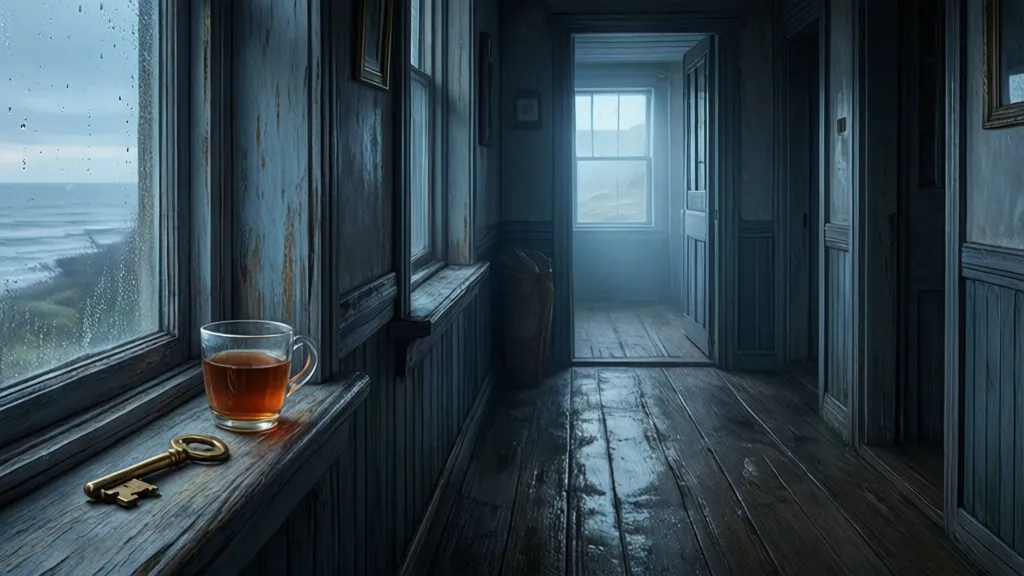
By seven twenty on the third morning, Natsumi stopped being surprised.
She opened her door, looked down the narrow first-floor corridor of Kaigan-so, and found everything exactly where it had been the night before: the fire bucket by the stairs, the framed print of black pines bent in sea wind, the pale strip of dawn under the front entrance. The inn smelled, as it always did, faintly of bleach and wet rope. Somewhere below, crockery touched crockery with the resigned sound of breakfast beginning.
On the windowsill at the end of the corridor stood a glass of tea gone thin with melted ice, and beside it lay a brass key.
Natsumi went to it without haste. The key was old enough for the cut edges to have softened under years of use. A rectangle of dark paper had once been tied through the bow, perhaps with a room number, but only the frayed thread remained. The tea was the same weak amber as on the first morning, a skin of cold clinging to the glass. Someone had put both there after the corridor had been locked for the night.
She touched the key. It was dry. The sill beneath it was dry too, though the sea mist had silvered the outside of the window.
Behind her, Room Five opened with unnecessary force. Mrs. Shibata emerged in a lavender tracksuit and a grievance.
"Again?" she said. "Honestly. If this is meant to be charming, it is not."
"You saw it yesterday," Natsumi said.
"I saw a key yesterday. They all look the same before breakfast."
This was not true. The brass key had a nick near the stem and one tooth worn lower than the others. Mrs. Shibata would not have seen either detail. She enjoyed being first to a complaint, not first to an observation.
The innkeeper came up from below while drying his hands on a towel. Horie Kenji was a narrow man with a neck that always seemed one apologetic bow ahead of him.
"Ah," he said, stopping when he saw the sill. He looked more tired than surprised. "It has happened again."
"You did not remove yesterday's one?" Natsumi asked.
"I did. I put it in the office drawer. It is still there." He seemed to hear the weakness in that sentence as he spoke it. "At least, I assumed—"
Mrs. Shibata gave a small triumphant sound. Contradiction was breakfast to her.
Natsumi lifted the key by the bow. "May I?"
Horie spread a hand. The gesture meant please do something with this because I cannot.
She slipped the key into her cardigan pocket. Her fingers found, already there, the object she had picked up the morning before and not mentioned: a small white chess pawn, left on the same sill beside the same glass.
The first morning there had been only the tea.
The second, tea and pawn.
The third, tea and key.
It was difficult not to feel that she was being addressed.
At breakfast, the inn attempted cheerfulness and achieved eggs. Rain needled the dining room windows. Beyond them, the harbour was a grey arrangement of boats and ropes and low concrete. Natsumi had come to the village to spend four quiet days cataloguing a dead poet's letters for the local historical society. The poet had proved less interesting than the society's filing system. The inn, until now, had been merely damp.
Horie's sister Yuko served rice and grilled horse mackerel with the air of a woman who had no intention of discussing apparitions, keys, or guests who invented either. She set down Natsumi's tea. It was too hot to drink. Natsumi let it sit in offended silence.
At the next table, a young couple argued politely over the map to the lighthouse. By the window, Professor Terao from Osaka Women's College, who had spent the previous evening explaining tides to anyone who approached the soy sauce, was telling Mrs. Shibata that old inns often had duplicate keys in circulation.
"Not duplicate," said Mrs. Shibata. "Migratory."
"All keys migrate if one gives them time," said the professor.
He had the face of a man who expected his jokes to be indexed.
Natsumi ate, then asked Horie, quietly, "May I see the office drawer?"
He took her at once. A person under strain will trust almost anyone who speaks without theatre.
The office was behind the front desk, a room of invoices, umbrellas, and a wall calendar still on last month. Horie opened the drawer. Inside lay pens, a spool of twine, two packets of antacid, and another brass key.
Natsumi placed the one from her pocket beside it.
The two were not merely similar. They were a pair. Same worn tooth, same nick near the stem, same absent paper tag.
Horie stared. "That is impossible."
"Only inconvenient," Natsumi said.
There was a blue wool thread caught in the corner of the drawer, fine as hair. She touched it with one fingernail and lifted it free.
"Do your staff wear blue sweaters?"
"No. White aprons in the morning, dark jackets in the evening. No blue."
She laid the thread on the desk blotter. It was bright, almost cheerful, and therefore at once suspicious in this office.
"Who locked the corridor last night?"
"My sister. At ten. She always does. Then she brings me the key."
"And after that?"
"No one goes up unless a guest calls." He frowned. "There is the linen chute. But it is too narrow."
"For linen, certainly."
He looked at her. She had not smiled. That seemed to worry him more.
The chute ran from each floor's service cupboard to the laundry room at the rear. It was lined in dented tin and smelled of soap, mildew, and old cotton. Natsumi stood with the cupboard door open and looked at the opening: a slanted square a little wider than a suitcase, fitted with a flap that swung inward.
A thin adult could not climb up it comfortably. Comfort, however, was rarely the deciding factor in human behaviour.
There were scrape marks on the inner lip. Not new, not old. On the hinge of the flap, a grain of sand shone pale. She found another on the floor inside the cupboard.
At the bottom, in the laundry room, a wicker basket sat beneath the chute. Beside it were shelves of folded sheets and pillowcases, all severe and clean. A side door, used for deliveries, opened onto the alley behind the inn. It was bolted now.
Yuko found Natsumi there and folded her arms.
"If my brother asked you to inspect the laundry, he has become very desperate."
"He asked me nothing. I dislike recurrence when I do not yet understand it."
Yuko considered this. "That sounds like a profession."
"Library work. We call it shelving."
Yuko almost smiled. She was heavier than her brother, broad through the shoulders, and moved with the brisk certainty of someone who had done other people's practical tasks since childhood. Her hair was pinned so severely that it suggested a moral principle.
"Nothing has been stolen," she said. "Nothing damaged. Only these little arrangements. Tea on the sill. A key. My brother acts as though a ghost has come to inspect us."
"You do not?"
"I think someone wants to make him nervous. This village has no shortage of people who enjoy that." She bent, tugged open a lower cupboard, and produced fresh table napkins. "Did you sleep well?"
"Well enough."
"Then if the intruder wished to terrify the guests, he lacks talent."
The pronoun was interesting. He. Not because it was correct, but because she had chosen it without thought.
Natsumi asked, "Why did you say he?"
Yuko shut the cupboard with her knee. "Because women here have better things to do than crawl through laundry."
That was not an answer, merely local sociology.
When Yuko had gone, Natsumi looked again at the delivery door. The bolt was thick with use. The lower edge of the door was scuffed and still damp, but near the jamb there was a thin white crescent on the wood, as though something powdered had brushed against it.
Bleach, perhaps. Or shell.
The watchmaker's shop stood across from the harbour, narrow as a corridor and full of patient ticking. Natsumi went because old brass keys had to begin somewhere, and because villages conducted information through retired men with magnifiers.
The sign read Mizue Clock & Watch Repair though half the letters had surrendered to salt air years ago. Inside, a white-haired man looked up from an opened carriage clock and said, before she spoke, "If you have brought me a quartz battery, leave."
"Only a question," Natsumi said, and set one of the keys on his felt pad.
He took it in tweezers. His hands were steady in the way of those who had spent decades insisting on small exactness.
"Hm. Not recent. Inn key. Prewar pattern copied after the war because everyone liked the old shape. This one was cut by Nakade's father, I think. See here." He pointed with the tweezers. "This slight asymmetry. He never corrected his file angle. Very human."
"Kaigan-so?"
"Most likely. Or the old boarding house that became Kaigan-so, which is almost the same thing if one is not sentimental. Why?"
She told him, briefly.
His expression did not alter. It simply acquired attention.
"And the tea?"
"A glass of watered tea each morning."
"Watched tea would be stranger," he said. Then, after a moment: "There were two inquiries last week. One was Horie Kenji himself, in daylight and anxiety, asking whether any old Kaigan-so keys might still be in village houses. The other was a person in a navy sweater with a repaired cuff. Tall. Hair hidden under a cap because it rained. Could have been a man, could have been a woman, could have been either on alternate days. Paid for a spring with exact change. Asked whether such a key could still be made to work."
That was better. Separate questions, separate motives, and a village man who had noticed enough to muddle them in memory but not in fact.
"Did you answer both?" she asked.
"Of course. I am retired, not dead. I told Horie that old families kept keys because nobody throws away brass if it might fit something later. I told the other one that age softens a key more often than a lock. Both seemed dissatisfied, which is the usual result of accuracy." He peered at her. "You are not police."
"No."
"Good. Police arrive after the interesting part." He set down the key. "If you want the less interesting part, ask Matsuda at the shell stall. He sees everyone carrying things they ought not."
Outside, the wind had freshened. The sea was beginning to pull colour out of the day.
Matsuda sold shells in front of his house from three wooden trays and an iron conviction that tourists were sentimental fools. Natsumi bought nothing. He respected her slightly for this.
When she described the split-white crescent on the delivery door, he reached under one tray and brought up half a shell.
"Like that?" he asked.
It was a cockle shell, split cleanly down the middle as if by a knife.
"Where did you get it?"
"On the lane behind Kaigan-so. Yesterday morning. Thought some child had been at it. Then I found the other half by the fish co-op fence. People step over clues in this village as if they are seaweed."
He handed it to her. The inside gleamed pink-white.
"Who wears blue wool?" she asked.
He snorted. "Half the village, if it gets cold enough. But mended blue? I know one person. Fujino Aoi. Teaches chess to children at the community hall, knits badly, lies worse."
"Lies about what?"
"Whatever is nearest. But kindly. Some people cannot leave truth where they found it."
The name meant nothing to Natsumi. That itself was useful.
At four o'clock, the storm warning went up.
By five, the harbour boats had been doubled on their ropes and the village loudspeaker, which made every instruction sound like a funeral, announced the possibility of an evening blackout. Kaigan-so's dining room filled early with damp guests and speculative weather opinions.
Horie stood at the entrance and said to each arrival, with the grave repetitiveness of a man rehearsing control, "If the power fails during dinner, please remain calm. Emergency lamps are ready. We may move guests to the storm shelter below if the wind rises further."
When Natsumi came in, he caught her sleeve.
"There is something else," he said. He looked around before reaching into his pocket. In his palm lay a small square of folded paper. "This was on the office desk when I came back from the harbour."
Inside, in careful pencil, were the words:
One thing remains. Before the lights go out.
No signature. No flourish. Only exactness.
Natsumi read it twice. The hand was neat but not naturally elegant. Someone accustomed to forming letters slowly.
"Who knew there might be a blackout?" she asked.
"Everyone. The ward office called this afternoon. My sister heard me tell the guests." He swallowed. "Should I call the police now?"
"And say what? That a person has left cold tea in your corridor with literary timing? They will come, because of the storm, and sit in your lobby, and the sender will not appear."
"Then what do I do?"
"Continue dinner." She folded the note and kept it. "Also, tell me where your emergency lamps are placed."
He blinked. "One by the kitchen door. One at the stairs. One in the storm shelter."
"Only three?"
"And candles."
"Then you are either economical or brave."
"Economical," he said at once.
The tea Yuko put by Natsumi's place had overcorrected from breakfast and was now unpleasantly cold. Natsumi drank it anyway. Across the room, Professor Terao was explaining atmospheric pressure to the young couple, who had achieved the blank intimacy of people regretting a trip together in public.
Mrs. Shibata, in pearls for the storm, said, "If someone wished to meet you privately, Miss Natsumi, I advise against cooperating. Private meetings are always untidy."
"Thank you," said Natsumi.
"That was not concern. It was experience."
From the far end of the room, Yuko called that the grilled squid would toughen if neglected. This had the useful effect of silencing everyone.
Natsumi ate little. Her attention moved through the room and touched, in turn, each person with an inward measure. Horie's agitation was real and unornamented. Mrs. Shibata's was delighted. Professor Terao's curiosity was larger than his fear. The young couple watched only each other. Yuko moved between kitchen and dining room with increasing speed, which meant either pressure or anger.
On Yuko's left cuff, where the sleeve had been rolled once and fallen, was a darn in blue wool.
Not navy. Brighter. A practical repair using the wrong yarn because that was what was at hand.
Natsumi looked away before Yuko could feel it.
A minute later she asked, as Yuko set down miso soup, "Do you play chess?"
Yuko gave her a flat stare. "No. Why would I improve at losing patiently?"
"No reason."
"My brother plays shogi badly. If that helps."
It did not. Or rather it helped too much. A person innocent of chess would not choose a pawn as a sign unless borrowing someone else's language.
Then the power failed.
The dining room dropped into a dark that belonged to weather, not architecture. Someone inhaled sharply. A spoon hit the floor. From the kitchen came Yuko's voice, calm and loud.
"Stay seated."
A yellow emergency lamp bloomed by the stairs, then another by the kitchen, casting everyone's face upward from beneath. Fear always arranged features coarsely. Vanity survived even this; Mrs. Shibata immediately patted her hair.
Natsumi stood.
"Please remain here," she said to no one in particular, which made people obey because it sounded as if someone else had authorised it.
She crossed the dining room, took the lamp from its hook by the stairs, and went down the corridor to the service cupboard.
There, on the floor before the linen chute, lay the final clue: the other half of the shell.
Beside it, caught under the flap, was a folded scrap torn from an invoice.
Laundry room.
Private, certainly. Dangerous, perhaps not in the obvious way.
She opened the cupboard and listened. Beneath the wind and the old house's small complaints came a sound from below: not movement, but breathing, controlled too carefully.
Natsumi descended by the back stairs instead. The emergency lamp shook once in her hand when the building took a stronger gust from the sea.
The laundry room was lit only by the yellow circle she carried. Sheets on the shelves became pale figures, then linen again. By the delivery door stood Yuko, one hand on the bolt.
Her apron was gone. In shirtsleeves she looked less like an innkeeper's sister and more like a dockworker who had wandered indoors by mistake.
"I thought so," Natsumi said.
Yuko did not start. "Because of the wool?"
"Partly. The repaired cuff. The thread in the office drawer. The shell dust on this door. Your use of he this morning, because you wanted me to stop looking at women. Also because only someone inside the inn could know exactly when the corridor was empty and where your brother kept the key."
Yuko let go of the bolt. "Not badly done."
"There are two of you," Natsumi said. "Or there were, at least for the first two mornings. One to enter through the delivery door and chute, another to unbolt the door, leave the office unguarded for a minute, and lock the corridor afterward. This morning you no longer needed help getting inside. You had yesterday's key in the drawer already, and access to the corridor yourself."
Yuko's mouth altered by a degree. It was not quite a smile.
"The first morning I opened the delivery door for Aoi and stood watch," she said. "The second, I left the office while Kenji carried firewood to the kitchen and put the key in his drawer afterward. You may count that as two accomplices if you like. It was only me."
The bolt slid back with a small iron sound. Yuko opened the door.
A person stepped in from the alley, rain-dark cap in hand, blue sweater damp at the shoulders. Tall, spare, perhaps thirty-five. Aoi, then, by elimination and by the quiet self-possession of someone too often mistaken for whichever gender best simplified another person's thinking.
"You brought a witness," Aoi said to Yuko.
"She brought herself," Yuko said.
There was, Natsumi thought, an entire history in the way neither looked surprised to find the other dangerous.
Aoi held out an old envelope. "That was the final clue. Not this theatre."
Yuko took it, but did not open it.
"You could have given it to me directly," she said.
"Could I?" Aoi asked.
The question was gentle, which made it less merciful.
Natsumi remained by the shelves. She had no wish to become dramatic furniture, but the room had arranged itself that way.
"Explain the keys," she said.
Aoi glanced at her. "Fair enough. I wanted Yuko to notice before Kenji did, and Kenji to notice before the guests left. Small things first. Tea on the sill because Yuko used to leave me watered tea there when we were seventeen and her mother would not let me in the front. The pawn because she once said I moved through this inn one square at a time and still expected to reach the far end alive. The key because this place has always had too many doors and not enough courage." A brief pause. "And because there was a key owed."
Yuko said nothing.
Aoi went on. "Kenji plans to sell the annex and the back lot after the season. That includes this room, the old laundry extension, and the passage to the alley. Yuko did not know."
Natsumi looked at Yuko. The stillness there was now comprehensible. Anger often wore movement. Hurt preferred economy.
"How do you know?" she asked.
"Because the buyer is my cousin's husband, who drinks before lunch and believes ambiguity is confidentiality. Also because Kenji asked the watchmaker whether old keys still existed. I asked separately, later, whether one could still be used. I was not subtle enough, apparently."
So that, then, was the earlier inquiry: two visitors, two questions, one old man with a careful memory.
"You chose not to tell Yuko plainly," Natsumi said.
Aoi smiled without pleasure. "Plainly has failed us for twenty years. We were trying something ceremonial."
"It was idiotic," said Yuko.
"Certainly."
"You crawled up a linen chute in this weather. At your age."
"I am younger than you."
"By nine months. Do not become extravagant."
The storm struck the wall