The Hour on the Slips
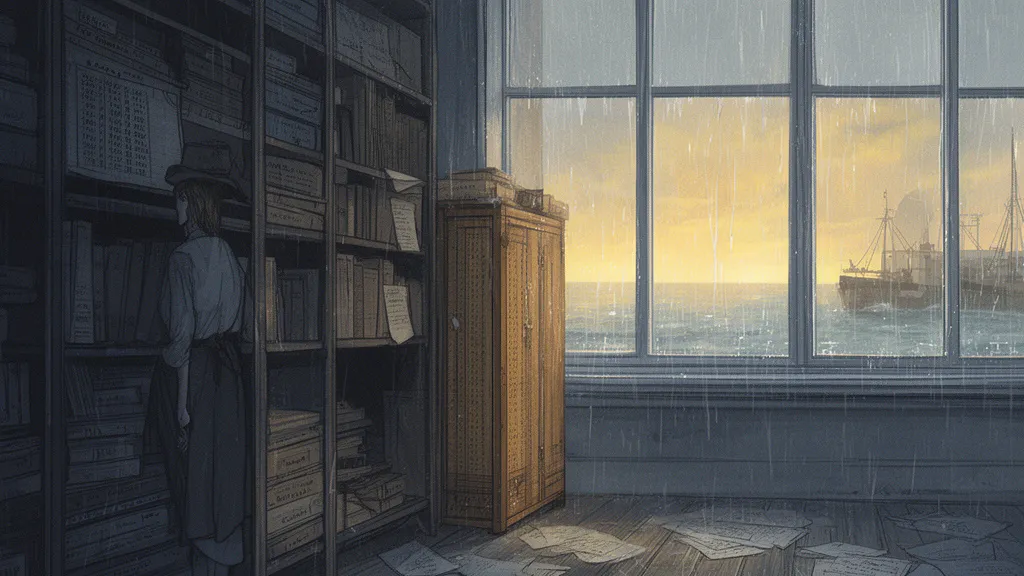
Mizuno Aki found the box because the rain had got into everything.
The municipal archive occupied the second floor of the old customs office, a stone building on the harbour road with windows that never quite shut. On wet days the place smelled of paper, salt, and a respectable defeat. Aki had spent the morning moving ledgers away from the north wall where the plaster darkened each winter, making small towers on a trolley and writing temporary location cards in her neat hand.
At eleven twenty, while shifting a shelf of fisheries permits from 1986 to 1991, she saw a narrow wooden crate behind the row, wedged flat against the wall as if the building itself had grown around it.
It was unlabeled, except for a cargo stencil almost worn away: Harbour Office.
Aki drew it out, coughing once at the dust. The lid had not been nailed down. Inside were bundles of receipts tied with cotton tape, each bundle wrapped in waxed paper gone soft at the corners. Dock receipts, she saw after opening the first packet. Berth fees, unloading charges, night mooring supplements, hand-stamped and signed in quick clerkly strokes.
All ordinary, until the time column.
2:17 a.m.
Aki turned over the next slip. 2:17 a.m. The next, the same. The stack covered different dates across one wet autumn three decades earlier, but the hour repeated with a devotion too exact to be accidental.
She sat on the low stool beside the trolley and read twenty-one receipts in silence. Vessel numbers changed. Amounts changed. Cargo descriptions varied in a modest way: fuel drums, repair timber, ice, lamp oil, groceries, one regrettable crate of ornamental tiles. Yet every one had been stamped at 2:17 a.m.
The last slip in the first bundle felt different between her fingers.
It was damp.
Not merely less dry than the others. Damp, cold at the edges, as if it had lately come from a pocket exposed to rain. Aki touched it to her wrist. The moisture smelled faintly of brine.
She looked at the window. Rain crossed it in bright slant lines. No one else was in the room. The inventory volunteer had gone downstairs for lunch; the assistant curator was home with influenza and principles.
Aki set the damp slip on blotting paper and read it carefully.
Receipt No. 4418
Night transfer fee
Vessel: Ferry service auxiliary launch
Account: Municipal emergency provision
Time: 2:17 a.m.
Destination code: H-3
Persons: 4
Initials: S.K.
Persons.
The other slips she had seen listed cargo. This one did not.
Aki untied the remaining bundles.
By noon she had made three piles on the table by type. Cargo. Fuel and berthing. Transfers. The transfers were few, only nine receipts in the whole crate, all stamped with the same hour, all using destination codes instead of wharf positions. H-1, H-3, K-2, M-1. Two slips listed one person, three listed two, one listed four. One had no number at all in the persons line, only a dash. That receipt was for a private launch she did not recognise, paid in cash.
The signatures varied. The stamp did not.
She was still arranging them when someone cleared his throat from the doorway.
Town clerk Nishida Osamu stood there with his umbrella hooked over one wrist and the expression of a man who believed doors should open before he reached them.
“Ah,” he said. “You are here.”
Aki looked up. “That is usually where I am.”
He accepted this without pleasure. Nishida was fifty, broad in the face, and immaculate in a way that made the damp seem a personal affront. “I spoke to Shibata an hour ago,” he said. “He told me he had brought something old from the harbour stores and left it where it might be found. He was being obscure in a self-satisfied manner, so I assumed he meant you would already have it.”
His gaze had already gone to the table. “You found something.”
Aki placed one hand lightly over the damp receipt. “Several somethings.”
“How fortunate.” He smiled with his mouth only. “May I see the box before you process it? Harbour accounts from that period should perhaps be returned to administration.”
That was wrong in two directions. First, records found in the archive remained in the archive unless accession proved mistaken. Second, harbour accounts had been under transport, not administration, even before the merger.
Aki said, “Why would Mr. Shibata tell you that?”
Nishida gave a small laugh that had not been rehearsed enough. “He wanted me to know he had done it. Shibata has a simple view of warning shots.”
He stepped farther into the room, still smiling. “Only a brief look. Before anything is misfiled.”
Aki had worked with records long enough to know that people lied most often when the object in question was small and made of paper. They lied as though paper were harmless. It had, in her experience, ruined marriages, elections, and one amateur choir.
She retied the damp slip into its bundle. “I haven’t logged provenance yet. When I have, you may submit a request.”
Nishida’s smile thinned. “This concerns municipal liability. I would prefer not to make a formal issue of it.”
“Then I recommend not making one.”
For a moment she thought he might try charm again. Instead he looked at the box with a frankness almost restful. Anxiety, then. Not greed. Not quite fear, either, but the strain of someone trying to keep a lid on an event that had swelled beyond its container.
“I should like to see it today,” he said.
“No.”
Rain rattled the window. Down on the harbour road, a truck changed gear with a noise like a complaint against God.
Nishida nodded once. “Very well. I will return before closing.”
When he had gone, Aki sat still long enough to hear his steps fade on the stairs.
Then she put the damp receipt in an envelope, locked the box in the map cabinet, and went to the ferry office.
The ferry office had been a ticket window once and was now a room for old notices to retire in. Schedules hung on clips by the counter, current ones at eye level and obsolete ones slowly descending toward the floor in archaeological bands. The harbourmaster’s deputy, Endo Fumie, was eating rice crackers and doing a crossword with professional resentment.
“Archivist,” she said. “If this is about the 1998 tide tables, I deny everything.”
“It’s about an old auxiliary launch,” Aki said. “And perhaps destination codes.”
Fumie lowered the cracker. “That sounds more interesting than guilt.”
Aki showed her the copy she had made of the damp receipt, not the original. Fumie put on her glasses, read it, and frowned.
“H-codes aren’t berths. Never were. Old emergency notation, maybe. During storm closures we used letters for fallback points.”
“Would the records still exist?”
Fumie snorted. “Exist, yes. Be findable, no. Unless you enjoy rooms where dead forms reproduce in darkness.”
“I do,” Aki said.
“That explains your profession.”
Fumie rose, swept cracker salt from her skirt, and led her into the back storage room. Here the paper smelled older and more marine. A rusted fan turned in a lazy circle without moving any air. They searched shelves of bound schedules and emergency plans while rain tapped on the corrugated roof with bureaucratic persistence.
Aki found the right folder because someone long ago had labelled it Temporary Routing, Ferry and Relief Boats, Autumn Storm Procedures and underlined Temporary three times, which was a habit of people whose temporary arrangements lasted years.
Inside was a stapled schedule from the same autumn as the receipts.
At 2:00 a.m., ordinary ferry service ceased in high weather. At 2:10, if the east quay became unusable, auxiliary launches were to move essential personnel and stranded passengers to designated shelter points. H-1 was the north fish warehouse loft. H-3 was the old net-mender’s hall behind the customs yard. K-2 was a private storehouse owned by Kadowaki Shipping. M-1 was the upper room of the Midori boathouse at West Inlet.
“Shelter points,” Aki said.
Fumie read over her shoulder. “During the flood year, maybe. We had two typhoons and one mayor with ideas.”
“Would four people in one launch be unusual?”
“Not at all. Depends who needed moving.”
“Moved from where?”
“From wherever the ferry couldn’t leave them.” Fumie looked at the receipt again. “That launch wasn’t for cargo. It was accounting after the fact. Making sure costs could be billed to emergency provisions.”
Accounting of who was moved where that night.
Aki asked, “West Inlet still has the Midori boathouse?”
“Has the boathouse. Does not have Midori. Not for years.”
Aki folded the schedule into her notebook. “Thank you.”
Fumie tilted her head. “If you are going to a collapsing structure in this weather, at least wear better shoes.”
“I own sensible shoes.”
“You archive in them. Different matter.”
By the time Aki reached West Inlet, her tea from lunch had gone cold in the flask and her coat hem had absorbed half the town.
The inlet lay beyond the old breakwater where the houses thinned and boat sheds stood with their backs to the wind. The Midori boathouse was larger than the others, painted once in green that the salt had argued into grey. One sliding door hung crooked. Nettles grew through the cracked concrete apron.
The steps to the side entrance were slick with rain.
On the second step stood a single red rainboot.
It was a child’s boot, though not for a very small child. Rubber, bright even in the weather, turned slightly inward as if waiting for its pair to return from some brief errand. Mud clung to the sole. The boot was dry inside.
Aki looked at it for a long moment before trying the door.
Unlocked.
Inside, the boathouse smelled of rot, rope, and tidal weeds. Light came through gaps in the boards. A loft platform ran along the rear wall above old racks for nets. There were marks in the dust on the ladder rungs. Recent.
Aki climbed.
The upper room had once served as a shelter exactly because it could be shut against weather. Someone had swept part of the floor clean not long ago. In one corner stood a paraffin stove, empty. Beside it lay a folded army blanket and a cardboard cup from the station vending machine, less than a week old. On the wall, in pencil, a list of dates had been written and rubbed away, written and rubbed away again until only pressure marks remained. Near the window she found a small ledger page weighted under a shell.
It was not old.
A list of names, five in all, with arrows and dates beside them. Two surnames had been crossed out. Three remained. No explanations.
Aki knew one of the crossed-out names at once. Sato Kiyoshi, former assistant harbour clerk.
The initials on the damp receipt: S.K.
She folded the page and put it into her notebook just as footsteps sounded below.
Aki did not freeze. She had never seen the point. People in stories froze and were discovered because suspense required poor circulation.
She moved to the top of the ladder and looked down.
The person entering was not Nishida. It was Honda Reika, teacher at the middle school and, on Saturdays, conductor of the town wind ensemble, whose members obeyed her with the alarmed devotion of people who had once missed a downbeat and lived to regret it.
Honda looked up, saw Aki, and shut her umbrella with a click sharp enough to be punctuation.
“I was hoping,” she said, “that no one would be here.”
“You have been disappointed early,” Aki said.
Honda’s gaze went once around the interior, landing at last on the ladder, the loft, and Aki’s notebook. “Did the clerk send you?”
“No. Did he send you?”
The answer was immediate and sincere. “Certainly not.”
That ruled out collusion and suggested irritation, which was often more useful.
Honda climbed halfway up the ladder and stopped. She was in her forties, handsome in the severe way some people acquire by expecting nonsense and often receiving it. Rain had darkened her hair at the temples.
“That room should have been emptied years ago,” she said.
“Why wasn’t it?”
“Because people avoid old arrangements when they have profited by forgetting them.”
Aki considered this. “Who wore the red boot?”
Something changed in Honda’s face; not surprise, but fatigue meeting memory. “You saw it.”
“It is difficult not to.”
Honda came the rest of the way up and stood in the loft without asking leave. “My younger sister. On the storm night. She was eight.”
Aki waited.
“She lost one boot here,” Honda said. “Or perhaps someone removed it later and put it on the step for drama. This town has always had a theatrical streak in petty matters. In serious ones, it prefers accountancy.”
She saw the folded page in Aki’s hand. “And now you have found one of their lists.”
“The receipts suggest people were moved to shelter points at 2:17 a.m. Repeatedly. Not hidden cargo. People.”
Honda laughed once, softly. “Of course people. What else is ever hidden?”
Aki asked, “What happened that night?”
Honda looked out through the cracked window at the inlet, the rain, the narrow strip of black water moving under the wind. “The official story was flood management. Ferry disruption. Emergency lodging. All technically true. The unofficial matter was a councillor’s son and a fisherman’s son and a boarding-house maid who had seen too much and said so while drunk. Also a woman from the Kadowaki warehouse office who was six months pregnant and not married to the man responsible, though half the town had nominated candidates.”
Aki said nothing.
Honda went on. “Storms are useful. Doors close. Boats move. People disappear from one place and emerge in another with a receipt to justify the petrol. By morning stories have aligned themselves.”
“Your sister?”
“She was with our mother at the ferry office. They were moved here because the lower road had flooded. That part was innocent. But she saw who else was brought in and who was taken out before dawn. Children remember with offensive accuracy.”
“And later?”
“Later she mentioned names.” Honda’s mouth flattened. “Our mother was advised that the child was imaginative and the family should avoid embarrassing reliable men during a civic emergency.”
Reliable men. Aki could imagine the phrase spoken in three committees and a corridor.
“Why come here now?” she asked.
“Because Nishida asked after old shelter logs yesterday.”
Aki felt the shape of the answer before it arrived. “And he should not have known where to ask unless he knew they existed.”
Honda nodded. “His predecessor handled some of the transfers. Nishida was a junior clerk then. He fetched papers. He remembers too much of other people’s tidying.”
The rain intensified, drumming on the roof. Aki took out the damp receipt and the copied schedule, laying them on the clean patch of floor between them.
Honda’s eyes narrowed at the moisture stain. “That was not damp thirty years ago.”
“No. Someone put it in the box recently.”
“To warn you?”
“Or to direct me.”
They both looked at the list of names.
Not a contemporary movement log, Aki thought. The dates and arrows were too sparse for that, and the crossed-out names too final. A retrospective list, then: someone had set down the names of those caught in the storm-night rearrangements and marked, later, what became of them. Who had been sent away, who had died, who remained. The three uncrossed names still in town.
One of them, she suspected, was not a victim.
Back at the archive, Nishida was waiting outside the reading room with the patience of a man listening at a locked cabinet.
“It is after four,” he said. “You have had the day.”
Aki set her wet umbrella in the stand. “And used it well.”
He followed her into the records room. “I will need that crate now.”
“No,” she said, opening the map cabinet. “But you may answer questions.”
His eyes went at once to the envelope containing the damp receipt. That did more for her than a confession might have.
“You knew there were transfer slips in the box,” Aki said. “Because someone put one there recently. It was not hidden behind a shelf for thirty years and still wet from the sea.”
Nishida said nothing.
“You did not put it there to conceal theft,” Aki went on. “There was no theft to conceal. The receipts are for emergency accounting of persons moved during the flood night. People whose presence in certain places needed to become presence in other places before morning.”
His face remained careful, but his shoulders changed first; a small descent, as if he had been carrying a tray no one could see.
“The schedule gave me the codes,” Aki said. “The boathouse gave me the shelter room. Teacher Honda supplied the human tendency.”
At the mention of Honda, Nishida shut his eyes briefly. “Of course she did.”
“She is not, I think, the one who dampened the slip.”
“No.” He opened his eyes. “That was Shibata.”
Aki searched the name. “Caretaker at the old net-mender’s hall?”
“He was a launch hand then. He found the box in a harbour cupboard during renovation. He brought it to me because he knew what period it was from. I told him to leave it. He did not trust me enough to obey, which was sensible of him.”
“And instead he put one slip where it would be found.”
Nishida gave a humourless smile. “With seawater from a bucket, apparently. He has always believed subtlety is a vice of the educated.”
Aki almost liked Mr. Shibata at once.
She said, “Why now?”
Nishida took off his glasses and dried them although they were not wet. “Because Kadowaki is dying.”
The shipping owner, eighty-three, still occupied the front pew at civic funerals and the back room at contract discussions. Aki had seen him once fall asleep during a school brass recital and wake in time to criticise tempo.
“He wanted a private history written for the family,” Nishida said. “Old papers were being reviewed. Names resurfaced. So did liabilities. Not legal ones, perhaps. Human ones.”
Aki thought of the pregnant warehouse clerk, the councillor’s son, the fisherman’s son, the boarding-house maid. Also the matter-of-fact precision with which a town could relocate a scandal if given boats and bad weather.
“And the list in the boathouse?”
Nishida looked up sharply. “You found that.”
“Yes.”
“That was made later. Years later. By someone trying to keep track of who had been protected and who had paid for the protection.”
“Who?”
He hesitated, and in that pause Aki heard the true shape of the fear at last. Not exposure of the dead. Injury to the living.
“The boarding-house maid,” he said. “Tsuda Emi.”
Aki knew the name only dimly. “She left town.”
“She did. After Kadowaki arranged money and silence and a husband for the pregnant clerk, after the councillor’s son was sent to Sapporo to study accountancy with curative speed, after the fisherman’s son was entered on a crew list for a boat that had already sailed and thereby became absent with paperwork. Emi stayed long enough to understand how it had all been done. Then she left.”
“And came back?”
“Last month. Dying, I am told. She asked Shibata to make sure the records were not lost.”
That settled the dampness. Sea water as emphasis, not message. Pulled from the sea, because the sea had been the town’s oldest accomplice.
Aki said, “The list is not of the night itself, then. It is Emi’s later accounting. The names of those entangled in it, with dates for what became of them after. The crossed-out two are gone. The remaining three are here.”
Nishida nodded. “Yes.”
“To protect whom?”
Nishida laughed then, softly and without mirth. “You make it sound nobler than it is. I wanted time to decide whether any good came of preserving a complete map of old cowardice.”
“And did it?”
He put his glasses back on. “No. But some accuracy might.”
Aki laid out the receipts in chronological order. There were enough now, with the schedule and Honda’s account and Nishida’s weary honesty, to reconstruct the night in plain steps.
Storm closure. Last ordinary ferry cancelled. Stranded and inconvenient persons gathered under the broad category of emergency provision. Auxiliary launch sent from quay to quay. Four to H-3, among them Honda’s mother and sister, and at least one person not meant to be observed. Two to K-2, where private storage became temporary refuge and private influence became policy. One to M-1. Another transferred off the public route entirely by cash-paid launch. Every movement entered at the same hour because the forms had been completed later, in a batch, to create one