The Map in Varnish
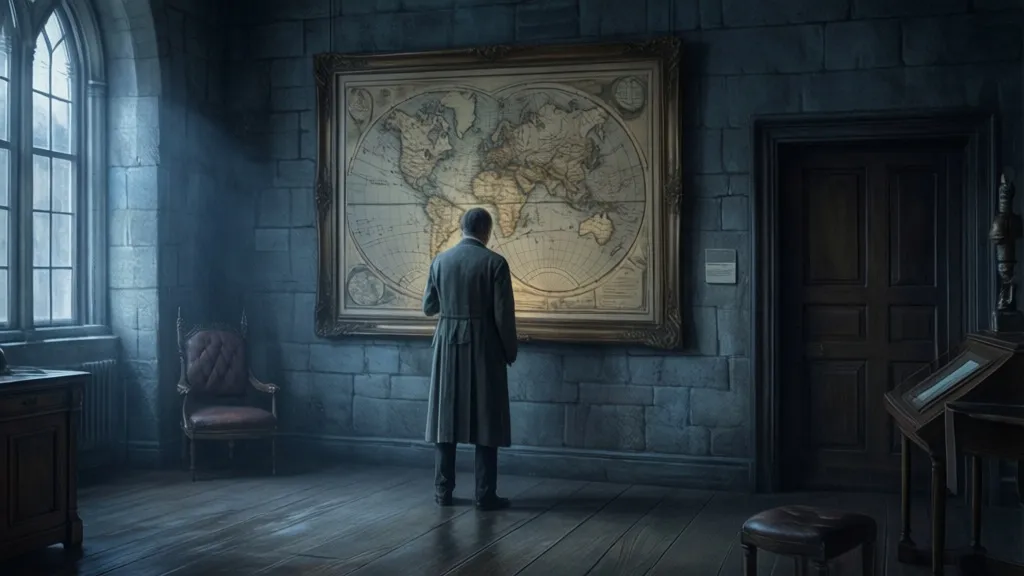
At eight-twenty, before the front doors were unlocked and while the galleries still held the sour-cool breath of night air and stone, Aya Nonomiya stopped in the City History Room and knew at once that something had been moved.
It was not the sort of knowledge one could explain to people who hung pictures by eye. The framed map on the east wall sat level, the brass hooks were in place, the cream mount was unmarked, and the glass held the same soft milkiness from old cleaning cloths. Yet the whole object had the look of a sentence copied out by someone with excellent handwriting and no understanding of grammar.
Aya set down her satchel on the bench and stepped closer.
The map was the Tenmei-era plan of the city, the museum's modest pride, less valuable than the lacquer screens upstairs but more beloved by local visitors, who liked to stand before it and point out where their family shops had been before fire, war, roads, and ambitious men. A faded coffee ring marked the lower right corner beneath the varnish, not on it, as if someone had once set down a cup while the sheet lay flat in a studio. Near the river district, a hairline split ran through the old varnish and stopped just before a bridge name. Aya knew these defects as one knows the position of furniture in one's own dark room.
They were present.
That was the problem.
She leaned in until her breath dimmed the glass. The foxing on the paper was right. The hand-colour wash on the embankments was right. The tiny worm-track near the northern gate was right. Someone had copied not only the map but its injuries, and had done so with a patience that bordered on devotion.
Behind her, the outer corridor door banged softly.
"Aya-san?" called Sano from security. "You wanted the humidity logs from yesterday."
"In a moment," she said.
She did not move. Her eyes had settled on the bottom margin, where the framer's old backing board concealed the sheet's edge. The exposed strip of paper was one millimetre wider on the left than she remembered. Not much. Enough.
Sano came in, carrying a clipboard and looking already apologetic, which was his habitual morning expression. "Something wrong?"
"Possibly." Aya straightened. "Did anyone enter this room after the galleries were cleared?"
Sano blinked at the wall, as if hoping the answer might be written there. He was a narrow man in his sixties, retired from something respectable and slightly military. In museums, such men became security guards because they enjoyed keys. "Cleaning finished at six-thirty. I did the west wing lock check at seven-ten. No alarm overnight."
"Any contractors?"
"No."
Aya nodded. That meant little. Absence in a logbook was often only absence in handwriting.
She took the clipboard from him, though she did not read it yet. "Please don't let anyone in here until I say so. Not staff, not docents, not board members who arrive early to feel useful."
Sano, who had encountered the board before, accepted this without argument.
She put on her cotton gloves, unlatched the frame from the wall, and carried it to the central table. Sano inhaled, but he did not offer help. He had once learned that conservators preferred people to be anxious at a distance.
The backing paper had been opened and resealed. Cleanly, but not with the museum's usual starch adhesive. Aya bent to the line and caught, faintly, the smell of something resinous and sweet.
"Shellac," she said.
"Is that bad?"
"It is informative."
She cut the paper seal at one corner and lifted the backing board. Inside, between mount and sheet, lay a folded square of ordinary accounting paper.
Not a note. Not a demand. Not even anything theatrical enough to be insulting.
It was a torn fragment from a ledger page, with the ruled lines and blue-ink column headings still visible. Most of the writing was gone with the missing portion. What remained was one date from twenty years earlier and the museum accession prefix, M-17, followed by the beginning of an object description: Map, city plan, restored—
Below that, where there should have been an acquisition or treatment reference, there was only a jagged edge.
Aya looked at it for a long moment.
Sano said, carefully, "Should I call the director?"
"Yes," she said. "And bring me the collections movement ledger for 1999 to 2005, if records have not sent it to storage. Also tea. No, don't bring tea. I withdraw the request."
"Right," said Sano, relieved to have failed safely, and went out.
Aya set the torn paper aside. On the reverse of the map frame, pencilled in a hand she knew, was the notation from the last reframing twelve years earlier. The frame itself was the correct one.
Which meant the exchange, if exchange it was, had been made with access, planning, and time enough to imitate defects hidden under glass.
By opening time, half the museum knew something was wrong, which was ordinary. Museums contained more gossip than dust, though only slightly. By ten-thirty the director, the head of education, one registrar, a cleaner who had no business being there, and Mrs. Kuroda from the board had all looked in at the doorway, acquired expressions, and left again.
Mrs. Kuroda remained.
She stood beside the central table in a navy suit with pearl buttons large enough to have convictions. "This is theft," she said. "There is no merit in diffidence. Call the police before the insurance people hear of it from someone else."
Aya, who was examining the frame rebate with a loupe, said, "If I call the police now, they will walk through the building before I know what to ask them to look for. I would prefer to know that first."
"A stolen object."
"Possibly. Or a changed record. Those are different inconveniences."
Mrs. Kuroda disliked Aya's manner for the same reason many people did: it implied that panic was an aesthetic choice. "You are not suggesting this may be a clerical matter."
"No. Clerical matters are usually much worse."
The director, who had come in sweating gently, made a helpless sound. He was not built for crisis before lunch.
Before Mrs. Kuroda could continue, Sano returned with a man in a brown summer suit, silver-haired and thin in the particular way of someone who had spent years outdoors and later complained about municipal drainage. He carried a hat and a walking stick he did not appear to need.
"This is Mr. Takamine," said Sano. "He said he had an appointment with education, but then he saw..."
Mr. Takamine had already crossed the room and was peering at the map on the table. "Who took it out?"
"I did," said Aya.
"Good. Glass distorts the line." He bent lower, his face tightening. "Hm. You say this is a copy?"
Mrs. Kuroda answered before Aya could. "Our conservator believes so."
"Then your conservator is perhaps half right and half late." He pointed with one bony finger, not touching the paper. "There. South of the old canal warehouse lot. Do you see that pale abrasion?"
Aya saw it: a rubbed speck in the wash, no larger than a sesame seed.
"An erasure," said Takamine. "Of a surveyor's correction mark. Three slanted strokes and a dot. We used them on provisional parcels in the old municipal office before they standardised forms. Very few people read them properly now, because very few people then wrote them properly. I did. So did Horie. And Horie made this notation on the original map in 1983, after the exhibit committee borrowed it for a property-lines display and someone asked us to verify one district boundary. He erased it again because the map was not to be altered. He erased badly." He looked up. "If that abrasion is present, this is the original."
The room became still in the disagreeable way of a corridor after dropped crockery.
Aya said, "You are certain?"
"As certain as one can be of other people's incompetence. The mark sat under magnification at this angle." He shifted his head, and the light caught. For one second, faint as breath on lacquer, three slanting furrows and a point appeared in the rubbed patch.
Aya felt the day's puzzle alter shape.
If Takamine was right, then either the map on the table was indeed the original and someone had removed the copy, replacing a long-standing substitute with the thing it imitated—or Takamine had been led, by memory and vanity, exactly where someone wished him to look.
He glanced around the room, taking in their expressions with dry satisfaction. "It is extraordinary what institutions lose by recording only what flatters them."
Mrs. Kuroda drew herself upright. "This is intolerable. Director, I insist—"
Aya interrupted. "Mr. Takamine, when did you last examine the map closely?"
"At least fifteen years ago. Perhaps more. My knees have become bourgeois."
"And who would know about this erased mark?"
"Anyone to whom I told the anecdote, if they listened. That excludes most committees." He considered. "Horie, naturally. He is dead. Two men in records from those days, both dead. Your former curator Miyama, who borrowed documents promiscuously and returned them less so. A young assistant then—Fujita? No, Furuse. She married. And perhaps the restorer working that year, though I doubt he cared for municipal scribbles."
Aya's eyes moved to the torn ledger fragment. A missing entry. A treatment reference. Twenty years.
"Thank you," she said. "Would you mind staying in the building for a little while?"
"I mind many things," said Takamine, "but not that." He looked at the wall where the map usually hung. "If someone has stolen a theft, I should like to know how elegant they were."
The records room lay in the basement, where all museums stored both their paper and their shame.
Aya sat at the long table with the movement ledgers, accession books, and conservation treatment binders arrayed around her. Beside her cooling elbow stood a cup of tea Sano had delivered despite clear instructions. It had reached the stage at which it was neither hot enough to console nor cold enough to ignore. She drank it anyway.
The accession book listed the Tenmei map as donated by the Ishiwata family in 1974. The movement ledger showed routine transfers to exhibition, reframing, and one conservation treatment in 2003 under an internal code: CR-218. The conservation binder for 2003 had numbers CR-217 and CR-219 adjacent, both present. Between them was a clean gap where a file had been removed so neatly it seemed almost courteous.
The movement ledger, however, had a different discourtesy. On the line for the map's transfer to conservation in March 2003, the outgoing signature remained, but the return entry—date, initials, destination—had been cut out with a blade and the fibres pressed flat.
Aya ran a fingertip over the incision through her glove.
Someone had not simply forgotten to write something down. Someone had taken away the proof that the map came back.
She asked records for staff files from that year. The clerk, who adored irregularities provided they happened to other departments, brought them with gratifying speed.
Miyama, then curator, retired. Furuse, assistant registrar, now Mrs. Hanai, part-time in education two mornings a week. Restorer on contract: Keisuke Nitta.
Aya closed her eyes briefly. Nitta still worked in the building three days a month on paper repairs and frame maintenance. He was upstairs at this very moment preparing materials for a screen-mount assessment.
She did not rush. Rushing made other people feel competent.
She took the ledger fragment from her pocket and held it against the light. Along the torn edge there remained the lower half of one character. Enough to be useless to most people. Enough, perhaps, if matched.
At eleven-fifty, she found Hanai in the education office arranging handouts for a school group she would later attempt, heroically and in vain, to interest in ceramics. Mrs. Hanai had the calm, glossy look of a woman who had once been beautiful enough to produce stories and had decided to keep none of them.
"Do you remember the map treatment in 2003?" Aya asked.
Hanai's hands paused on the paper stack. "The city plan? Barely. We had roof leaks that spring. Everything smelt of buckets."
"Did it leave conservation and return to display normally?"
"I signed outgoing forms then. Return signatures were usually the receiving department." A small smile. "Usually, paperwork was whichever person still felt guilty at four in the afternoon."
"Do you remember Nitta?"
"Of course. He was impossible not to remember. He flirted with glue pots."
Aya waited.
Hanai looked down. "He and Miyama quarrelled. About attribution, I think, and money, which is attribution translated for administrators. Nitta said the museum wanted miracles on a stationery budget. Miyama said Nitta padded hours. Both were probably right."
"Anything else?"
The smile altered by a degree. "Miyama was very fond of dramatic rescues. He liked to 'discover' problems just in time to solve them. It made committees grateful." She added, matter-of-factly, "He was also in love with Nitta for six months, or believed he was, which is much the same in practical terms. Nitta was kind enough not to laugh, and unkind enough not to leave."
Aya thanked her and went upstairs.
Nitta worked in the paper lab with the windows cracked for ventilation. Even before she entered, the resin-sweet smell reached her. Shellac.
He stood at the bench in apron and spectacles, sixty now, elegant in the way of men who had once been dangerous to themselves and had since become expensive. A frame lay before him face down. On a side trolley sat a small jar of fresh shellac, a brush, and strips of backing paper.
"Aya-san," he said. "I hear your morning has become theatrical."
"Only second act." She looked at the jar. "Have you recently resealed a frame?"
"Three, last week. Labels were lifting." He saw where she was looking and smiled faintly. "If this is about the map, you should know half the building uses my materials and none of them close lids."
"Did you treat the Tenmei map in 2003?"
"I did many things in 2003. Most of them underpaid."
"Did you replace it?"
His expression did not change. That itself was interesting. Most innocent people became indignant too quickly or amused too early. Nitta became attentive.
"With what?" he asked.
"A copy." Aya placed the torn ledger fragment on the bench between them. "And if you did, was it last night or then?"
He glanced down once. "A very neat question. I assume you have found something untidy."
Aya said, "The map in the gallery bears an erased municipal correction mark that Mr. Takamine believes existed on the original. The return entry from conservation in 2003 has been cut from the movement ledger. The treatment file CR-218 is missing. This morning I found this fragment behind the frame. It comes from that missing line. Someone wanted me to know the record had been altered, but not by whom."
Nitta removed his spectacles and set them beside the shellac jar. Without them, his face seemed suddenly older and less composed. "Did Miyama send you?" he asked.
"Miyama is retired in Kanazawa. I doubt he sends anyone anywhere."
"Pity. He enjoyed dispatching women to do what he feared doing himself."
Aya let the sentence lie. People often told the truth while aiming at a different target.
Nitta turned the ledger fragment over with one finger. "If Takamine saw the erased mark, then he is right. That sheet is the original."
"So a copy hung there for years."
"Yes."
"Why?"
He looked past her shoulder toward the corridor, as if estimating whether confession improved by witnesses. "Because in 2003 Miyama spilled coffee on the original while reviewing labels after hours. Onto the lower corner. He then attempted to wipe it, which spread acids through the paper and lifted old varnish. When he brought it to me the next morning, he wept. I should add that he was not weeping for the map."
The coffee ring. The varnish split. Aya said nothing.
"The damage was ugly but repairable," Nitta went on. "Not invisible, not at our budget. Miyama was in the middle of soliciting board donations for the gallery refurbishment. He said if the board learned he had damaged the museum's most popular object through vanity and fatigue, he would be ruined. This was not wholly false. He asked whether I could stabilise the original and meanwhile display a facsimile. We had already commissioned a photographic reproduction for study use. I told him any facsimile would need clear marking on the reverse and temporary authorisation. He agreed to everything. People agree magnificently when frightened."
"But the records were cut."
"Not by me." Nitta's mouth hardened. "I mounted the facsimile in the original frame after copying every visible defect, because visitors notice absence more than substitution. I expected it to hang for two weeks. Then Miyama said the board was calmer, the copy sufficiently accurate, and replacing it again would only invite questions. He meant his questions. I argued. He reminded me I was contract staff and had not been paid for two invoices. We settled, like cowards, on silence."
Aya said, "And the original?"
Nitta gestured toward the racks at the far wall. "In this building, hidden in plain sight, exactly where bureaucracies hide what embarrasses them. Flat file seven, drawer C, under oversize reproductions and failed exhibition mounts. Wrapped as 'teaching facsimile—harbour charts.' I looked at it every few years and told myself I was waiting for the right director. This is an explanation, not a defence."
Aya stood very still.
"Last night?" she asked.
He gave the smallest shrug. "Mrs. Hanai telephoned me yesterday. She had found, while clearing old education papers, a carbon note from 2003 asking for copy labels to be printed for a 'temporary facsimile pending treatment.' She recognised the map accession prefix. She thought, correctly, that I would know what it meant. I came after closing with my key, took the original from storage, and put it back on the wall. I left the ledger fragment because if I did not force the issue, I might die respectable and still not have corrected it. The shellac was mine. I resealed the backing. Not elegantly enough, it seems."
Aya said, "Why not simply tell me this morning?"
"Because I wanted the object found before the shame. Also," he added, with a dryness she almost respected, "I was deciding whether to lie better."
She looked at him, at the shellac, at the bench ordered with a restorer's impossible neatness. The motive was comprehensible enough to be disappointing: not greed, not grand conspiracy, only a chain of vanity, fear, loyalty, and delayed conscience. The sort of thing institutions were built to preserve more carefully than paper.
"Show me the original storage wrapping," she said.
He did.
The drawer held an empty package labelled in Miyama's hand. Inside the folded tissue, a ghost rectangle of dust showed where the frame had once rested. There was also, tucked between support boards, the missing conservation file CR-218. Nitta had not taken that last night; the paper edges were yellowed evenly, and the file had been hidden there for years. Inside lay treatment notes describing coffee staining to lower right, partial varnish cleavage near river district, recommendation: display facsimile temporarily during humidification and infill; original to return after board notification.
It had never returned.
At one-thirty, in the City History Room, Aya explained it all to the director, Mrs. Kuroda, Sano, Mr. Takamine, and Mrs. Hanai, who had come and stood by the door with the expression of someone listening to weather long predicted.
Aya did not dramatise. She set out the sequence as one laid tools in order.
Miyama damaged the original in 2003 with coffee.
Nitta treated it and made a facsimile for temporary display, copying the ring and varnish split so visitors would not notice abrupt change.
Miyama, fearing scandal, left the facsimile on the wall and removed the return record and treatment file from ordinary circulation.
The original remained in a storage drawer under a false label.
Yesterday Mrs. Hanai found a note that revived the matter.
Last night Nitta replaced the facsimile with the original and left the ledger fragment behind the frame to force discovery.
"So," said Mrs. Kuroda after a silence sharpened by outrage, "the object was not stolen last night. It was concealed twenty years ago."
"Yes," said Aya. "And restored to view last night without authorisation."
Takamine gave a small sound that might have been laughter and might have been contempt; with him the distinction was decorative. "How municipal," he said.
The director had gone pale in a conscientious way. "Do we call the police?"
Aya looked at the map on the table. The original, with its faint erased surveyor's mark and old badly mended wound, lay under clean paper weights. Beside it rested the facsimile, excellent enough to have fooled a room full of professionals until one retired surveyor brought his stubborn memory to bear.
"For what present crime?" she asked. "An unauthorised entry by a keyholder,