The Painted Door
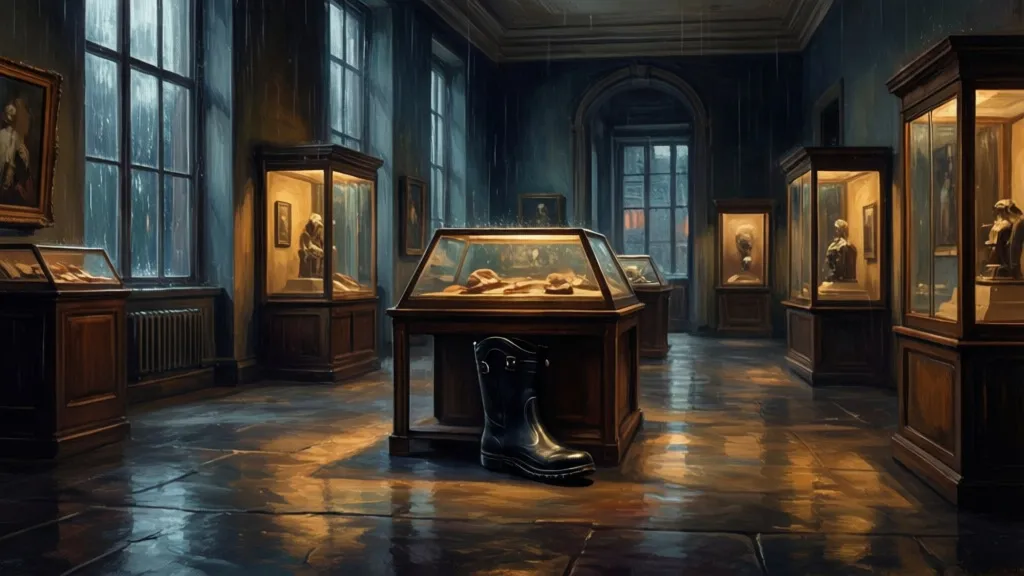
At six-fifteen, while the museum was closing itself in stages like a careful old woman fastening buttons, Sato Emi bent to retrieve a child's dropped brochure and saw the boot.
It lay beneath the long glass case in Gallery Three, one black rubber boot on its side, a bead of rain still bright along the sole. The gallery lights had been dimmed to evening level, which made the object look more intimate than alarming. A forgotten thing always looked personal. Theft, when it happened in museums, looked absurd.
Emi straightened and stood still.
Outside, rain tapped at the high windows. Inside, Gallery Three held lacquer screens, ironwork, and one central case that, until noon, had displayed the Natsume Mirror — polished bronze, eighth century, cloud pattern around the rim, the museum's current pride and tomorrow morning's donor bait. The label remained in place beneath the empty mount. It was possible to remove an object and leave a label; institutions did it constantly. It was less common to leave a wet boot.
She crouched again, this time without the brochure. The case was locked. She knew because she had checked it at four, and because she could see the brass tongue of the lock seated cleanly. The boot was three feet inside the perimeter of the case's base, where no visitor's hand could have pushed it.
Her own shoes made no sound on the waxed floor. She called toward the doorway. "Kobayashi-san?"
No answer. Gallery Three had the attentive hush of rooms designed for expensive silence.
Emi took out her key ring, unlocked the case, and slid back the glass panel. The smell that came up was dust, metal, and damp wool. She reached in and picked up the boot. It was small, perhaps a woman's or an adolescent's, black with a red lining. Cheap. Wet along the toe and heel, dry at the calf. Mud clung to the tread in a fine brown paste.
She set the brochure on the empty mount, put the boot beside it, and looked at the mirror's absence in the way she might have looked at a missing tooth in someone else's smile. There was no immediate blood, but one felt a dislocation.
The logbook at the security desk was as neat as ever. Visitor count by hour. Staff sign-ins. Gallery checks. The line for Gallery Three showed routine entry at noon by Curator Takeda Jun, Registrar Imai Keiko, and conservator Fujimori Ritsu. Object movement notation: Natsume Mirror to Conservation, 12:10. Initials: JT.
After that, no entry until Emi's own check at four. Then closing sweep at six-fifteen.
"If it went to Conservation," Kobayashi said, peering over her shoulder, "why are you looking like that?"
Kobayashi supervised the evening guards with a degree of tragedy not justified by the work. He was a broad, patient man who wore his tie as though it had insulted him. He looked at the log, then at the boot on the desk.
"Because," Emi said, "it is raining now. It did not begin until after three."
Kobayashi considered this. He was not stupid; he simply preferred a slower route. "So the boot came in after three."
"Into a locked case."
"Perhaps someone dropped it there at noon and it only became wet in spirit."
She gave him a look.
"Fine," he said. "We ask Takeda. Politely. Before he begins to act as though the museum belongs to his ancestors."
Curator Takeda was in his office on the second floor, standing over layout proofs for tomorrow's donor preview catalogue with the despair of a man betrayed by margins. He was elegant in a starched way, silver at the temples, with a voice that made ordinary statements sound like corrections.
When Emi placed the boot on his desk, his eyebrows rose first in irritation, then in something smaller and quicker.
"What is this?"
"Found inside the mirror case at closing," she said. "The mirror is gone. The log says you moved it to Conservation at twelve-ten."
Takeda looked at the boot as though it were an undesirable insect that had nevertheless arrived by appointment. "Yes. The mirror was moved. Hairline instability in the backing. Fujimori recommended immediate assessment."
"Then why is the mount still in place?"
"Because the gallery team was occupied. The room was not reopened." He tapped the log with one finger. "You have the record there."
"And the boot?"
"I cannot account for every stray object in the building, Sato-san. Must I?"
Kobayashi shifted very slightly. Emi had seen him stare down drunken visitors, but curators made him cautious.
"I would like to verify the move," she said.
"By all means. The mirror is in Conservation. Or rather, if Fujimori has already transferred it to the secure workroom, it is in the secure workroom. I am trying to save tomorrow morning, not ruin this evening." He reached for the boot with two fingers and then thought better of it. "Have Housekeeping remove that."
He was lying.
Not because of anything dramatic. Not because his voice shook. It was smaller than that. He had said the mirror is in Conservation in the present tense, and then repaired the sentence into possibility. People did that when they hoped one of their statements would prove true by the time anyone checked.
Emi and Kobayashi went downstairs again. The rain had strengthened. In the long corridor beside Gallery Three, a draft moved faintly along the floor.
"Conservation first?" Kobayashi asked.
"In a moment."
She turned instead into Gallery Three with the boot in one hand.
The room was empty now, its final visitors gone. Evening light pressed dimly at the window wells. She replaced the boot beneath the case and stood where she had first seen it. From there the line was visible, once she knew to look: three faint brown marks on the pale floor, then a pause, then another, each no larger than a thumbprint. Mud, diluted by water. Not enough for a trail if one expected one. Enough if one had already been irritated into attention.
The marks led away from the case.
Not toward the loading bay corridor where objects moved in and out under signatures and foam packing and institutional anxiety. Not toward Conservation.
Toward the narrow staff door in the northeast wall.
The door had once connected Gallery Three to an old service stair. It had not been used in years. During the west wing repainting, before Emi joined the staff, the museum had covered it in the same pale grey as the wall. The outline remained visible only because old wood and plaster held paint differently. Its brass plate had been removed; its knob painted over; a rope barrier and a tall celadon jar on a stand had been placed nearby in the decorative spirit of pretending function had become history.
Emi approached. The jar was six inches away from the wall, not touching it. She did not remember whether it had always been six inches away.
The paint line around the doorframe had a hair-thin crack along the latch side.
She touched it. The surface was tacky in one place, dry everywhere else.
"Well," Kobayashi said softly. "That is unpleasant."
Emi crouched, set the boot down, and looked at the floor by the threshold. More mud there, but smeared, as if a foot had twisted. Near the bottom edge of the door, the grey paint had flaked in a tiny crescent, exposing older cream beneath.
She stood and glanced at the case, then at the door, then back. The room arranged itself in her head not as furniture but as movement.
If someone had used this door today, then the room had opened after noon without entering by the main gallery doors. If the mirror had not gone to Conservation, then either it had gone through this painted door or the boot had, inconveniently and independently, committed its own mystery.
The second possibility had little style.
Conservation occupied two rooms at the rear of the building and smelled of paper, solvent, and moral superiority. Fujimori Ritsu was there alone, sleeves rolled neatly, examining a cracked lacquer box under a lamp. They had the cool, alert face of someone who had learned that people were more manageable when they underestimated how much was being noticed.
"The Natsume Mirror?" Fujimori repeated. "No, it never came here."
Kobayashi exhaled through his nose with quiet drama. Emi held up the logbook.
"Curator Takeda entered this."
"Then he entered a fiction." Fujimori looked at the page and did not seem especially surprised. "He told me at noon that he might need my opinion later. I have not seen the mirror since this morning."
"Would he know where the old service door from Gallery Three leads?"
"Everyone knows where it leads. The old catalogue stair. It is full of framed reproductions no one can throw away." Fujimori's gaze shifted to the boot. "Ah. There is weather in this story."
The museum director, summoned from a dinner she had not yet begun to enjoy, arrived at seven-ten and became angry with enviable efficiency. Director Hasegawa was small, controlled, and visibly deciding which catastrophe would be cheapest. When Emi showed her the painted door and the absent mirror, she said nothing for several seconds.
"Tomorrow at nine," she said at last, "forty-two donors will be given coffee and the illusion that culture depends on them personally. The mirror cannot simply be gone. Open that door."
Facilities sent for tools. While they waited, Takeda was brought down from his office. He maintained, with diminishing grace, that the mirror had been moved for precautionary reasons and that some clerical confusion had followed.
"Then where is it now?" Hasegawa asked.
"I am trying to determine that."
"By standing here?"
There was pleasure in watching certain people be addressed plainly. Emi did not show it.
The maintenance man, Nakano, arrived with a knife, a screwdriver, and the expression of one invited to witness family disgrace. He cut the paint seam first. The sound was slight, almost tender. Then he worked the latch. The door resisted, then gave with a breath of stale air.
Beyond was a narrow landing and a steep service stair descending into gloom. Dust furred the corners. Against the wall leaned old exhibition panels, crates, and a rolled carpet tied with cord. On the top stair lay three more muddy marks.
No mirror.
"Lights," Hasegawa said.
The switch at the landing worked after a protest. Yellow bulbs showed the stair down to the basement corridor, where a second door stood ajar.
Emi went first. The mud marks continued, clearer now on the concrete steps, one full tread from the little boot, and beside it broader smudges from a man's leather sole. Two people, then. Or one carrying the boot. No — the spacing was wrong. Two.
In the basement corridor the air was cooler. Storage rooms lined one side, all locked except the old photography studio at the end, now used for overflow packing materials and objects awaiting paperwork. Its door was open.
Inside, among bubble wrap, folded plinths, and a crate stencilled SUZUKI INN, loan textiles, return, the Natsume Mirror stood upright against a padded trolley, wrapped in a blanket like a patient hidden from visitors.
No one spoke for a second.
Then Hasegawa turned to Takeda. "Explain."
Takeda's face had gone an unflattering white. "I moved it here temporarily."
"Through a sealed staff door, without notifying Security, Registration, or Conservation?"
"Because I had not finished deciding."
"Deciding what?"
He did not answer.
Emi looked instead at the room. A cup sat on the windowsill, tea long cold, skin formed on the surface. Beside it lay a packet of adhesive labels, one used. On the packing table rested a donor placard mock-up for tomorrow's preview. She read the top line upside down.
Special promised gift: Natsume Mirror, from the Kageura Collection
Promised gift.
Not current museum holding.
The museum's brochures had said on special display through the generosity of the Kageura family. Most visitors would read that as ownership by the museum in all but law. Donors were expected to enjoy certainty.
Emi looked back at Takeda. His tie had shifted half an inch left, which gave him the appearance of having already been corrected by the evening.
"It was not ours," she said.
Fujimori, who had followed them down, said, "Ah."
Hasegawa's eyes narrowed. "I am going to need a more complete sentence than that."
Takeda sat down heavily on an upturned crate. For the first time he looked his age. "The Kageura heirs withdrew the promised donation this afternoon. At eleven-forty. The solicitor brought the letter. Their aunt had intended to give the mirror. She died in March. The nephews have decided to sell."
The room took this in with the flat silence of institutional injury.
"Tomorrow's preview materials have already been printed," he said. "The donors are coming specifically to see the mirror before the public announcement of the gift. If the case were empty, there would be questions. Questions become rumours. Rumours become funding losses. I thought..."
"You thought you would hide the object," Hasegawa said, "and then what? Produce a tasteful excuse at breakfast?"
Takeda gave a short, exhausted laugh. "Something of that kind. A sudden conservation issue. A postponement. By Monday I might have persuaded the heirs to reconsider, or at least delayed the embarrassment long enough for language to be arranged."
"And the boot?" Kobayashi asked, who had a loyalty to practical details.
That, at least, Takeda did not know.
The answer came from the doorway.
"Mine," said Registrar Imai Keiko.
She stood there with an umbrella still dripping into the corridor and one stockinged foot in a flat shoe borrowed from someone less particular than herself. Imai was in her forties, narrow as a paper knife, and usually so composed that one assumed she had been filed alphabetically at birth. Tonight her hair had escaped one pin.
Hasegawa closed her eyes briefly. "Of course. Come in."
Imai did. She looked once at Takeda, and he did not look back.
"He asked for my help at noon," she said. "Not with the deception. He omitted that part. He said only that the mirror had to be taken off display at once because the ownership position had changed and he needed discretion until he had spoken to the director. Which was, in a technical sense, not wholly false."
"A technical sense is often the worst one," Fujimori murmured.
Imai ignored this. "We used the staff door because he did not want the movement seen from the public corridor. We brought the mirror down here. Then he said he would tell Director Hasegawa immediately. He did not. I returned to Registration. At five-thirty, after the rain started, I realised I had left one overshoe in the gallery. I had put them on to fetch tea from the annex during lunch." She glanced at the little black boot on the floor. "One split on the stair. I removed it and forgot it under the case while we were lifting the mirror. I went back this evening to retrieve the pair, found the gallery already roped for closing, and then understood he had not reported the move."
"So you said nothing," Hasegawa said.
Imai's face remained still, but the stillness had cost her something. "For twenty minutes, yes. I was deciding whether to protect him or the institution. That was selfish. I came when I heard Maintenance opening the door."
There it was, at last, with enough honesty to have shape.
Emi looked from one to the other. Takeda's shame was professional, but not only professional. Imai's anger was too specific for mere procedure. One did not need gossip to understand attachment; it sat in the room like a third person. Not romance in any decorative sense, perhaps. Devotion. Complicity. Twenty years of finishing each other's sentences over acquisitions and budgets and impossible donors. A relationship that would have irritated labels.
Hasegawa folded her arms. "You forged the log entry, removed an object through an unauthorised route, misled Security, and nearly let me discover a major donor problem in front of donors. I am finding it difficult to admire your strategy."
Takeda said quietly, "I know."
"Do you?"
"Yes."
That was the end of his defence.
By eight-thirty the mirror had been returned to Gallery Three under sufficient witnesses to satisfy every future memorandum. Fujimori examined the backing and announced that, unlike several humans present, it was sound. The donor placards were removed. New wording was drafted for the morning: The Natsume Mirror is currently on loan. We are grateful for the Kageura family's continuing support. It was not elegant, but it was survivable.
The painted door was taped and marked for proper sealing. Nakano, pleased to have been right about old wood, promised to fit a new internal bar before midnight. Kobayashi rewrote the security incident report in block capitals of injured virtue.
At some point, someone gave Emi tea in a paper cup. She drank it too soon, burned her tongue, set it down on a plinth, forgot it, found it ten minutes later, and drank the rest cold.
Near ten, when the museum had emptied of emergency and become again a building with opinions about humidity, Emi sat on a bench in Gallery Three. The mirror was back in its case, dull gold under the low lights, cloud pattern circling itself with ancient patience. The little boot had been bagged for records and would presumably embarrass Imai forever, which was a modest justice.
Takeda had been taken upstairs with Hasegawa for a conversation that would likely alter his future into smaller rooms. Imai had remained in Registration to prepare corrected object files. Fujimori had gone, with the visible relief of one escaping amateurs.
The gallery was quiet. Rain moved at the windows. A cleaner's cart rattled somewhere far off.
Emi looked at the painted outline of the old door. In the morning, donors would admire the mirror, sip coffee, and hear a version of the truth made smooth enough for porcelain cups. They would not hear about panic, or the solicitor's letter, or the narrow stair with muddy steps. They would not hear how quickly love, loyalty, vanity, and fear arranged themselves into practical lies.
That was ordinary. People preserved institutions in the same way they preserved each other: selectively.
What had nearly been lost was not only the mirror, though that would have been bad enough. It was the easier thing beneath it — the shared belief that the museum's careful language meant careful conduct. Once cracked, such things could be mended, but never invisibly.
Emi took up the paper cup again. The tea was now the temperature of resignation. She drank it anyway and sat with the mirror until the lights dimmed another degree.