The Ring Under the Ledger
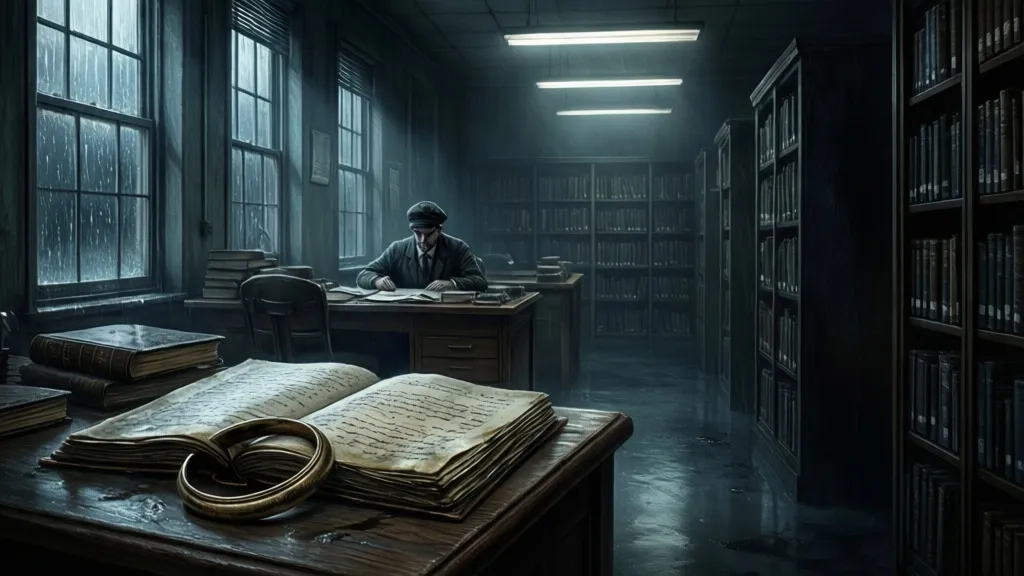
At eight forty-three, Natori Fumika was halfway through putting the dampness log back in its drawer when the duty phone began to ring again.
The municipal archive after hours always sounded larger than it was. The corridor carried each noise a little too far. The fluorescent lights hummed with official patience. Fumika looked at the phone for one ring too long, as if disapproval might silence it, then picked it up.
"Records Preservation," she said.
There was wind on the line, and station announcements blurred into one another. Then a man cleared his throat. "Sorry. This is Takeda from Midori Line maintenance. Flood response sent me your number. We recovered a box of property tags from the old lost-and-found cage under East Platform. Water got in. They said somebody from archives has to verify before we throw anything away."
Fumika closed her eyes. "Tonight?"
"Tonight would be best. Everything smells like a river."
That at least sounded true. "Where are you?"
"Platform office. East side."
She glanced at the clock. Her coat was already on the chair. Her umbrella was not where she remembered leaving it, which was no surprise; objects in municipal buildings developed private opinions after six o'clock.
"I'll come," she said.
She signed herself out in the night ledger, took the umbrella from a stand that was almost certainly not hers, and went into rain fine enough to look decorative and thorough enough to soak wool in minutes.
The station had the exhausted look of a place pretending to remain useful. Sandbags sat along one corridor. A yellow rope blocked the stairs to the lower passage. The air smelled of wet concrete, old metal, and the kind of mud that had travelled some distance to be there.
Takeda turned out to be a compact man in railway coveralls, with the formal manner of someone who had spent all evening saying sorry to strangers. He bowed over a cardboard box lined with newspaper.
"These," he said.
Inside were property tags of thick cream card, tied in bundles with cotton string darkened by water. Some had blurred to pale fur. Some remained perfectly legible, which was how paper usually behaved when one wanted the opposite.
Fumika pulled on gloves. "Recovered from where exactly?"
"Old cage room below East Platform. We don't use it now except as overflow storage. Floodwater backed up through the drain and shifted things. This box floated against the door."
"Who had charge of the room?"
Takeda gave the small shrug of a man who knew the answer existed in triplicate somewhere and not in his own head. "Station office, then Facilities, then us for clean-up. There should be a transfer sheet."
There should indeed.
She untied the first bundle. The tags were old station property tags: item descriptions, dates, finder locations, case numbers, and, where known, names. Umbrella. Brown scarf. School satchel. One black shoe. A violin case, empty, which seemed more philosophical than useful.
The fourth bundle had been protected by the others and was nearly dry. Fumika sorted by year. Most were from five to ten years ago, the station's forgotten sediment. Then one card caught under her thumb.
Ladies' coat, charcoal. Pocket contents transferred separately. Name confirmed: Hasegawa Ritsuko.
The date was three years and two months earlier.
Fumika read it again, not because she had misread it, but because some names altered the room around them.
Takeda was saying something about replacing shelving. She looked up.
"Sorry. This name. Hasegawa Ritsuko."
"Do I know her?"
"Probably not." Fumika turned the tag toward the desk lamp. In the lower corner was a notation in blue pencil. Unclaimed. Hold by instruction. There was no standard code beside it.
Three years earlier, Hasegawa Ritsuko had been declared dead after falling from the river path during the typhoon season. Her body had not been recovered. In practical terms, the city treated this as death once the paperwork had passed through enough hands. Fumika remembered because she had processed a request from Probate and noticed, idly, that the missing-person file was thicker than most. There had been a husband. There had been a younger sister who challenged one date and then withdrew the objection. There had been sympathy arranged into folders.
And there had not, as far as she knew, been any lost-property coat entering station storage a month later under her name.
"I need the transfer sheet," she said.
Takeda blinked. "For the box?"
"For that room. Tonight, if possible."
He looked at her face, decided this was one of those archive matters whose importance became obvious only after one had offended it, and left.
Fumika sat with the tag between two gloved fingers. The card stock was old issue. The handwriting for the item entry belonged to station staff—upright, compressed, tired. The blue-pencil note was more careful. Not elegant. Deliberate.
There was tea in a paper cup beside the desk, abandoned by someone else. Takeda's office kettle clicked in the corner. After a moment a woman from cleaning, who had seen Fumika standing and therefore assumed she required feeding, handed her a fresh cup from a thermos. It was hot in the way lava was hot. Fumika thanked her and set it down to cool, which meant she would later drink it cold.
Takeda returned with a key and an apology. "Transfer sheet's probably still in the room. The flood crew stacked everything by the door. If you don't mind a smell."
"I would have been disappointed without one," Fumika said.
He laughed uncertainly and led her down a service stair.
The old storage room sat behind a metal door with peeling numbers. When Takeda opened it, a current of air came out carrying rust, wet wool, adhesive, and the medicinal odour of soaked cardboard. It was not pleasant, but it was specific, which she preferred.
Inside, steel shelves lined three walls. A desk stood against the fourth with a ledger swollen from damp. Lost umbrellas leaned in a defeated bouquet near the corner. On the floor, the waterline had left a brown tidemark across several boxes.
Takeda switched on the light. "We were told not to touch paperwork until archives saw it."
"A rare moment of administrative wisdom." She stepped carefully around a bucket catching drips. "Please don't move anything until I've looked."
He hovered in the doorway, then thought better of hovering and went upstairs.
Fumika took photographs with the station's disposable incident camera because no one had thought to give archives anything modern, and because she mistrusted modern things in stories of paper. Then she examined the desk.
The ledger covered two years of storage transfers. The pages had buckled but remained readable. Shelf positions, incoming items, disposal authorisations. Nothing dramatic. Administration seldom announced its secrets in red ink.
She turned the book over to check the binding, and something bright caught beneath the lowest edge.
A narrow strip of transparent tape had fixed a ring to the underside of the back cover.
Fumika stopped moving for a full second.
The ring was gold, plain except for a tiny leaf pattern engraved inside the band. The tape had yellowed. Moisture had crept under one end but not enough to loosen it. Whoever had hidden it had wanted it found by no one performing ordinary work.
She eased the tape up with a letter opener from the desk. The ring came away cold and damp. Inside the band, beneath the pattern, was a date.
Three years earlier.
Not proof. Never begin by calling a thing proof. But it was a married woman's ring hidden beneath the ledger of a station storage room holding a property tag in the name of a woman said to be dead before that tag should have existed.
The neat timeline, already cracked, now looked assembled by somebody who had used too much pressure.
She searched the remaining pages. Near the back she found an entry for the same case number as the coat tag. Pocket contents transferred separately to Shelf C-3 pending instruction. The disposition column was blank.
Shelf C-3 held a row of small parcels wrapped in brown paper gone soft at the corners. Most were labelled. One space was empty. Dust marked its shape more sharply than the others.
There was also, tucked under the ledger blotter, a carbon copy transfer slip with only the bottom half legible.
Received from Temporary Holding for special retention, by order of M. Hasegawa. Witnessed —
The signature below the line had bled in the damp, but the first character remained clear enough: a long downward stroke, the start of Natori.
Fumika looked at it until irritation steadied into something colder.
Her father, Natori Shinji, had worked station administration for thirty-eight years before his lungs and then his heart persuaded him to stop. Three years ago, just before retirement, he had been responsible for interdepartmental transfers at East Platform during renovations. Since spring he had become one of those ill people whose good hours came as a rumour. If asked one question, he could often answer. Asked five, he became tired, agreeable, and inaccurate.
And now there was perhaps one useful question, perhaps three, and no certainty of a second chance.
She slipped the ring into an evidence envelope, logged its position, and took the carbon copy.
The tea on the desk had become perfectly cold.
She drank it anyway.
Her father lived in a small house behind the old post office with a persimmon tree that had outlived several roofs. By the time she arrived, the rain had thinned. Her aunt had gone home. The neighbour who checked in after dark had left soup in labelled containers as if illness could be managed by proper handwriting.
Shinji was awake in the front room under a blanket, looking both shrunken and irritable, which was his best condition. He looked at the envelope in her hand before he looked at her face.
"Work," he said.
"Unfortunately." Fumika set down her bag. "Have you taken your medicine?"
"If I say no, will you become more interesting?"
She checked the tray. He had. "I need to ask you about a transfer at East Platform. Three years ago. Just one thing to start with."
His mouth twitched. He disliked being approached as a witness in his own sitting room. This made him more reliable, not less.
She showed him the carbon slip without handing it over. "Do you remember receiving property on special retention by order of M. Hasegawa?"
He looked, and in looking became less frail for a moment. Memory did that. "Special retention. Coat? Small packet?"
"Yes. Whose order was it?"
"Man called Hasegawa. Husband, I think." He frowned. "No. Not husband then. Widower by then, officially. Polite fellow. Too polite. Brought papers no one asked for. Said station had identified items linked to his wife after the river search confusion. Wanted them held until family matters settled."
"Did you see the items?"
"Coat, yes. Packet, no. Already sealed." He coughed and paused. Fumika waited. Rushing sick men produced only invention. "There was a woman with him once. Younger. Sister maybe. She did not like him."
"Did you witness transfer to storage?"
"I signed receipt. Not shelfing. That would have been Sone from station office or..." He shut his eyes. "Or Morita in overflow. One of those. Why?"
Fumika considered lying and found she was too tired. "Because there is a wedding ring hidden under the shelf ledger."
His eyes opened. The silence that followed was not confusion. It was a rapid, private sorting.
"Then ask the sister," he said.
"Name?"
"Hasegawa? No, that was married name. Original was Kijima, I think. Worked at the florist beside City Hall for a time. Always wore green nail varnish, terrible shade."
This was how her father remembered people: by shoes, pen nibs, or colours that ought not to have existed.
"Can you remember the husband's given name?"
"Masato. M. Hasegawa. He cried correctly." Shinji turned his face toward the window. "Don't make me explain that."
Fumika did not need him to. There were people whose grief arrived too complete, as if rehearsed to spare others trouble.
"One more question," she said.
He made an irritated sound but did not refuse.
"Could someone have filed special retention without seeing the person named on the tag?"
"Easily. Names come from documents, from relatives, from notes in pockets. Why?" Then, before she answered, he said, very quietly, "Was she not dead then?"
"I don't know," Fumika said.
That was the honest centre of it, and hearing it made the room feel colder.
Before she left, he caught her wrist with surprising force. "Ask the sister first," he repeated. "Not the husband. A husband prepares. A sister only decides."
The florist beside City Hall had become a bakery, then a tax adviser, then empty. Green nail varnish did not assist records searches. The family register did.
By ten the next morning, after three calls, two forms, and one conversation with a clerk who believed curiosity should require a permit, Fumika had Kijima Sanae's address. It was in a narrow apartment building near the river, above a shop selling kitchen scales and enamel basins.
Sanae opened the door on the chain, saw Fumika's card, and removed the chain without asking whether this was wise. She was thirtyish, perhaps younger than the wear at the corners of her mouth suggested, with cropped hair and hands stained faintly green by flower stems or perhaps habit. Her nails, today, were bare.
Fumika explained only enough. The name Ritsuko altered Sanae's expression in the opposite way from her father's; instead of sharpening her, it took something away.
"Come in," she said.
The apartment was tidy with effort. A man was asleep on a futon behind a folding screen, one arm flung out toward a pile of sheet music. Sanae saw Fumika notice and said, "He works nights at the jazz bar. We are not married, which saves forms and annoys my mother. Tea?"
"If it's no trouble."
It was, judging by the kettle's protest and the state of the cups. Fumika accepted one that was too hot to touch and set it down until it could disappoint her properly.
She placed the property tag on the table.
Sanae read the name and sat very still. "Where did you get this?"
"Station storage. Recovered after flooding."
"Three years late," Sanae said.
"Yes."
"Then he kept it." Not a question.
"Masato Hasegawa?"
Sanae gave a short laugh with no amusement in it. "You mean my brother-in-law, my dear brother-in-law, who mourned publicly and calculated privately." She looked at the tag again. "Ritsuko didn't die on the day they said."
Fumika waited.
"She left him first," Sanae said. "That part no one wished to hear. He was careful. Never enough bruises for scandal, never enough witnesses for law. Only the daily grind of correction. How she folded towels. Who she spoke to. Which shopkeeper smiled too warmly. The kind of cruelty that leaves no memorable shape. She left after the typhoon warning, took a train into the city, and went to stay with a friend from school. She planned to ask me for money once she had found work."
"Did she?"
"No. She called me from the station the next morning. Said she had lost her coat in the confusion and laughed about it. She almost never laughed by then." Sanae pressed thumb to forefinger as if feeling a vanished stem. "She also said she had met someone she knew. A woman from a music circle, years before. They had tea. They talked. She sounded... embarrassed, in a pleased way."
From behind the screen, the sleeping man turned over and muttered half a trumpet scale into the blanket.
Fumika said, "Did your sister have a lover?"
Sanae looked at her, saw no judgment there, and relaxed by a degree. "Perhaps. Perhaps she only wanted one. She had wanted several versions of a life. Masato believed wanting itself was adultery."
"When did she die?"
"Two weeks later. I know because I saw her." Sanae's voice remained level by effort. "She called me to the old parcel room under East Platform. Said she needed to leave something safe before going farther away. She was frightened of him finding her. When I got there, she was already gone. Not gone from the city. Gone from the room. Masato was there instead. He said she had run off the moment she heard I was coming. He had found her by chance and tried to reason with her. There was a coat, and a paper parcel, and he was perfectly calm. Too calm."
"Why did you not tell the police?"
Sanae looked mildly offended. "I did. They asked whether I had seen my sister that day. I had not. They asked whether my brother-in-law had. He said no. They asked whether my sister had been unstable after marital strain. Several people said yes, because misery always resembles instability to comfortable observers. Then there was the river path and the missing umbrella and the witness who saw a woman in charcoal near the railing. It arranged itself very neatly." She paused. "Masato came to me later with papers. He said if I continued making ugly suggestions, my sister would become gossip before she became mourned. He was probably right."
"The ring," Fumika said. "Would your sister remove her wedding ring?"
"Never while deciding. Only after deciding." Sanae looked up sharply. "You found it?"
Fumika nodded.
Sanae closed her eyes. "Then she meant to leave him. Properly, not just in anger. She would have taken it off there. Left it where he would understand."
A shape that had been present from the beginning shifted into focus.
Ritsuko went to the station. Lost or checked her coat. Met someone from her old life and hesitated over another future. Called her sister. Removed her ring in the parcel room before leaving on. Masato, who had already been searching for her, found her there. Whether he begged, argued, or threatened hardly mattered to the arrangement that followed. He did not need a spectacular crime. He needed only a dead place, flood-prone storage, and a city willing to complete a narrative once offered one.
"The packet," Fumika said. "Do you know what she intended to leave?"
Sanae pointed to a small lacquer box on the shelf. "Letters. Mine now. He returned them months later, saying they had turned up among station property after all formalities. I never believed him. They were tied with the blue ribbon from her school hat. He knew I would recognise that and stop asking how they came back."
"May I see them?"
Sanae fetched the box. Inside lay a bundle of letters, dry, worn at the folds. On top was a note in Ritsuko's hand.
Sanae,
If I lose my nerve, remind me I had one. If I do not lose it, forgive the method.
Below that were train times, an address in another prefecture, and a woman's initials. Not a confession. Not a farewell. A plan.
Enough, perhaps, when laid beside the tag, the hidden ring, the false retention, and the husband's prepared grief.
Enough to check.
Masato Hasegawa received Fumika in an office above his insurance firm, where every surface had been arranged to suggest calm solvency and no one had made an accidental gesture in years.
He was handsome in the correct civic way, his tie modest, his sorrow apparently house-trained. On the wall behind him hung a certificate from a volunteer flood-relief committee.
When she showed him the property tag, he did not start. He gave it the look one grants an old receipt.
"I remember some confusion about my late wife's belongings," he said. "A dreadful period. If the station mishandled them, I hardly see—"
"You signed a special-retention order two weeks after her official disappearance."
"Did I? Then perhaps items connected to the search were recovered later." He spread his hands. "Surely this is all in the files."
"Some of it is. Some of it was taped beneath a ledger."
That interrupted him, almost invisibly. People who valued neatness hated hidden things because they recognised the mind that made them.
"A wedding ring," Fumika said.
He smiled then, very slightly. It was the smile of a man discovering which lie remained available. "My wife was sentimental. She often removed it and regretted doing so."
"At a station storage room?"
"Archivist Natori, are you accusing me of something?"
"Not directly. I am asking whether your wife was alive when you arranged retention of her coat."
His pause was now too long. Not dramatic. Merely practical. He was selecting among possibilities and finding none elegant.
"My wife," he said at last, "was unhappy and erratic. She met unsuitable people. She could be persuaded into scenes. If she appeared briefly after she had left home, that would not alter the tragic essentials."
The phrase tragic essentials sat between them like bad flowers.
"It would alter dates," Fumika said.
"Dates." He leaned back. "You work with paper, Ms. Natori. You know how uncertain people are. A witness misremembers rain. A clerk enters the wrong day. A sister with grievances imagines hope where there was none. And after three years?