The Salt on the Frame
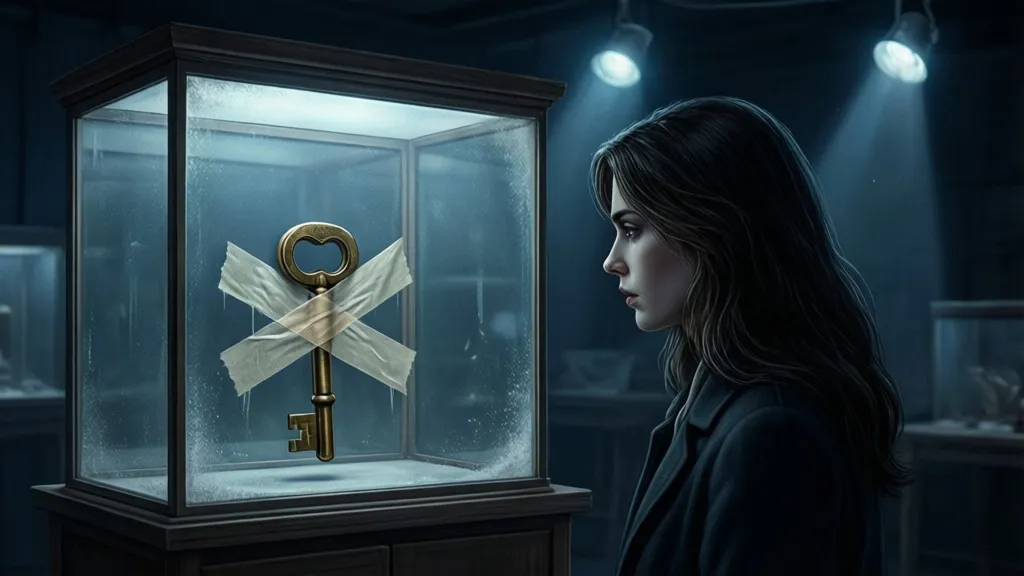
At two ten in the morning, Akiyama Rei stopped with her hand still on the light switch and looked again.
The brass key should have been hanging from a thin cotton cord beside the display case, touching the glass with a neat metallic patience she had always disliked. Instead, a strip of masking tape drooped from the cord. It was darkened with moisture. One end had been folded over on itself, as if someone had made a little flag of it in haste.
Rei crossed the conservation room in six fast steps. The case stood where it always stood, on its low aluminum plinth under the ceiling track lights. Inside it, propped on a velvet cradle, was Seascape with Two Boats, a painting so small it seemed to have been made for a doll’s house and so important, according to the museum director, that all ordinary inconvenience must kneel before it.
Rei bent close.
The wax seal over the tiny latch was intact. The latch itself sat flat. No splintering around the frame. No crack in the glass. Nothing that a person could point to, with relief, and say: there, then. That is how.
She smelled it before she understood she was smelling anything at all.
Sea salt. Faint, but definite. Not old dust. Not varnish. Not the dry paper smell of a room where objects were expected to outlive everyone in it. A breath of shore air had touched the painting and gone.
Behind her, the electric kettle on the worktable clicked off with a sound of private satisfaction. Rei ignored it.
She looked down at the dangling tape again. Wet. Replacing the key.
Then she lifted her eyes to the aluminum lip at the base of the case. A narrow line of grit ran under it, pale against the dark floor, too coarse for ordinary dust and too uneven to be part of the room. Sand, perhaps. Or something close enough to become trouble.
At two fourteen, she phoned the museum director at home.
He arrived at three three, wearing a tie under an overcoat and the expression of a man who had not forgiven the existence of weather. By then Rei had done very little, which was exactly what she intended people later to hear. She had checked the doors. Locked. She had checked the windows. Locked. She had looked at the seal and not touched it. She had moved the kettle away from the edge of the table, where it had threatened to offend gravity, and poured tea she no longer wanted.
By the time Director Fujishiro entered the conservation room, it had gone cold.
He stood over the case with his hands behind his back.
“Can it have been switched?” he said.
“With what?” Rei asked.
“The painting.”
She looked at him. “Something else very small and painted. Possibly also damp.”
He pretended not to hear the last part. “Well?”
Rei put down the cup. “If it has been switched, it was done by someone who knew the exact dimensions of the frame and had access to a work very close in age, panel warp, craquelure, pigment condition, and smell.”
“Smell.”
“It smells faintly of sea salt.”
He bent, inhaled, and straightened at once, having learned something he did not enjoy. “The police.”
“Yes.”
“I will call them at seven. Quietly. Before the public hours begin.”
“Fine.”
He looked at the tape. “What is that?”
“A substitute for a key,” Rei said. “A very rude one.”
By morning, the building had acquired people.
Museums at dawn had a monastic appearance, but they were never actually peaceful. They only contained their absurdities behind stone walls. At eight twenty, before the doors opened, Rei found three separate persons in or near the conservation suite, each with an expression suggesting that this had happened to them by moral right.
The first was Sugimoto Gen, retired locksmith, seventy-one, volunteer consultant to the museum whenever anything old, brass, jammed, or self-important was involved. He wore a cardigan with leather patches and held his cap in both hands as though visiting someone ill.
The second was Handa Yuto, the night security guard, thirty-two, broad-shouldered, with two fresh white bandages across the knuckles of his right hand. He had the apologetic stiffness of a man already aware that his body had become evidence.
The third was Naruse Chiharu, daughter of the donor whose family had lent Seascape with Two Boats for the current exhibition. She stood in a cream raincoat that had no business being in a museum before breakfast and looked at the display case as if it had personally insulted her mother.
Director Fujishiro, having gathered all available difficulties in one place, made introductions that did not need making.
“Everyone,” he said, “claims to have been the last person to touch the case.”
“Not claims,” said Chiharu. “I was.”
“No,” said Sugimoto mildly. “That would be me.”
Handa cleared his throat. “I checked it after patrol. So, respectfully, neither of you.”
Rei sat down on the low stool by her worktable. The tea she had just been handed by an assistant was too hot to drink. This was, in its way, reassuring. “One at a time,” she said.
Director Fujishiro glanced at the clock. “The police will be here in twenty minutes.”
He said it as if twenty minutes were a moral failing on someone’s part.
Rei folded her hands. “Good. Then we only need the truth before that.”
No one smiled. This was also normal.
Chiharu spoke first, because people accustomed to being obeyed often mistook order for evidence.
“I came yesterday afternoon with the revised loan documents. Around four thirty. The director was in a meeting, so I waited in Gallery Three. The little painting was there, still in the case. I noticed the key hanging beside it, which seemed reckless, and I touched the cord to see whether it was secure.”
“Touched the cord,” Rei said.
“And the side of the case,” Chiharu said. “Only the side. I did not open anything.”
“Why would you test the cord?”
“Because my mother should never have agreed to such a display system. A key attached to a case is decorative idiocy.”
Director Fujishiro inhaled through his nose. Rei made a small note and let the sentence live.
Sugimoto went next.
“I was called at five fifteen,” he said, “because the storage room lock on the west corridor had been sticking for two days. I repaired it. On the way out, I stopped to admire the Naruse seascape again.”
“Again?” Rei said.
He nodded. “It is an honest little painting. It does not flatter itself.”
This was a judgment Rei thought probably sound.
“I touched the case,” he continued, “here.” He laid one finger, very gently, on the front right corner of the aluminum lip. “Not the glass. I bent down to inspect the latch arrangement. Old habit. The key was present then.”
“At what time?”
“Six, perhaps a little after.”
Handa said, “I did my final interior patrol at one forty-five. Gallery Three, conservation hallway, loading corridor. Standard route. I checked the case because Miss Naruse had complained about security to my supervisor last week.”
Chiharu opened her mouth. Rei lifted a hand. Chiharu closed it again.
“I touched the latch area,” Handa said, indicating the sealed point on the glass. “Just to see that the wax hadn’t loosened. The key was hanging there then.”
“With your right hand?” Rei asked.
He glanced at the bandages. “Left.”
“How did you injure the right?”
“Freight door slipped while I was locking up the loading bay. Skin only. Around midnight.”
“Who saw?”
“My supervisor. And the janitor.”
Director Fujishiro shifted. “We can verify that later.”
Rei looked from one face to another. Three last touches were impossible only if time remained tidy and objects stayed where they were put. In buildings, as in families, this was optimistic.
She stood and moved to the case.
The aluminum plinth was square, waist-high, custom-built to hold vibration-damping supports. Under its front lip, the line of grit remained undisturbed. The particles were not museum dust. Too granular. A few sparkled faintly. She crouched for a better look.
Sugimoto crouched too, with the alarming silent efficiency of the old.
“Sand,” he said.
“Probably,” Rei said.
“Beach sand?” Chiharu asked.
“You have brought us a sea-smelling painting,” Rei said without looking up. “Beach sand would be theatrically consistent. That does not make it true.”
Handa said, “The loading bay had some grit from the rain last night.”
Rei turned her head. “Did it look like this?”
He hesitated a moment too long. “I didn’t check closely.”
She stood. “Tell me about last night. All of it. Start with the weather.”
He blinked. “Rain after eleven. Hard around one. Wind from the east, I think.”
“Why do you think that?”
“Because the bay doors rattled.”
“And because it mattered to you personally?”
He looked down at his bandaged hand. “No.”
This, Rei thought, was truthful. Or truthful enough to be useful.
She turned to Chiharu. “How often do you visit the shore?”
Chiharu stared at her. “I grew up in Kamakura. I am not sure whether that is a confession.”
“Your shoes?”
“My shoes are clean.”
Rei looked. They were. Cream leather ankle boots, absurdly immaculate.
Sugimoto cleared his throat. “If I may. The key itself is a copy. The original key is too old for daily use. I cut this one three years ago.”
“That was not in the records,” Rei said.
“It was in a sensible conversation,” he said. “Which records rarely are.”
Director Fujishiro made a weak movement of protest. Sugimoto continued.
“The case lock is simple but peculiar. A narrow bit, shallow throw. You would not pick it by accident.”
“Could you open it without damaging the wax seal?” Rei asked.
“Yes,” he said at once.
No one liked that answer except Rei.
“How?”
“By removing the hinge pin from the opposite side, if one had room and a thin enough tool. But that would leave marks. Or by accessing the latch through a gap if the frame were shifted. Again, marks.”
She looked at the case. No visible marks. “Could the whole upper vitrine be lifted?”
“Not easily,” Sugimoto said. “Two people, perhaps. The seal would remain if they were delicate.”
Handa said, “No one moved that case. I’d have seen.”
“At one forty-five,” Rei said.
He did not answer.
The tea on her table had reached drinkable temperature by the time she returned to it, and in this the morning overreached itself. She took one sip. It was already edging toward cold.
She set it down.
“Miss Naruse,” she said, “why are you here before opening?”
Chiharu folded her arms. “Because my mother received a call from someone in this museum at seven twenty informing her there had been an ‘irregularity’ concerning the painting. She is in Kyoto. I came in her place.”
“Who called?”
Director Fujishiro said, “I did.”
“You used the word irregularity?” Rei asked.
“It seemed preferable to ‘something has gone wrong in a locked case with your family’s loaned property.’”
“Charming,” said Chiharu.
Rei ignored that. “And you, Mr. Sugimoto? Why are you here?”
“The director called me after six. If a key has vanished, one asks a locksmith.”
That, unfortunately, was reasonable.
“And you, Handa?”
He said, “I was told not to leave.”
Also reasonable.
Now consider the tape.
Rei took a fresh pair of cotton gloves from the box, then decided against them and used tweezers instead. The masking tape hung from the same cord that had held the key. It was ordinary cream tape, torn by hand. Wet, but drying. She lowered it onto a clean tray.
“One of you put that there,” Director Fujishiro said.
“It is possible,” Rei said, “that someone else did. But yes. I imagine so.”
She bent close. The tape had been folded lengthwise before being wrapped over the cord, leaving a narrow central channel. Something thin had rested inside it. Not now.
Sugimoto peered over her shoulder. “A key shank would fit there.”
“Exactly.”
Chiharu frowned. “Then whoever removed the key taped it first?”
“Or replaced it after removing it,” Rei said. “In order that a glance from a distance would still see something pale dangling where something metallic should be.”
Handa said, “In low light, maybe.”
Rei looked up. “Gallery Three is dimmed after closing?”
“Yes. Security level only.”
“So a hanging strip could pass for a key, from several feet away.”
Director Fujishiro said, “But why take the key and not the painting?”
Sugimoto answered before Rei did. “Because the key opens something else.”
Everyone turned to him.
He shrugged. “People seldom steal keys for sentimental reasons.”
Rei felt the room alter by a small degree. That was better. A theft of a painting invited melodrama. A theft of a key invited thought.
“Mr. Sugimoto,” she said, “how many objects in this building use that same cut?”
“One,” he said. “This case. Unless some fool had me duplicate it unofficially.”
No one spoke.
He added, “Which, to be fair, does happen.”
Rei moved to the case again. Sea salt on the painting, grit under the lip, key replaced with wet tape. The object inside still present. A thing had happened around the case, not to it.
She examined the painting through the glass. The frame’s lower edge held a fine dark seam where wood met backing board. There, at the right corner, a pale crescent clung.
“Director,” she said, “when was the painting installed?”
“Yesterday morning.”
“From where?”
“Directly from the lender’s courier crate.”
“Condition report?”
He handed it to her from the folder under his arm.
She scanned it quickly. Surface stable. Varnish uneven. Frame old repairs. Backing board replaced in the 1980s. Nothing about odor, because reports did not mention smell unless something had already gone wrong.
“Who unpacked it?”
“Myself, Ms. Akiyama, and Registrar Ono.”
Rei nodded. “Did it smell then?”
“No.”
“No,” said Fujishiro. “Certainly not.”
“Then the salt came later.”
Chiharu said, “Could condensation do that?”
“Only if the weather had become the Pacific.”
A brief silence followed, not unfriendly.
Rei crouched again and slid a thin spatula just short of the grit line without touching it. The grains were concentrated at the front, directly below the central viewing area, not beneath the sides. A little more on the right than the left.
She stood. “Who cleaned this gallery last?”
Handa said, “Evening staff, before close. Around five.”
“So the grit arrived after five.”
Sugimoto said quietly, “And after I was there.”
“Yes.”
Rei turned to Handa. “Show me the loading bay door that injured you.”
Director Fujishiro began, “The police—”
“Have nineteen minutes,” Rei said. “They will appreciate a shorter problem.”
The loading bay lay at the rear of the museum, past the temporary storage corridor and a side stair that smelled permanently of wet concrete. Handa led them there with the resigned air of a man escorting his own bad luck.
The bay door was steel, counterweighted, with a secondary personnel door set into one side. Rain had blown in beneath it during the night, leaving the floor edges stained dark.
Rei looked down. Sand, yes—but a different kind. Coarser, mixed with black soil from the parking lot gravel.
She knelt anyway. The bandages on Handa’s right hand were clean. Too clean, she thought, for a man who had spent a sleepless morning bracing himself against accusation.
“What struck your knuckles?” she asked.
“The handle.”
“With enough force to split the skin across two fingers in parallel?”
He said nothing.
Sugimoto, beside the door, touched the latch plate with one bent finger. “This wasn’t last night,” he said.
“What wasn’t?” said Director Fujishiro.
“This scrape. Old rust under fresh polish. Someone cleaned at it recently to make it look new.”
Handa said, “I don’t know anything about that.”
Rei turned. “No. But someone in the building did. Let us go back.”
Chiharu, who had remained astonishingly practical in heeled boots, said, “You know who took the key.”
“Not yet,” Rei said. “I know who is trying to make the wrong thing look like the right thing.”
Now consider the sea.
Back in the conservation room, Rei asked for the courier crate. Registrar Ono, pale and alarmed, brought it from temporary storage at once. It was a compact wooden box lined with inert foam, loan labels intact. Chiharu watched closely, her annoyance becoming attention.
Rei opened the crate. No smell of sea salt.
She checked the packing tissue, the foam recess, the backing supports. Dry. Clean.
“Miss Naruse,” she said, “where was the painting before it came here?”
“In my mother’s apartment,” Chiharu said. “Before that, our family villa by the water, years ago. Why?”
“Because it smells of salt now, not then.”
Chiharu hesitated. “There is one possibility. My mother had it lightly dusted last month by a local restorer she should not have trusted. He said the frame had held moisture from old storage near the coast.”
Director Fujishiro closed his eyes very briefly.
“But it did not smell yesterday?” Rei asked.
“No.”
So not the frame. Or not only the frame.
She went back to the case. The grit lay under the lip like a sentence with one word missing.
“Mr. Sugimoto,” she said, “if someone wished to remove the key from the cord without standing in front of the case long enough to be noticed, how would they do it?”
He considered. “Untie the cord? Too slow. Cut it? Obvious. Slip the ring off, if the key ring were poorly closed.”
He leaned nearer and gave a soft grunt. “It is poorly closed.”
Rei saw it then: the tiny split ring at the end of the cord had a slight opening, bent just enough to free the key with a fingernail or thin blade. The kind of defect that passed unnoticed until it became motive.
“Who knew that?” she asked.
Sugimoto said, “Not I, until now.”
Chiharu said, “Not I.”
Handa said, “I didn’t even know there was a ring.”
A transparent lie. Not because it was large, but because it was unnecessary. Of course he knew there was a ring. He had looked at the key every patrol. People lied most badly when denying things too small to matter.
Rei let that settle.
Then she said, “Mr. Handa, when you checked the wax seal at one forty-five with your left hand, you signed the patrol sheet in Gallery Three, didn’t you?”
He looked at her. “Yes.”
“There is pencil there,” Rei said. “Your supervisor showed it to me at dawn when I asked for your route log. The figures for 1:45 are written firmly with the right hand. A broad downward stroke on the seven, pressure strongest on the right side of the line. Not careful lettering done in pain, not clumsy substitution by the left. If your knuckles were split by midnight, you did not write that way nearly two hours later.”
He said nothing.
“And one more thing,” Rei said. “The bandage crosses the middle joints. A man with that injury does not press a wax seal to test whether it has loosened. He avoids contact with glass edges, latches, any point that might strike the same place again. Yet you volunteered the detail cheerfully, because you had not yet understood that the injury itself had become part of the room.”
His face changed, not into guilt exactly, but into fatigue.
Director Fujishiro said sharply, “What did you do?”
“Nothing to the painting,” Handa said at once. “I swear that.”
“That was not the question,” Rei said.
He took a breath. “I touched the case at one forty-five. The key was there. Later, around one fifty-five, I came back.”
“Why?”
Silence.
Chiharu said softly, “Because you had already taken it.”
He nodded