The Sand Fold
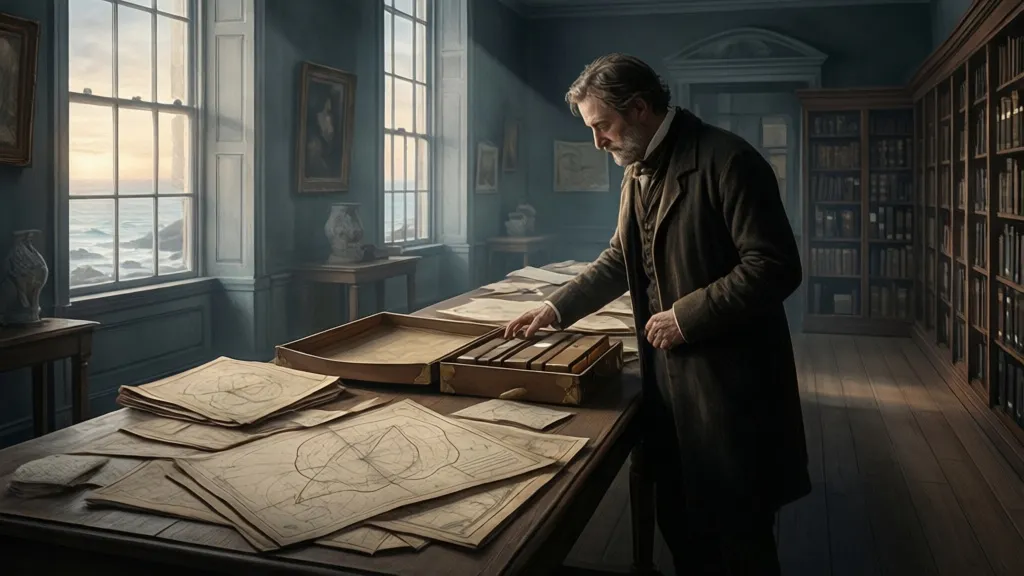
At nine-twelve, Akiyama Mio lifted the lid of Box 14 and knew at once that someone had touched the charts.
She did not know it because anything was missing. It was worse than that. Everything was present, and wrong.
The boxed set of nineteenth-century sailcloth charts from the Shirosaki donation had been tied in three bundles with cotton tape, then laid in the custom tray according to size. Mio had done it herself yesterday afternoon, under the supervision of Chief Curator Yanagi, who supervised in the manner of a cat occupying a cushion: entirely, and without visible effort. The largest coastal survey had gone at the bottom, then the harbour soundings, then the narrow route charts folded into rectangles no wider than a hand.
Now the order had shifted. The second and third bundles had been exchanged. One chart had been lifted out and laid back in with its fold running against the others, as if a reader had become distracted halfway through tidying. Another sat a fraction too high, exposing a sliver of sailcloth edge darkened by old damp.
And one map was still pinned to the examination board by the rusted nail Mio had used, because the board's wooden clip had failed again. That should not have surprised her; she remembered leaving it there to flatten overnight. What stopped her was the grain of sand on the central fold.
The paper label tied to the nail string read: Approach to Nishi Bay, revised 1884.
Mio bent closer. The grain was pale, almost white. Sand found its way into a coastal museum by a hundred innocent routes. Schoolchildren shook it from their cuffs. Volunteers carried it in under their shoes. The deputy director had a habit of eating rice crackers on the sea wall at lunch and returning with the weather clinging to him in fine layers. None of that mattered. This grain sat precisely in the crease where the chart had been opened and refolded.
She straightened and looked around the map room.
It was, as usual, a room devoted to order by people who had only a passing acquaintance with it. The long tables were clean. The blinds were half-drawn against the shine from the harbour. Acid-free boxes stood in neat ranks on the shelving. At the far end, under the portrait of a donor who looked offended by posterity, Assistant Curator Matsuda was writing labels in a hand so beautiful it seemed mildly unreasonable.
Mio crossed to him with the chart label in her hand.
"Did you come in here this morning?"
Matsuda looked up. He was thirty, immaculate, and capable of making each syllable sound ironed. "Good morning to you as well. No. Why?"
"Someone has handled the Shirosaki charts."
He rose at once, which was one point in his favour. "Handled them or disturbed them? That room is not sealed against human tragedy."
"Both, I think."
He followed her back, clasping his label brush between his fingers like a conductor's baton. Chief Curator Yanagi was already approaching from the corridor, not because he had heard anything—his hearing was selective—but because he possessed the museum instinct for moving toward the possibility of paperwork.
Yanagi peered into Box 14, blinked twice, and said, "Who untied these?"
"That is what I was about to ask," Mio said.
"Not I," Matsuda said.
Yanagi looked from one to the other. He was a thin, courteous man with a habit of speaking as if minutes were being taken. "The room was locked at six-fifteen yesterday. Opened at eight-fifty by Miss Akiyama. No public access. Keys with myself, security, and facilities."
"And Deputy Director Kuroda," Matsuda said.
Yanagi's eyelids lowered a little. "The deputy director does not generally rummage among damp sailcloth."
"No," Mio said, still looking at the pinned chart. "If he had, he would have called it canvas."
Matsuda coughed into his hand. Yanagi, who disliked wit unless he had made it, said nothing.
Mio pointed to the fold. "There's sand."
They both bent. Matsuda frowned. Yanagi took off his glasses and cleaned them, which meant he had seen perfectly well and did not like the implications.
"You are sure it was not there yesterday?" he asked.
"No one can be sure about a single grain of sand," Mio said. "But I unfolded this chart, brushed the creases with the goat-hair brush, and pinned it before tea. There was no sand then."
Tea had arrived at that moment yesterday, too hot to touch and carried by volunteer Mrs. Numabe, who believed archivists forgot to drink unless supervised. Mio had left the cup by the window, dealt with a query about accession stamps, and returned twenty minutes later to tea the temperature of regret. She had drunk it anyway.
Yanagi examined the cotton tape. "Retied differently. See the knot. Matsuda?"
"I tie bows," Matsuda said. "Even under stress."
That was true. His labels curled like expensive handwriting in old letters.
Mio looked again at the chart. The rusted nail had left a faint orange bloom around the pinhole. She had meant to replace it with stainless steel and had not. Beside the board, on the trolley, sat the donor file for the Shirosaki materials: correspondence, preliminary inventory, transfer forms, and the shipment ledger copied from the boathouse records of the late Captain Shirosaki's estate. They had been working through it all week because the museum intended a small autumn display on coastal navigation.
Mio said, "I want to compare the chart order with the provisional list."
Yanagi gave a small sigh intended to mean that wanting things led to work. "Do so. Quietly. If an item is gone, inform me immediately. If not, then we may have the more common problem of careless curiosity."
"In a locked room?" Matsuda asked.
Yanagi put his glasses back on. "Museums are built from careful curiosity and sustained trespass, Mr. Matsuda. That is practically our mission statement."
He left them to it.
Mio checked the contents against the list. The count was correct. Twenty-three charts, one folded coastal survey notebook, two harbour tracings on oiled linen. Nothing missing.
Yet the unease remained. It did not belong only to the shifted bundles. It belonged to that single chart left pinned out overnight, and to the fact that if someone had opened Box 14 for one chart in particular, they had not chosen the most valuable one. Approach to Nishi Bay was practical, local, and not very grand. The chart showed reefs, depths, tide notes, and a narrow entry channel into the inner harbour. There was one pencilled correction in a later hand near a sandbar. Mio had noticed it yesterday and marked it for note.
She turned the chart over carefully. Nothing. The reverse was plain.
Matsuda was reading the provisional inventory over her shoulder. "You think someone searched for this specific map?"
"Or read it and put things back badly."
"To what end?"
"That would be the interesting part."
He gave her a look that had, over the past year, developed into a category of its own. It was not flirtation; it was much too tidy for that. Nor was it purely professional regard. Matsuda admired order and, perhaps against his better judgment, admired that Mio noticed where it had failed. They had once gone to dinner after a lecture on local ceramics and spoken for two hours about forged provenance and whether lying improved under pressure or merely became faster. Nothing had followed. It was one of the quieter arrangements in her life, and therefore one of the more durable.
"You enjoy this," he said.
"No."
"A little."
"Only when people are absurd."
"Then you are in employment perfectly suited to your character."
By eleven, the museum had become itself: school groups in bright hats, a retired shipbuilder arguing amiably with a volunteer about anchor design, the gift shop radio leaking old enka through the stairwell. The Shiosato Maritime Museum occupied a converted customs house on the harbour road, with whitewashed walls, timber beams, and the sea visible from any window that did not prefer another building. It was small enough that everyone knew everyone else, and large enough that they could pretend not to when useful.
Mio took the donor file to the reading desk in the archive office and worked through the correspondence. The original donation had come not from Captain Shirosaki, who had died twenty years ago, but from his daughter, Reiko Shirosaki, now Mrs. Hayama, who kept a guesthouse out near the old lighthouse road. Her letter offered "charts, boathouse records, signal books, and associated family papers of no practical use to us but, perhaps, of interest to a museum." The phrase of no practical use had been underlined once, lightly.
The shipment ledger listed six boxes removed from the Shirosaki boathouse and received by the museum stores on 18 April. At the bottom, beneath Facilities Manager Okabe's broad receiving signature, was the donor's name: Reiko Hayama.
Mio looked at the corresponding letter again. The donor had signed it Reiko Shirosaki Hayama in blue-black ink, with a particular loop in the R that leaned back before moving forward. The ledger signature was shorter, firmer, and in a dense black that sat on the paper differently. Not necessarily suspicious. People signed differently on forms, on letters, on receipts. Pens varied. Haste existed.
She set the letter beside the ledger and frowned.
At noon, she was still frowning when volunteer Mrs. Numabe arrived with tea in thick cups patterned with tiny ships. Mio accepted hers automatically, discovered it was too hot, set it down beside the ledger, and forgot it while comparing strokes.
"You have your I have noticed a worm in Eden face," Mrs. Numabe said.
"Do I?"
"Certainly. Last time it was because Mr. Kuroda had used the dehumidifier outlet to plug in a fan."
"That was not a worm. That was open war."
Mrs. Numabe, who had buried two husbands and several rumours, glanced at the papers. "Whose hand?"
"A donor's. Perhaps."
"Ah." She nodded with relish. "Forgery is nice. So domestic."
"It may be nothing."
"Nothing never needs that expression." Mrs. Numabe lowered her voice. "The deputy director has a donor lunch at one-thirty with Mrs. Hayama, by the way. He has been polishing his gratitude since ten."
Mio looked up. "Mrs. Hayama is coming here today?"
"She arrived already. In the harbour gallery with Kuroda and that dreadful local columnist who says our maritime soul as if she keeps one in a drawer."
This was useful. It was also inconvenient in ways not yet visible.
When Mrs. Numabe had gone, Mio touched her tea. Cold.
She drank it.
At one-fifteen she carried the letter and ledger upstairs to the deputy director's office and found Kuroda absent, his door open, and on the side table a vase of lilies suffering for his ambition. Kuroda liked donors, speeches, and being photographed beside objects other people had catalogued. He was handsome in the broad civic style that looked excellent in newspapers and less impressive in doorways when one was trying to pass him.
Mio left the papers on his desk with a note requesting five minutes. As she turned to go, she saw on the visitor tray a pair of gloves dusted faintly with something pale.
Sand, perhaps. Or paper fibre. Or simply the sediment of useful-looking surfaces. She bent, rubbed one finger lightly along the leather, and felt grit.
Kuroda's voice sounded from the corridor. "Miss Akiyama?"
She straightened. He entered with Mrs. Hayama behind him.
Reiko Hayama was sixty if a day, handsome in the way of weathered wood, and wore a navy jacket with brass buttons that took her back, by a decade or two, to a life she had no intention of apologising for. Her hair was silver and cut practical. She smelled faintly of sea soap.
Kuroda smiled with the full wattage he reserved for benefaction. "You wanted me?"
"Briefly. About the Shirosaki paperwork."
Mrs. Hayama's eyes flicked to the ledger on the desk. Not alarmed. Sharpened.
"If this concerns my father's effects," she said, "I should hear it. Half the point of giving museums things is to be consulted after one has given them."
Kuroda laughed as if this had been witty by design. "Of course."
Mio put the letter and ledger side by side. "I was comparing signatures. The ledger receipt and the original donation letter seem to be in different ink, and perhaps not by the same hand. I wondered whether you recalled the transfer day."
Kuroda's smile adjusted itself. He had not been present on the transfer day; that would become clear in a moment and mildly annoy him. Mrs. Hayama leaned in.
"The letter is mine," she said. "The receipt—"
She stopped.
It was not a dramatic pause. It was the smaller, more interesting kind, in which memory and decision met each other in a doorway.
"—may not be. I signed many things that week. Okabe dealt with the boxes. My husband was ill then. I sent my niece ahead once or twice. I cannot promise every scribble in my name is mine. Has something gone missing?"
"Not that we know of," Mio said.
Kuroda spread his hands. "A procedural irregularity only, I am sure."
Mrs. Hayama looked at him with detached amusement. "That is a phrase used by men when they mean I would prefer not to know this in front of lunch."
Kuroda's smile remained in place by professional reflex alone.
Mio said, "Do you remember whether any family papers were withheld before shipment?"
"Yes," Mrs. Hayama said at once. "Personal letters. My father had no talent for privacy while alive; I saw no reason to surrender what little he acquired after death. Why?"
"Because someone appears to have gone through the charts this morning."
There it was. Kuroda stiffened almost imperceptibly. Mrs. Hayama did not.
"Which chart?" she asked.
"Approach to Nishi Bay."
This time she did react. Not with fear. With recognition.
Her gaze moved, not to Kuroda, but to the window, where one could see a strip of harbour water and, beyond it, the road bending toward the old lighthouse point.
"I see," she said.
"Do you?" Mio asked.
Mrs. Hayama gave a small breath that might have been a laugh if it had found more room. "Perhaps. Ask Okabe who signed the receipt. Ask him where my father's boathouse key went after the transfer. And ask your chief curator whether he has shown anyone the pencilled note on that chart."
Kuroda said quickly, "Mrs. Hayama, if there is some concern—"
"There is always some concern," she said. "That is what museums and families have in common. They store things badly, then become sentimental about the damage."
She turned to Mio. "If this is about theft, you will know soon. If it is about a mistake, you will be told immediately. If it is about someone erasing a trail, they will become helpful. Watch for that."
Then she smiled, not unkindly, at Kuroda. "Now, shall we go and admire my generosity?"
Facilities Manager Okabe was in the loading bay with a stepladder, a box of lightbulbs, and the expression of a man who considered all archives a species of dust with opinions.
He listened to Mio's question about the receipt signature, scratched his cheek, and said, "Could be her niece signed. Could be me told her where to sign and forgot to watch. Could be no one cared because six wet boxes were leaking on my floor. Why?"
"Because the ink does not match the donor letter."
"The ink in this building never matches anything. We have seventeen pens and fourteen of them are traitors."
"Who had the boathouse key after the transfer?"
Okabe looked at her more carefully. "Why ask that?"
"Mrs. Hayama suggested it."
He set down the box of bulbs. "Ah. Well. Officially, key returned to donor. Unofficially, there was confusion. Her niece—what's her name, Tomi?—brought one set of boxes in advance because the old lady had to take her husband to the clinic. Then Yanagi wanted an inventory check against the boathouse shelf marks because some labels were odd. So for two days there was one spare key on the office board. Then it vanished. Then it turned up in an envelope on my desk with no note."
"When?"
"Two, three days later."
"Did anyone sign it out?"
Okabe laughed once. "This is a small museum, Miss Akiyama. We sign out ladders because ladders are honest. Keys, people borrow with their consciences."
"Who knew about the shelf marks?"
"Me, Yanagi, you by now, probably Matsuda because he knows all gossip before it's spoken, and Kuroda because he asks questions when donors are involved. Also Mrs. Hayama's niece, because she said the boathouse had been rifled before and wanted us to move things quickly."
"Rifled?"
"Her word. Could've meant rats. Could've meant relatives."
Mio thanked him and went back upstairs, where the archive office felt smaller than it had in the morning.
The pencilled note on Approach to Nishi Bay returned to her mind. Had Yanagi shown it to anyone? She took the chart from the board and looked again. Near the inner channel, beside a sandbar marked winter shift, someone had added in pencil: see ledger B, south loft. The hand was old and cramped, perhaps Captain Shirosaki's, perhaps not.
Ledger B, south loft. Not a navigational note. A finding note.
She took the donor file to Yanagi's office.
He was eating a bun over exhibition plans with the concentration of a man pretending not to eat a bun.
"Did you show anyone the pencilled note on the Nishi Bay chart?" Mio asked.
Yanagi swallowed with dignity. "I mentioned it to Kuroda yesterday. He likes such details for donor conversation."
"Only to him?"
"And to Mrs. Numabe, because she was there and incapable of not hearing. Why?"
Mio told him, briefly, what Mrs. Hayama had said, what Okabe had said, and what the chart note indicated.
Yanagi set down the bun. "South loft. The Shirosaki boathouse had a loft over the net room. If there is or was a ledger there, it ought to have come with the shipment."
"Unless someone withheld it."
"Or forgot it."
"Or went back for it."
Yanagi's expression became pained in advance of administration. "If there is an unaccessioned family ledger still in private hands, that is not yet our business."
"If someone entered our map room to trace its existence, it is."
He looked at her a moment. Mio had learned that Yanagi was not timid; he was economical. He disliked disturbance because disturbance generated forms, and forms suggested accountability. But he also disliked being made a fool of, and someone searching his archive without permission offended him more intimately than ethics could have managed.
"Very well," he said. "Keep this discreet. Speak to Matsuda. And to the niece, if she is on site."
"She is?"
"Guest services. Temporary contract through autumn. Hayama Tomoe. You have met her; she wears striped scarves in weather that does not require them."
Mio had indeed met her. Tomoe guided school groups with brisk charm and corrected adults on nautical terms with a family confidence that bordered on hereditary trespass.
She found Tomoe in the education room coaxing seven children into tying reef knots with more enthusiasm than success. Tomoe was twenty-seven, quick, neat, and pretty in a way she seemed to find operationally useful rather than personally significant. When the children were led away by a teacher, she closed the door and said, before Mio had asked anything, "Aunt Reiko sent you?"
"In effect."
Tomoe folded her arms. "Then I suppose this is about Grandfather's boathouse. Or the chart. Or both."
"You know about the chart?"
"Only that Mr. Kuroda asked me at lunch whether Approach to Nishi Bay meant anything special in family lore. He asked too casually. Men are often betrayed by adverbs."
This family, Mio thought, had a regrettable gift for precision.
"Did you sign the shipment receipt in your aunt's name?" she asked.
Tomoe considered, then nodded. "Yes. She was at the clinic. Okabe wanted a signature and I was carrying two boxes and a bad temper. I did not think a museum would one day raise an eyebrow over it."
"Why didn't anyone note it?"
"Because no one thought it important. Was it?"
"Perhaps not. But someone has gone through the charts since yesterday, and your aunt believes it may concern a trail someone wants erased."
Tomoe's face changed. She sat down on the edge of the table.
"Then it's the south loft ledger," she said.
"You know of it."
"I know of the argument about it. My grandfather kept duplicate records of certain cargoes, mooring fees, private fuel purchases, things