The Umbrella's Inventory
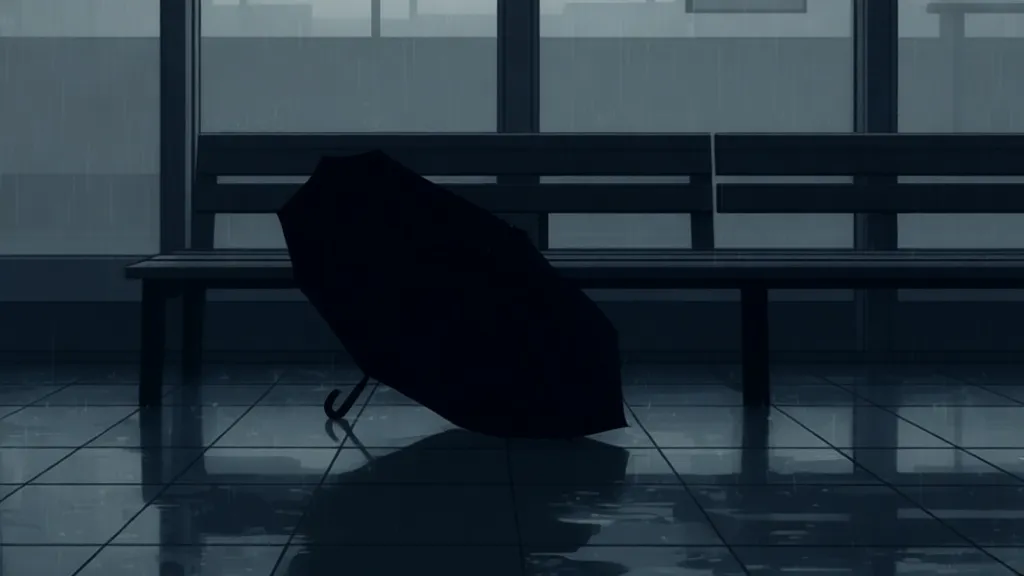
The umbrella had no owner.
That was the first thing Kenji Matsuda noticed when he knelt to collect it from the waiting area at Namba Station. Rainwater pooled in its aluminum ribs, and the handle was smooth and anonymous—a plain black crook, the kind sold at any convenience store. Someone had left it beneath the bench, abandoned with the particular carelessness of a person who no longer needed it.
He knew he shouldn't open it. Lost property protocol was clear: sealed bags, logged descriptions, no examination of contents. But the train wouldn't arrive for another three minutes, and his hands were already wet from the platform, and there was something about the weight of it, the way it sat in his grip, that felt like a question.
The canopy opened with a soft pop.
Folded once, then twice, a slip of paper had been tucked into the ferrule—the metal cap at the tip of the shaft. It was dry. Someone had placed it there deliberately, sealed against the rain.
Kenji unfolded it.
Car 3. Seat 17A. At 9:47, the doors will open on the wrong side. When the lights fail, he will disappear. Do not warn anyone. Read everything first.
He checked his watch. 9:41.
The note was written in neat, small characters, printed rather than written by hand. No signature. The paper was the pale blue of a legal pad, the kind used for lists—for inventories.
Kenji looked up. The platform was dense with commuters despite the late hour, umbrellas blooming and folding along the yellow safety line. He scanned Car 3 on the approaching train. The numbers were painted in white on the side of each carriage.
Car 3. Seat 17A.
A man stood by the window, one hand raised to adjust his glasses. He was perhaps forty, with the soft gut of someone who sat too long and a briefcase clutched against his chest. He glanced at his phone, then at the platform clock. He did not look nervous. He looked like a man counting minutes until home.
Kenji folded the note and slipped it into his jacket pocket. He should report this. He should call the control room, have the man escorted off the platform, have the doors inspected before departure.
But the note said read everything first.
He turned the umbrella over.
The fabric was black nylon, unremarkable, the kind that cost eight hundred yen and lasted one season. But when he spread it wide under the platform lights, he saw it: a white tag sewn into the seam near the handle. A laundry mark. Initials.
TK.
He remembered the name on the incident report from three weeks ago. A conductor on the Hankyu line had filed a complaint against a passenger for harassment—a supervisor named Takeuchi Keiko. Takeuchi had claimed the passenger, a regular commuter, had been following her, leaving notes, gifts. The case had been closed for insufficient evidence.
Kenji looked back at the man in Seat 17A. He was still adjusting his glasses. His face was pleasant, forgettable, the kind of face that moved through crowds without leaving a trace.
The train arrived.
He did not sit in Car 3. He positioned himself in the narrow vestibule between Car 2 and Car 3, where he could see through the connecting door without being seen. The man in 17A had taken out a newspaper. He read it with the absorption of someone waiting for time to pass.
9:43. Four minutes.
Kenji examined the umbrella again. The ferrule unscrewed with a soft twist, revealing a hollow shaft. Inside, wrapped in a twist of tissue paper, were two more items.
A photograph. A woman in her thirties, smiling, standing in front of a bakery. On the back, in the same printed hand: She baked for him every morning. He said it was suffocating.
And a small brass key, the kind used for private mailboxes. A number was etched into the bow: 247.
9:45. Two minutes.
The train entered the tunnel.
The lights flickered—once, twice—and then the sound came. A grinding shriek of metal on metal, and the carriage lurched sideways. In the darkness, Kenji heard the doors unlock.
Not all of them. Only those on the left side of Car 3.
The doors slid open toward the tunnel wall.
In the emergency lighting, dim and red, he saw the man from 17A rise from his seat. The newspaper fell. He moved toward the open doors with the slow deliberation of a man walking in his sleep, one hand outstretched as if reaching for a handhold that wasn't there.
The tunnel was inches beyond the threshold. A gap of forty centimeters between the train and the wall—enough for a body to fall through, to be swallowed by the dark and the space between two worlds.
Kenji's hand was on the emergency stop. One press and the train would halt, the alarm would sound, and the man would be saved.
But he did not press it.
He watched.
The man reached the doorway. He did not fall. He turned—slowly, almost carefully—and looked directly at Kenji through the connecting door. Their eyes met. The man's expression was not surprised. It was not frightened. It was the look of someone who has been waiting for a particular face to appear.
He smiled.
And then he stepped backward into the gap, and the darkness took him.
The lights returned at 9:48. The train emerged from the tunnel into the gray rain of the next station. Passengers murmured about the interruption, the shudder, the darkness. They gathered their things. They did not notice that Seat 17A was empty. Why would they? Empty seats were not remarkable.
Kenji walked through the carriage. He stood in the vestibule where the man had stood. The gap was there, as he had seen it: forty centimeters of shadow, of nothing.
The umbrella had been left on the floor of Car 3, its canopy still spread open, its ribs catching the light like the bones of something that had once lived.
He collected it. He did not put it in lost property.
The police report would call it a suicide. Witnesses would confirm the lights had failed, the doors had malfunctioned, and a man had simply ceased to be. His wife would weep at the funeral. His colleagues would speak of his quiet competence, his dedication, his habit of arriving early and leaving late.
Kenji did not attend the funeral. Instead, he rode the train again the next morning, and the morning after that. He watched the passengers board at Namba. He watched them settle into their seats. He watched them read, sleep, stare at their phones.
On the third day, he saw her.
She was small, dark-haired, wearing the gray uniform of a Hankyu conductor. She carried a clear plastic umbrella, the kind with a curved handle and a logo on the canopy. She did not look at the passengers. She looked at the platform clock.
9:41.
Kenji approached her. He held out the black umbrella—damp, still faintly rainy, its canopy curled inward like a sleeping animal.
"You left this," he said.
Takeuchi Keiko looked at the umbrella. She looked at him.
"No," she said. "I didn't."
"The initials match your name. The photograph is of someone who matters to you. The key is for mailbox 247—the one at the postal center on Fukushima Street, where you keep your personal mail."
She said nothing.
"The note said read everything first. It said not to warn anyone. So I didn't."
"You saw him step through."
"I saw him choose to step through."
The train arrived. The doors opened. Passengers flowed between them, umbrellas dripping, faces turned away.
Takeuchi took the umbrella. She did not open it.
"He followed me for eight months," she said quietly. "He sent letters. He waited outside my station. He told my supervisor I was having an affair with a passenger—a lie. When I reported him, they said there was no evidence." She looked at the umbrella as if seeing it for the first time. "He told me I would regret it. He told me he would make sure I understood what it felt like to have someone watch you, wait for you, decide when you could stop."
"And the umbrella?"
"I left it on the platform. Anyone could have found it. The note was for whoever was paying attention. If someone was watching—someone who could have stopped him—then they would see. They would understand. And they would not stop him."
Kenji considered this. The weight of the decision he had made, the choice to read rather than act.
"The doors," he said. "How did you know they would open?"
"I work for the railway." Her voice was flat, factual. "I know the maintenance schedules. I know which sections of tunnel have scheduled work windows—where doors lock open for crew access during overnight repairs. I know which routes run through those sections at which times." She paused. "There's a section between Namba and Fukushima where the left-side doors on Car 3 are locked open every night this month. The work order is filed in the central office. Anyone with system access can read it."
"You read his intention."
"He had been watching the same trains I worked. He had chosen his date, his car, his seat. He had written notes to himself—the ones he left in his apartment, his suicide note. He wanted to disappear. No investigation. No insurance complications. No family guilt." She turned the umbrella over in her hands. "He didn't know I was watching him watch me. When I understood what he planned, I understood how to use it."
"You let him disappear. And then you made sure there would be a witness who saw exactly how."
"A witness who could have stopped it. A witness who chose not to. Who read everything first, exactly as I asked." Her eyes met his. "You did exactly what the note said. You didn't warn anyone. You watched. You understood."
Kenji thought of the man's smile. The terrible, peaceful certainty in it.
"He knew," Kenji said. "Right at the end. He looked right at me and he smiled because he knew someone was watching. He wanted someone to see."
"He wanted to disappear without questions. He got what he wanted." She tucked the umbrella under her arm. "What he didn't know was that I had already positioned you. He thought he was alone. He thought the darkness would be absolute. But I made sure there was a witness, and I made sure that witness would understand why intervention was not the kind thing to do."
"And if I had pressed the emergency stop?"
"Then he would have lived. And I would have found another way." She turned toward the train. "But you didn't press it. You understood."
The warning chime sounded. The doors began to close.
Takeuchi turned toward the interior of the train. Then she paused and looked at him over her shoulder.
"Why didn't you press it?"
He thought of the man's smile. The terrible, peaceful certainty in it.
"Because he wanted to disappear," Kenji said. "And you made sure he got to."
The doors sealed. The train pulled away.
On the platform, the rain continued to fall, and Kenji stood in it, watching the lights disappear into the tunnel.
He did not have an umbrella.