The White Thread
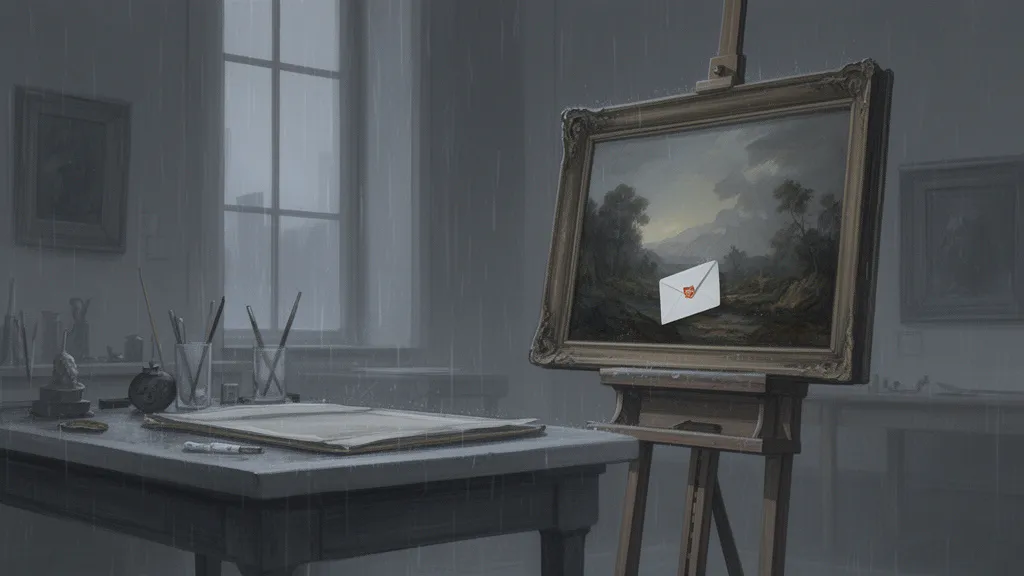
At six forty-three, before the front lights had been brought up and while the rain still worked carefully at the museum windows, Hara Chisato set her canvas bag on the conservation table and saw the envelope in the frame.
For a moment she thought some visitor from the previous day had tucked it there by accident, though that would have required a visitor to ignore both barriers and common sense. The landscape stood on an easel in the intake room, half uncrated, awaiting condition photography. It had arrived the evening before as part of the Tsunemori bequest: one late nineteenth-century mountain view, unsigned, family-held, not especially valuable on paper and therefore immediately troublesome.
The envelope was narrow, rain-darkened along one edge, and pushed behind the gilt rebate at the lower right corner so that only a finger’s width showed. Chisato stopped unbuttoning her coat. Then she crossed the room and looked without touching.
The paper was old, cream gone to a smoker’s yellow. On the front, in brown-black ink that had bled very slightly with damp, was written only:
Return what was taken.
The handwriting was deliberate and old-fashioned, as if the writer had learned from copybooks and disapproved of hurry.
Chisato put on gloves. She drew the envelope out by its sides and laid it on the blotter. Something flat shifted inside.
The museum, a former merchant house enlarged with more optimism than money, was quiet in the way only public buildings were before opening: every closed door seemed to be waiting to become somebody’s problem. Chisato listened for footsteps and heard none. She slit the envelope with a microspatula.
Inside was a single folded sheet. It had torn unevenly along one side long ago. A line of text appeared before she fully opened it.
—the right bank is false. The woman in blue—
She sat down.
There were not many things in the storeroom files capable of making the conservator sit abruptly before breakfast, but this was one. Chisato had spent two months, off and on, rehousing old documentation from the museum’s worst scandal: the theft of the Aizawa Collection in 1983. Three drawings and a notebook had vanished during a fund-raising exhibition; one elderly guard had resigned in tears; the police had found nothing. The museum had found, over the next forty years, a way to speak of heritage education instead.
Among the file copies there had been a report about a note believed to have been removed from the notebook before the theft. A page fragment, handwritten, mentioning alterations to a riverside painting and “the woman in blue.” The original fragment had later disappeared from the curatorial office during the confusion after the theft, along with several loose papers nobody had logged carefully enough. Chisato had read the typed transcript a week ago because she was the sort of person who, when given a box of badly ordered papers, wanted to know why one list had three carbons and another had none.
Now the missing fragment was in her gloved hands, tucked into a newly donated picture before opening hours.
She read the rest.
—the right bank is false. The woman in blue was painted out after the fire. Ask T. before he limps himself into the grave with it. He knows where the first canvas went.
No signature. No date. The tear matched, in ugly principle at least, the archival copy she remembered.
Chisato folded the sheet again and looked at the landscape.
It was a modest thing: river under low hills, a path, three pines, autumn reeds. The handling was competent but not distinguished. The kind of painting families preserved because somebody’s grandfather had preserved it first. The donor label tied to the crate named the owner as Tsunemori Sachiko, deceased, through the Tsunemori family office.
T. could be a number of things. It could, very inconveniently, be Tsunemori.
The rain strengthened. She took the condition lamp in both hands and tilted the beam over the canvas.
At first she saw only what she had noted the evening before: slight cracking in the darker passages, old surface dirt, a recent varnish not yet disgraceful. Then she lowered the light to rake across the lower right corner, and there it was—a thin dragged line of white caught in the texture of the weave. Not a crack. Not dust. A stroke too narrow to belong to the present composition, ending under the frame edge as if somebody had wiped a loaded brush without quite erasing the evidence.
Like a thread caught in a sleeve.
Chisato took off one glove and reached for the intake file. The donor contact form had been clipped to the front. Primary liaison: Tsunemori family secretary. For provenance questions, contact Mr. Tsunemori Keigo.
Age seventy-six. Former insurance executive. Museum patron for twenty years.
Photographed at a gala three springs ago beside a lacquer screen and a director he was not looking at.
The article mentioned his limp from injuries sustained in a warehouse fire in 1968, when he had reportedly rescued two junior clerks and several account ledgers, in that order or nearly so.
Chisato looked again at the note.
After the fire.
She disliked coincidences in museums. They were usually administrative.
At six fifty-seven the electric kettle clicked in the staff pantry down the corridor. Someone had set it on a timer, an act of optimism. Chisato rose, crossed to the office phone, and called the deputy director at home.
He answered on the fourth ring in a voice full of blanket.
"Fujimori speaking."
"It’s Hara in conservation. I’m sorry. There’s a matter concerning the Tsunemori painting and the Aizawa theft files. I think you should come in before opening."
Silence. A shift from blanket to shirt collar.
"How bad?"
"Possibly newspaper bad. Possibly only board bad. I can’t tell yet."
"That is not comforting."
"No."
He exhaled. "I’ll be there in thirty-five minutes. Touch nothing you don’t have to. And Hara—"
"Yes?"
"If this is a prank by a volunteer, I shall retire."
"That would still be paperwork," Chisato said, and put the receiver down.
She made tea because there was waiting to be done and because one should have a hot thing in hand while looking at old lies. The tea emerged too quickly and tasted of indecision. She carried it back to the intake room, where it was instantly too hot to drink.
On the opposite wall hung a plan of the special exhibition spaces. Beside it was a framed photograph from last year’s donors’ excursion to the Suzuki Inn in the mountains, everyone lined up under maples with identical smiles and different umbrellas. Tsunemori Keigo stood at one end, silver-haired, elegant, weight on a cane. Next to him was Director Minegishi, who had once described him, in a tone of civic gratitude, as “the kind of donor institutions are built upon.”
Chisato had always felt that institutions were more often built on plaster, debt, and women who knew where the forms were filed. Donors paid for the plaques.
She drank the tea too soon, burnt her tongue, and read the note once more.
By seven forty the deputy director had arrived, shaved in patches and tied into authority. He read the note standing up, sat down without intending to, and asked for tea. Chisato gave him hers. He drank it, discovered its temperature, and bore this with administrative dignity.
"You’re sure this is the fragment from 1983?"
"Sure is too large a word. The wording matches the transcript in the theft file. The torn side might fit the copy photograph of the notebook leaf. And somebody put it in a frame after I left last night or before I looked closely this morning."
"Who had access?"
"Registrar, art handlers, me, security, the family secretary during delivery for six minutes while he insisted on watching. The crate arrived at five twenty. I left at six ten. Security did an hourly round at six thirty and logged the intake room as normal. At six thirty-eight the morning cleaner signed into this corridor to mop the front stair and use the pantry sink. She has no reason to touch a frame, but she was physically here. The envelope wasn’t visible when I left, though I wasn’t examining the corners."
Fujimori pinched the bridge of his nose. "The board has a finance subcommittee at eleven. If this concerns the Tsunemori family, they will want a quiet explanation before lunch."
"Then they should have arranged for a quieter century."
He gave her the tired look people gave Chisato when she had become accidentally exact.
"Can you determine whether the painting’s been altered?"
"Perhaps. Not properly in an hour. But enough to know whether the note refers to this canvas."
"Do it. I’ll pull the old files and ask security exactly who entered this corridor after six. If Keigo Tsunemori is involved, I’d rather know in what manner before he hears from us."
"You think he sent it?"
"I think respectable men with family offices do not usually tuck anonymous notes into frames in the rain. Which means either he is less respectable than advertised, or someone wants us to look at him."
Respectable and advertised often overlapped more neatly than they deserved.
When he had gone, Chisato carried the painting to the examination room. She switched on the microscope lamp, checked the humidity reading, and set the landscape under the stronger lights. On paper the work was unspecial. Up close it became interesting in the way a sentence became interesting when one word had been altered by another hand.
The sky and hills belonged together. The pines did as well. The river had been glazed twice. But the right bank—the low slope where reeds met a pale path—had a different surface. The craquelure there was finer, and the varnish sat more evenly, as if the area had once been disturbed and then coaxed into similarity. Nothing flamboyant. Whoever had altered it had intended family peace, not criminal glory.
She brought the magnifier over the lower right corner and found the white thread again: lead white or zinc, impossible to say at a glance, dragged through olive-brown paint and partially buried under later varnish. It did not belong to reeds, clouds, or path. It belonged to something curved. A sleeve edge, perhaps. A bonnet ribbon. A shoulder highlighted then painted away.
A woman in blue.
At eight ten the registrar, Noda Haruka, came in with a stack of loan forms and immediately sensed the room’s concentration the way cats sensed thunderstorms.
"Has it begun badly?" she asked.
"Moderately," said Chisato.
Noda set the forms down. She was thirty and arranged her fringe with the seriousness of a calligrapher. "That sounds like our standard."
Chisato showed her the envelope, not the note itself. Noda listened, widened her eyes correctly, and then said, "The secretary was peculiar yesterday."
"In what way?"
"In the way of men who have spent many years carrying secrets for richer men. He kept saying the picture had sentimental value but no market value, which is a sentence no one says unless they want the second half heard. Also he asked whether old labels would remain on the reverse. I said of course, and he looked relieved, then annoyed at having looked relieved."
"Did he come near the frame?"
"Near everything. He hovered like a badly trained guardian spirit."
"What about Mr. Tsunemori?"
"Not present. Ill, according to the secretary. His daughter called later to make sure we had received the work safely. She sounded less anxious about the painting than about whether her father’s name had been entered correctly. Which, to be fair, is hereditary donor behaviour."
Noda paused, looking at the canvas. "Do you think it’s fake?"
"I think someone altered it. Fake is a matter of degree. Families do not generally fake minor landscapes for no profit. They improve them. Or simplify them."
"That sounds more dangerous."
"It often is."
Noda considered this, then leaned on the door frame. "The Tsunemoris aren’t simple, if that helps. Keigo’s sister, Sachiko, was the real collector. Never married. Or perhaps married in some emotional sense to three women and one violin teacher, depending on who is speaking. Keigo managed the finances. Their father donated aggressively. Their mother painted flowers and was said to have stopped after a house fire, though whether from grief, smoke, or marriage no one seems clear."
"Which house fire?"
"There were two. The warehouse in sixty-eight, where Keigo hurt his leg. And a smaller fire at the family villa a year later. An ashtray, officially. Why?"
Chisato did not answer at once. There was no need to explain a thought before it had bones.
"Could you get me any old photographs of the painting in the Tsunemori house? Interiors, party shots, newsletters, anything absurd?"
"Absurd I can do."
"Also, if Fujimori learns who was on the corridor this morning, tell me before he turns it into a memo."
Noda smiled with professional malice and left.
Chisato returned to the canvas. Under ultraviolet light the right bank bloomed a duller tone than the rest. Retouching. Broadly applied, then disguised. Not recent, but later than the original painting. She sketched the affected area on tracing paper. The absent figure, if figure there had been, stood just where the path widened by the reeds. A person once in the landscape and then made to leave it forever.
She thought of the note’s phrasing: painted out after the fire.
Not restored after a fire. Painted out.
At eight fifty-two Fujimori returned carrying three archive folders, one box of correspondence, and a stale cheese roll from the station. He placed all four objects on the table with equal mistrust.
"The board chair called," he said. "I lied to her. This has given me appetite. What have you found?"
Chisato showed him the UV response and the white dragged stroke. He nodded as if trying to look educated by wavelength.
"So there was a woman?"
"There was something pale over blue at this edge, I think. The note is probably referring to this canvas."
He opened one folder. "Security says the cleaner, Mrs. Ishida, came through this corridor at six thirty-eight carrying a damp umbrella and a bucket. She remembers a man in a dark coat asking whether the public lavatory was open yet. She told him no and sent him back toward the front vestibule. He was elderly, polite, and leaned on a cane. Security at the entrance assumed he was with administration because he gave the Tsunemori family name and said he had brought a provenance correction for the donated work. No one thought to telephone conservation before opening because no one in this building has enough imagination at that hour."
"So Keigo came himself," said Chisato.
"Or wished us to think so. The cleaner says he was wet from the rain and wore gloves. She turned away to fill the kettle in the pantry. When she came back down the corridor, he was gone."
That accounted for the rain-darkened edge and the brief, idiotic opportunity. Museums did not need ingenious crimes. They had doors and habits.
Fujimori turned a page. "The 1983 file mentions the missing notebook belonged to Aizawa Bunpei, dealer and occasional forger-detector, which sounds like a man who made enemies in decorative ways. He wrote comments on works he examined. One page was torn out before the theft. A museum intern copied part of the text because she found it dramatic. Bless interns."
"Who had access to the notebook before it vanished?"
"Staff, researchers, and two patrons lending works to the exhibition. One was Tsunemori Sachiko. The other is dead and was honest enough to be poor."
"Then Sachiko or someone close to her could have removed the page."
"Yes. There’s more. A private memo from our then-director says Aizawa had intended to discuss ‘a discrepancy in the Tsunemori river scene’ after the gala. He never got the chance."
Fujimori looked up. "The memo was never acted on. The director had a stroke three months later, and everyone preferred catastrophe in single servings."
There was a dry, old sadness in archives that no conservation treatment improved.
"Who in the family is alive?" Chisato asked.
"Keigo. A daughter, Mizue. A grandson studying economics against his will, probably. Sachiko died last month."
"And the mother who painted flowers?"
"No. Rieko Tsunemori. Died in 1991."
Noda appeared in the doorway with a photograph sleeve and the expression of a person who had found something both useful and socially delightful.
"I brought absurd," she said.
There were six snapshots from a charity garden party in 1979 at the Tsunemori villa. Guests in hats. A table of melons. A cocker spaniel looking compromised. In the fourth image, half-obscured behind two men discussing chrysanthemums, hung the landscape.
Chisato took a magnifier to the snapshot. The quality was poor, the colors shifted, but on the right bank there was a vertical pale mark too substantial to be reed or glare. Next to it, a denser dark shape.
A figure.
Noda watched her face. "Well?"
"In 1979 the painting was different."
Fujimori closed his eyes briefly. "Excellent. We are now in possession of both evidence and a donor."
"Do we call him?" asked Noda.
Chisato considered. The rain had eased. Eleven o’clock approached with the steady tread of board governance. She looked at the note again, and at the phrase that had seemed melodramatic until now.
Ask T. before he limps himself into the grave with it.
Not expose him. Ask him.
"No," she said. "We go to him. If this was sent by someone in the family, they wanted the painting examined before he could stop it. If it was sent by him, he may speak more easily at home than on the telephone with the museum becoming official in his ear."
Fujimori looked at his watch. "We have one hour."
"Then we should not waste it on etiquette."
The Tsunemori house stood on a hill above the old tram line, modern in the weary style of expensive homes built after people decided wood had suffered enough. The secretary admitted them with the expression of a man who had just understood that his day was no longer his own.
"Mr. Tsunemori is not receiving visitors," he said.
"Then he is receiving custodians of recently donated property implicated in an unresolved theft," said Fujimori, who improved under pressure. "Please choose which sentence he prefers."
The secretary chose resignation and led them to a sitting room with low shelves, pale carpet, and an arrangement of lilies expensive enough to suggest apology. On one wall hung flower paintings of steady, careful quality. Chisato went to them at once.
Camellias. Iris. White anemones. Unsigned, but all by the same hand.
"His mother’s," said a voice from the doorway.
Tsunemori Keigo came in with a cane and no secretary’s support. He was a large, beautifully kept old man with the kind of face newspapers called distinguished because they had no other harmless adjective. The limp was real and practiced into discretion.
He saw the envelope on the table. His expression altered less than a lesser actor’s would have, but enough.
"So it has surfaced," he said.
Fujimori, who had prepared for denial, looked slightly put out.
"You know it?" Chisato asked.
"I know of it. Not this paper in this condition. Not where it has been. May I sit? Age is an undemocratic condition."
He sat before anyone answered. Chisato remained standing near the flower paintings.
"The landscape you donated," she said, "has been altered. We believe a figure on the right bank was painted out after 1979 and before 1983. A missing note from the Aizawa theft files refers to such an alteration and mentions asking T. before he limps into the grave with the matter."
"Charming," said Keigo. "That would be my sister’s wording, or something very like it. She had a theatrical conscience."
"Your sister wrote the note?"
"Not exactly. Aizawa wrote the page in his notebook after examining the picture at our house in 1983. Sachiko found what he had written before he spoke to anyone at the gala and tore out that page. She carried it away in her handbag, intending, I think, to decide later whether to confront me with it. The notebook itself was stolen from your exhibition that same week. The torn page was never in it by then, only in the museum’s curatorial office briefly, because Sachiko panicked, copied out part of it for herself, and sent the original back anonymously after the theft had already begun to grow teeth. During that confusion it vanished again. She told me years later that she had seen one of your temporary clerks pocket loose papers from a desk while everyone ran after larger disasters. She said nothing, naturally. Forty years on, the clerk died, his widow sold boxes of old documents to a dealer, and my daughter found this fragment among Sachiko’s effects together with the copy and a letter explaining the journey in her usual vindictive handwriting. That, at least, solves the archaeology."
"Then why place it in the frame now?" Fujimori asked.
Keigo looked toward the door. The secretary, still there, found a sudden reason to withdraw. When he had gone, Keigo said, "Because my sister is dead, my daughter has inherited her dislike of silence, and the family office mistakes concealment for administration. Mizue wanted the