the cake still waiting to be cut
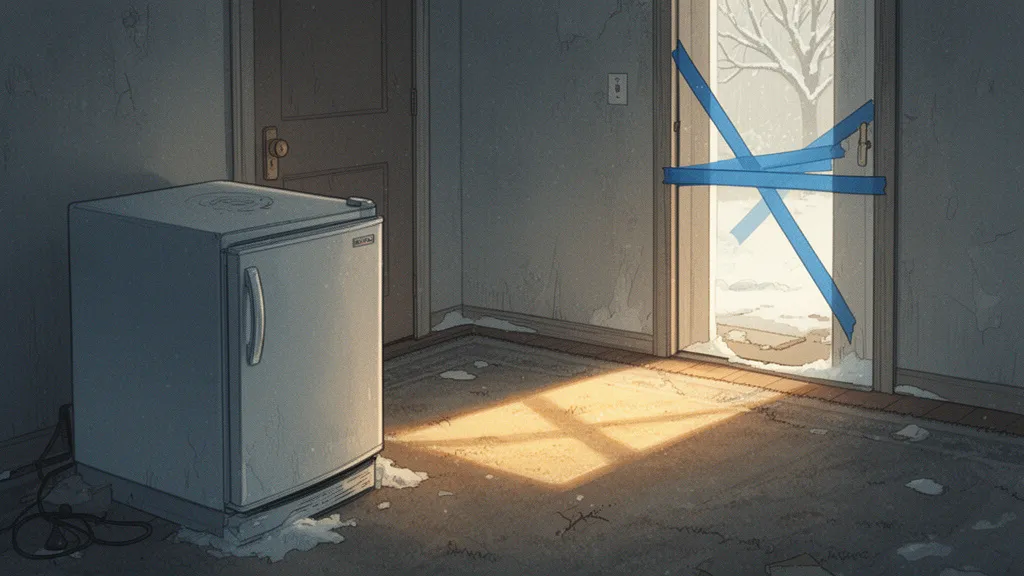
The freezer hums.
She stands in the doorway with a roll of garbage bags and a coat she doesn't need. April. The apartment has no heat but the sun is doing something through the living room window, warming the carpet in a rectangle she will later stand inside of, briefly, without knowing why.
The freezer hums like it has been waiting.
Blue painter's tape across the door. She doesn't remember who put it there. Maybe the super. Maybe the lawyer. Maybe Marcus himself, before — no. She runs her thumb along the edge. Frost has crept out from the seal, a white line like someone drew the freezer's outline in chalk, the way they do with bodies on television, which is not how they do it in life, which she knows now.
Things she brought:
- Garbage bags (13-gallon, the wrong size)
- A box cutter
- Her phone, volume off
- A list on the back of a gas receipt: freezer, closet, bathroom cabinet, desk
- The spare key he gave her in 2019, still on a keychain shaped like a little wrench
Things she did not bring:
- Another person
She peels the tape. Slowly, because the adhesive has fused with the paint and she doesn't want to leave a mark, which is absurd — the apartment will be emptied, repainted, rented to someone who will never know that a man lived here who alphabetized his spice rack but could not keep a single houseplant alive.
The tape comes away in two strips. She drops them on the floor.
The door resists. Not locked — swollen. She pulls and feels the seal break with a sound like breath.
Cold pours out like water finding a drain.
Inside:
Top shelf. Two bags of peas, store brand. A ziplock of something brown — broth, maybe, or gravy, frozen into a shape that fits the space between the bags. An ice cube tray, full, the cubes clouded white in the center the way ice gets when it's been forgotten.
Middle shelf. A foil-wrapped rectangle she recognizes before she touches it. The weight of it when she lifts it out. The way the foil crinkles and holds the impression of her fingers.
She sets it on the counter.
Bottom shelf. A frost-covered bag of hash browns. Two ice packs, the reusable kind, still blue. And behind them, flat against the back wall like someone slid it there on purpose —
An envelope.
The envelope is standard. White. Letter-sized. It has been in the freezer long enough that the paper has stiffened and the corners have curled inward, but it is not damaged. It is not even particularly cold, she thinks, and then realizes her hands are numb and she cannot tell.
On the front, in block letters so careful they look architectural:
ELLIE
That's all.
She puts the envelope on the counter next to the foil rectangle, which she already knows is the birthday cake. Marble. From the bakery on Ninth whose name she can never remember, the one with the green awning that used to be red. He bought it every year for her birthday. He bought it this year, too. Her birthday was March 12th. He died March 9th.
She stands in the rectangle of sun on the carpet. She counts to something. She stops counting.
The cake, unwrapped:
White frosting, slightly crystallized from freezer burn. The top reads Happy Birthday E in blue cursive. Not Ellie. Just E. Because the woman at the bakery always asked how to spell it, and Marcus always said, just the letter, she'll know, and Ellie always pretended to be annoyed, and now she is not pretending anything.
She wraps it back up.
The envelope.
She picks it up. It is lighter than she expected. She holds it to the window. A single sheet, folded. She cannot read through the paper.
She could not open it. She understands this as an option. She could put it in her coat pocket and carry it home and slide it into the drawer of her nightstand where she keeps the wrench keychain and the photo from the beach in 2016 and the parking ticket he got the night he drove her to the ER for the kidney stone, and she could leave it sealed, and it would become another object in the archive of him, and eventually she would die too, and someone would find it, and maybe they would open it or maybe they wouldn't, and the words inside would have meant the same thing either way, which is to say: something only to her, and then nothing to anyone.
She opens it.
The letter:
Ellie —
I know you'll be the one to clean this out. You're the only person I'd trust to actually throw away frozen peas.
The cake is for your birthday. I bought it early because the bakery closes for two weeks in March and I didn't want to forget. If you're reading this and your birthday has already passed, I'm sorry. Eat it anyway. It freezes well.
I need to ask you something and I'm putting it in here because if I say it out loud you'll argue with me and I don't have the energy to win.
The desk in the other room. Bottom drawer, left side. There's a notebook with a red cover. It has everything in it. I mean everything. The years I didn't talk to you. The years I should have. What happened with Dad. What I did after. All the things I could not figure out how to carry in a conversation.
I want you to get rid of it. Don't read it. I know that's unfair. I know you'll want to. But the notebook was for me — it was how I got through it. And some of what's in there would hurt you, not because it's about you but because you'd try to take it on. You'd try to fix something that doesn't need fixing anymore. I already fixed it. It took a long time and the fixing is ugly and I don't want you to see the mess I made on the way.
Throw it out or burn it. Please.
The cake is yours. The notebook isn't.
I love you. I should have said that more in the version of me that was standing in front of you.
— M
She reads it twice. She reads it a third time. The paper is warming in her hands now and it softens, loses the freezer stiffness, becomes just paper. She folds it along the original crease and puts it back in the envelope and puts the envelope in her coat pocket.
She walks to the other room.
The desk is old — particleboard, the kind that sags in the center after a few years. She'd offered to buy him a real one. He'd said this one was fine. The bottom drawer sticks. She pulls harder and something shifts inside, a sliding sound, and the drawer opens.
Left side. Red cover.
The notebook is the kind you buy at a drugstore. Seventy pages, college-ruled. The cover is red but faded at the edges to a color closer to rust. She picks it up. It is heavier than a seventy-page notebook should be. He wrote on every page. She can see that from the way the pages swell against the binding, ink and pressure thickening each sheet.
She holds it.
What she knows about the years he didn't talk to her: almost nothing. 2014 to 2017. Three years of voicemails she left and he didn't return. She'd assumed it was about the drinking, or about their father, or about something she did at the funeral that she has replayed so many times it has lost all shape, like a word said too often.
He came back in 2017. He called on a Tuesday. He said, I'm sorry, I had to go somewhere, I'm back now. She didn't ask where. She should have asked where.
The notebook would tell her where.
She sits on the floor with the notebook in her lap. The carpet smells like dust and something faintly sweet — his laundry detergent, maybe, soaked into the fibers over years.
She does not open it.
She thinks about the word fixed. She thinks about Marcus saying I already fixed it in his careful block letters, as if healing were carpentry, as if you could point to the joint and say, there, that's where it holds now.
She thinks about how he asked her not to look.
She thinks about how the asking is, itself, a kind of looking — how he is showing her the shape of the wound by telling her not to touch it. She already knows it was bad. She already knows he went somewhere she couldn't follow. The notebook would give her details, but details are not the same as understanding, and understanding is not the same as closeness, and closeness is not what he is offering.
What he is offering is the cake.
She stands up. She puts the notebook in a garbage bag. She ties the bag. She carries it to the kitchen and puts it by the door with the other things to throw away.
Then she unties the bag. She takes the notebook out. She puts it back in the bag. She ties it again.
She leaves it by the door.
The cake is still on the counter, wrapped in foil, beginning to sweat. She peels back one corner. The frosting has softened just enough that the blue E is bleeding slightly into the white, the letter losing its edge, becoming less a letter and more a bruise of color.
She finds a fork in the dish rack. It is clean. He always washed his dishes before bed, even at the end, even when other things were falling away from him. She remembers this. She will keep remembering this.
She eats the cake standing up, starting from the corner farthest from the E, saving the letter for last.
The garbage bag stays by the door.
She does not open it again.
She does not need to tell you whether this cost her something. You already know. You've been standing in a room like this, or you will be, holding something that belongs to someone who is asking you, from a great and permanent distance, to trust that they knew what they were doing.
The freezer hums.
She unplugs it.
The silence is the loudest thing in the apartment, and she stands inside it until it becomes ordinary, which takes longer than you'd think.