the coat still warm from somewhere
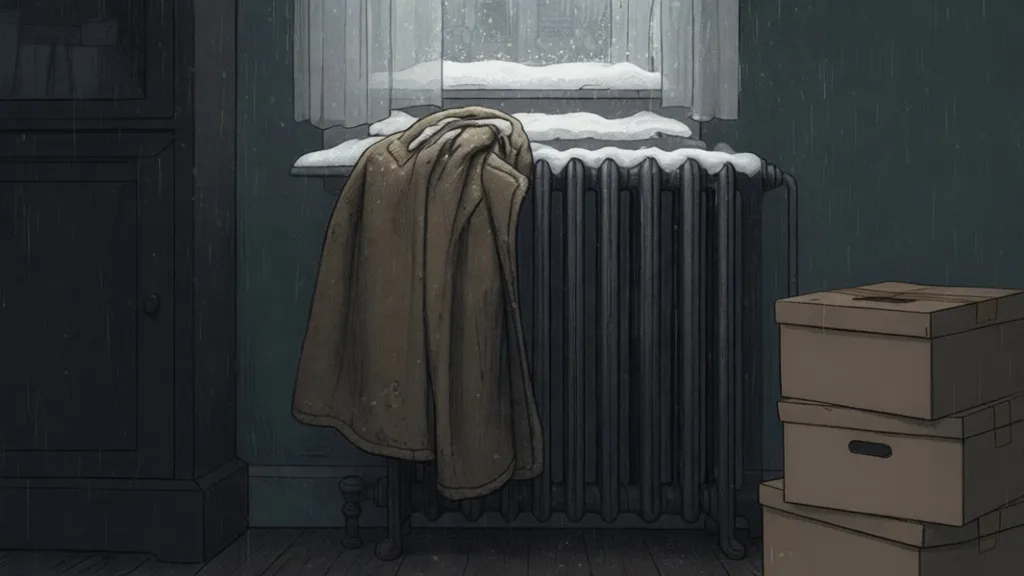
The radiator is off. She checked.
The coat is warm anyway — draped across the iron ribs like someone just set it down, wool the color of mud after rain, two buttons missing. She touches the sleeve before she means to.
Moth-eaten at the left cuff. A hole near the collar she could fit her thumb through.
She has been in the apartment eleven minutes. She has opened nothing, moved nothing, sorted nothing. She is still wearing her shoes.
The boxes are from the funeral home. Flat-packed, unassembled. Her mother ordered them by phone: twenty bankers boxes, delivered to the building entrance, carried up by the super. For his things, her mother said, as though things were a finite category.
She counts the rooms. Kitchen. Bathroom. The room he slept in. The room he didn't sleep in but filled with — she doesn't have a word. Not junk. Not collection. Evidence, maybe. Evidence of having been a person who acquired.
The coat pocket.
She doesn't check it right away. She lifts the coat from the radiator and holds it against herself, arms out, the way you'd hold a child's painting to judge its scale. It's too big for her. It was too big for him. He was not a large person. He wore things oversized because — she realizes she doesn't know why. She assumed she knew. She assumed it was an aesthetic. Maybe it was comfort. Maybe it was hiding.
She folds the coat over one arm and the receipt slips out of the right pocket and lands on the floor, face up.
Milk (2%). Bread, sourdough. Peanut butter. Oranges (3). Laundry detergent, unscented.
At the bottom, in pen, a name: Dara.
And a phone number.
She does not know a Dara. She sits on the floor with the receipt in her lap and goes through the list of people she met at the funeral. Thirty-one people, maybe thirty-five. She'd shaken every hand. She remembers the hands better than the faces — dry, damp, firm, trembling, one woman with rings on every finger, one man whose grip lasted a beat too long.
No Dara.
She turns the receipt over. The back is blank. The date is eleven days before he died. The store is the one on the corner, the one she can see from this window if she stands and looks.
She does not stand and look.
She assembles four boxes. The tape gun is loud in the apartment. Every sound is loud in the apartment. She hadn't noticed, before, how the building's pipes carry noise — someone else's water running through the wall behind the kitchen. Someone else's life in its ordinary rhythm.
She puts the receipt on the kitchen counter, next to the stove, under a salt shaker shaped like a small bear. She doesn't remember giving him the salt shaker but it looks like something she would have given him.
The knock.
The super is named Gio. She knows this from the lease, not from conversation. He's standing in the hall with a ring of keys and a face that is trying to look casual and failing.
"Just checking you got in okay," he says.
"I got in okay."
He nods. Doesn't leave. His eyes move past her into the apartment and she watches them land on the coat, now folded on the couch.
"I should mention," he says.
Two nights after the funeral. Around one in the morning. Gio was on the first floor fixing a hinge — he does not explain why he was fixing a hinge at one in the morning and she does not ask. Someone came in through the front entrance with a key. Not buzzing in. A key. Went upstairs. He heard the door. Her brother's door. The same sticky lock, the same sound it makes, the lift-and-turn.
He went up twenty minutes later. The door was closed. Locked. He knocked and no one answered.
In the morning, he let himself in. Nothing looked different. Nothing looked disturbed. But the recycling bin in the kitchen had been emptied.
"Just the recycling?" she says.
"Just the recycling."
She thinks about this. "What was in it?"
Gio shakes his head. "Bottles, I think. Papers. I didn't look close. I wasn't — I mean, he was alive then. It was just recycling."
She sits on the couch with the coat beside her. The wool smells like him — or like the apartment, which smelled like him, which is becoming a distinction without a difference.
She picks up the receipt again.
Dara.
The handwriting is not her brother's. His handwriting was angular, tall, like a city seen from a distance. This handwriting is round. Careful. The D has a small serif at the top, deliberate, like someone who practiced their own name as a child and never stopped.
She could call the number.
She dials five of the digits and then stops. Sets the phone on the counter. Picks up the tape gun. Starts on the bedroom.
Shirts. He had so many shirts. Not expensive, not new, mostly cotton, mostly blue or grey or green. She folds each one the way he folded them — she'd watched him once, at a laundromat when they were both in their twenties, and thought: so that's how you fold a shirt. Not their mother's method. His own. Two folds, not three. The sleeves tucked under, not across.
Box one fills. Box two fills.
In the third drawer: a scarf she doesn't recognize. Cashmere or something close. Plum-colored. Not his color. She lifts it and something falls — a photograph, wallet-sized, tucked inside the scarf's fold.
Two people at a table. Him. And someone else. The someone else has short dark hair and is laughing with their mouth open and their hand on his arm. He is not laughing but he is looking at the person who is. His face is doing something she has never seen it do.
She turns it over. Nothing written.
She does not know who this is.
She sits on his bed, which is made — he made his bed, she knew that, but seeing it now undoes something — and holds the photograph under the lamp.
His face. The expression she can't name. Not happiness exactly. Something before happiness, or beside it. A kind of willingness. His shoulders are down. His jaw is unclenched. He is wearing the coat.
She calls the number.
It rings four times. A voice answers — not hello, just a sound, a breath, a waiting.
"My name is — I'm —" She stops. Starts over. "I found this number in a coat pocket. My brother's coat."
Silence.
"He died," she says, though this is not news, or maybe it is.
The silence changes shape. It becomes held.
"I know," the voice says. Quiet. Not steady.
She asks: "Did you come to the apartment?"
A pause she could fall into.
"I had a key," Dara says. Not answering the question. Answering a different one.
They don't meet. That's not what happens. What happens is the phone call lasts forty minutes and when it's over she knows the following:
Dara and her brother ate dinner together most Thursdays. Dara is the one who bought the sourdough. Her brother kept a spider plant on the fire escape and named it, though Dara won't say the name — that's his, Dara says, and the possessive tense holds. Dara took the recycling because it had letters in it, letters Dara had written, and Dara didn't want anyone to read them. Not because they contained anything wrong. Because they were spoken into a room that was just the two of them — Dara says this exactly — and the room was gone now.
She asks how long.
"Three years," Dara says.
Three years.
She stands at the window. The corner store is closing, a man pulling the metal gate down in sections. The sound reaches her a half-second late, the way everything in this apartment reaches her — delayed, through a medium she can't identify.
Three years of Thursdays. A hundred and fifty dinners, give or take. Sourdough. Unscented detergent because — she doesn't know. She doesn't know if it was an allergy or a preference or something Dara needed. She doesn't know any of it.
She puts the photograph on top of the scarf. She puts the scarf in the coat pocket, where the receipt was. She puts the receipt in her own wallet, behind her license, where she'll find it in six months and stand very still in a pharmacy aisle remembering this exact moment.
She doesn't finish the boxes. She folds two of them back flat and leans them against the wall.
The coat she puts on. It is still warm, or she is warm inside it, or warmth has become an unreliable category.
She locks the door. The lock sticks. She lifts the door slightly with her knee while turning the key, the gesture arriving in her body before she can think about who taught it to her.
The hallway is dim. Gio's light is on downstairs. She doesn't stop.
She is wearing his coat into the street, into the last hour of daylight, and the coat holds what it holds: the scarf, the photograph, the shape of someone she did not finish knowing and will not now. The wool scratches at her wrists where the moths have been. She does not fold the cuffs.
She wears it as it is. Too big. Full of holes. Warm from somewhere she cannot explain and has stopped trying to.