the dates still legible in black
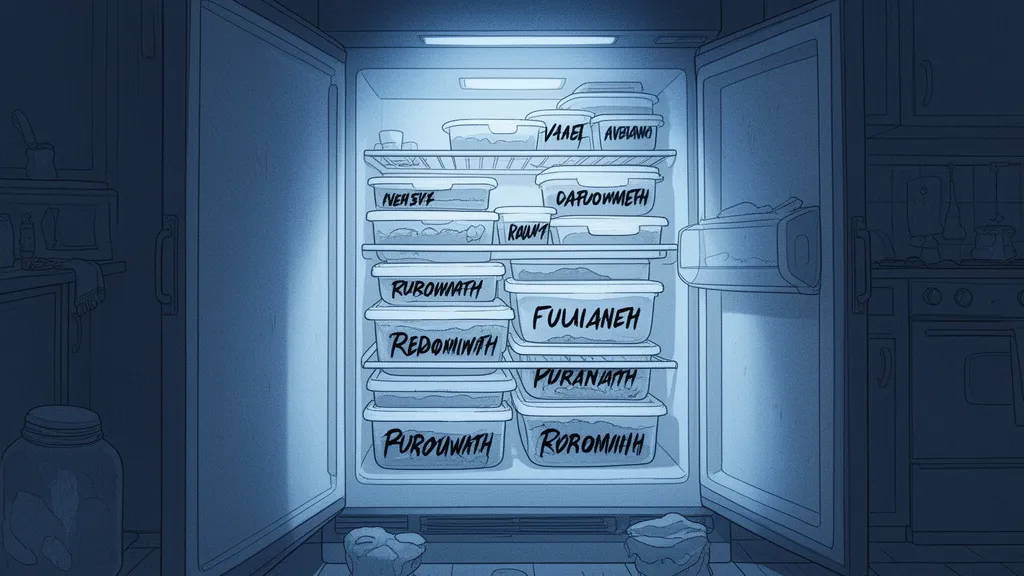
The freezer is organized the way a person organizes things when they believe they will come back.
She counts them. Eleven containers. White lids, rectangular, the kind you buy in stacks of five at the hardware store on Ellesmere. Each one labeled in black marker — his handwriting, which never changed from the time he was twelve, all capitals, the A's always missing their crossbars.
MARCH 8. MARCH 9. MARCH 10. MARCH 10 (2). MARCH 11.
He died on the twelfth.
The apartment smells the way it must have for weeks before anyone came. Onions — maybe the ones still in the mesh bag on the counter, softening into themselves. And bleach, which she can't explain. She hasn't cleaned anything. Someone else did, or he did, or the smell is something she is inventing because the alternative is worse.
She sets her bag by the door. She does not take off her shoes. This is not her home.
The landlord said five o'clock. That was the only firm thing in his voicemail, which was otherwise a small fog of sympathy and logistics. I'm sorry for your loss. If you could have the unit cleared by — well, we're flexible, but the new tenant — five o'clock would be ideal. I'll bring boxes if you need.
She does not need boxes. She brought garbage bags.
She starts with the bathroom because it is the smallest room and she can close the door behind her when she's done. Razor. Toothbrush. A bottle of ibuprofen with seven pills left. She shakes them into the toilet and watches them dissolve partway before she flushes. The medicine cabinet mirror swings open and she sees herself cut in half by the frame — one eye, half a mouth — and she closes it.
The bathroom takes eleven minutes.
She does not start with the bedroom.
The kitchen. The mesh bag of onions goes into a garbage bag. A loaf of bread, green at the edges. A jar of peanut butter, lid off, a knife still resting across the mouth. She stares at the knife for a long time. Not because it means anything. Because it was the last thing he touched in this room, or near to it, and she is trying to reconstruct the ordinary sequence of a day that ended.
Peanut butter. Bread. Maybe he stood at the counter. Maybe he sat.
She puts the knife in the sink.
The freezer.
She has been avoiding it the way you avoid a room where someone is sleeping.
MARCH 8 is the oldest.
She pries the lid off. Inside: soup, frozen solid, a deep orange that means carrots and something else — sweet potato, maybe. The surface is cracked where it expanded. She sets it on the counter and watches the frost begin to sweat.
MARCH 9 is the same. Soup. Darker. She doesn't open it all the way.
MARCH 10 contains rice and something in a brown sauce. The lid is slightly warped.
MARCH 10 (2) — she pauses here. Two meals in one day, both labeled, both stored. She doesn't know what to do with this information. She doesn't know what to do with any of it.
MARCH 11 is lighter than the others. She can tell before she opens it. It doesn't have the weight of food.
Inside: a single ziplock bag, pressed flat against the bottom of the container. Inside the bag, folded once: a receipt.
She unfolds it at the kitchen table.
The ink has bled slightly, the way thermal paper does when it gets cold, but she can read it.
HARBORLINE HOTEL 414 COURT ST ROOM 6 1 NIGHT — $187.00 PAID: CASH 03/11
March eleventh. The day before.
She reads it again.
She reads it a third time, as if the numbers might rearrange themselves into something she already knows.
A hotel room. Cash. One night. The night before he died, or the night of — she doesn't know what time, the receipt doesn't say check-in, just the date and the amount and the address, which she recognizes. Court Street. That's south, past the bridge, in the part of the city she has never had a reason to visit.
She puts the receipt on the table and presses it flat with both hands.
Here is what she knows: he lived alone. He cooked every day. He labeled things. He did not call her the last week of his life, which was not unusual — they went weeks sometimes, both of them, it was not a silence that signaled anything. He had friends she'd met and friends she hadn't. He worked at the print shop on Delaney until it closed, and then he didn't work, and she didn't ask how he was managing because the one time she asked he said I'm managing and the conversation sealed itself shut.
Here is what she doesn't know: why he would pay cash for a hotel room fifteen minutes from his own apartment on the last night of his life.
The soup from March 8 is beginning to thaw. A thin orange liquid pools around the base of the container. She moves it to the sink.
She checks her phone. 2:14.
She has until five.
She could finish the kitchen. She could do the bedroom. She could fill the garbage bags and line them by the door and hand the key to the landlord and drive home and sit in her own kitchen and read the receipt again under her own light and decide then. Tomorrow. Next week.
Or she could go to 414 Court Street and ask — what. My brother stayed here on March 11th. What can you tell me.
What could they tell her. What would she want them to.
She opens the remaining containers.
All soup. All frozen. No more receipts, no more plastic bags. Just food made by a person who expected to eat it.
The bedroom door is closed. She opens it.
Bed made. Not neatly — the comforter pulled up, the pillows stacked, the way someone makes a bed without thinking about it. A glass of water on the nightstand, still half full, and she looks at it and feels the whole weight of the afternoon land on her chest because he poured this. He filled a glass and set it down and the water is still here and he is not.
She sits on the edge of the bed. The mattress dips the way mattresses do.
She stays there for four minutes. She counts.
In the closet: shirts she remembers, shirts she doesn't. A coat she gave him three Christmases ago, the lining torn at the left pocket. She puts her hand through the hole and finds, at the bottom, between the shell and the lining, a subway card with $4.50 remaining.
She puts it in her own pocket. She doesn't decide to. Her hand just does it.
The receipt is still on the kitchen table.
She photographs it with her phone. She folds it back into the ziplock bag. She puts the bag in her coat pocket, next to the subway card.
2:41.
She could take the subway. Court Street is four stops south on the local line. She could be there by 3:15, ask her question, receive no answer or an answer she doesn't want, and be back by 4:30 with time to finish.
Or she could stay. Clear the apartment. Hand over the key. Let the receipt be a thing she found, a detail with no context, a door she chose not to open.
She runs the water in the sink. The orange soup liquid swirls and drains. She watches it go.
The thing about grief — she has learned this, she is still learning it — is that it does not ask you to understand. It asks you to continue in the presence of what you do not understand. To sit at a kitchen table with a receipt that means something you cannot yet name and to keep breathing while the freezer defrosts and the light outside shifts from the quality of early afternoon to the quality of something later.
She knows this. She has known it for weeks.
It does not help.
She puts the remaining containers back in the freezer. She does not know why. The landlord will throw them out. The new tenant will find an empty freezer, or the landlord will unplug it, and the soup will thaw and spoil and be discarded, and none of it will matter.
She puts them back anyway, lids aligned, labels facing out.
2:58.
She picks up her bag. She leaves the garbage bags half full by the door. She locks the apartment with the key she was given, the one that was mailed to her in an envelope with no return address, just her name in handwriting she didn't recognize — the landlord's, probably — and she walks to the subway entrance on the corner.
The turnstile accepts the card from his coat lining. $4.50. Enough for a round trip.
The platform is nearly empty. A man with a stroller. A teenager reading something on her phone with the intensity of someone being told a secret.
She stands at the yellow line and waits.
She does not know what she will find.
She does not know that she will find anything.
The train comes, and the doors open, and she steps into the car, and the doors close behind her, and the train moves south, toward the part of the city she has never had a reason to visit until now.
The soup is thawing in the sink.
The bed is made.
The apartment holds its breath.
She rides with her hand in her pocket, the receipt folded against her fingers, the amount memorized already — $187, cash, one night — and the train rocks gently on the rails, and she watches the stations pass, and she does not yet know what the room will look like, whether it will still smell like him, whether the desk clerk will remember, whether there is anything to remember, whether knowing will be better or worse than not knowing, whether better and worse are even the right words for what this is.
The train stops. The doors open.
She gets off.