the key still warm from holding
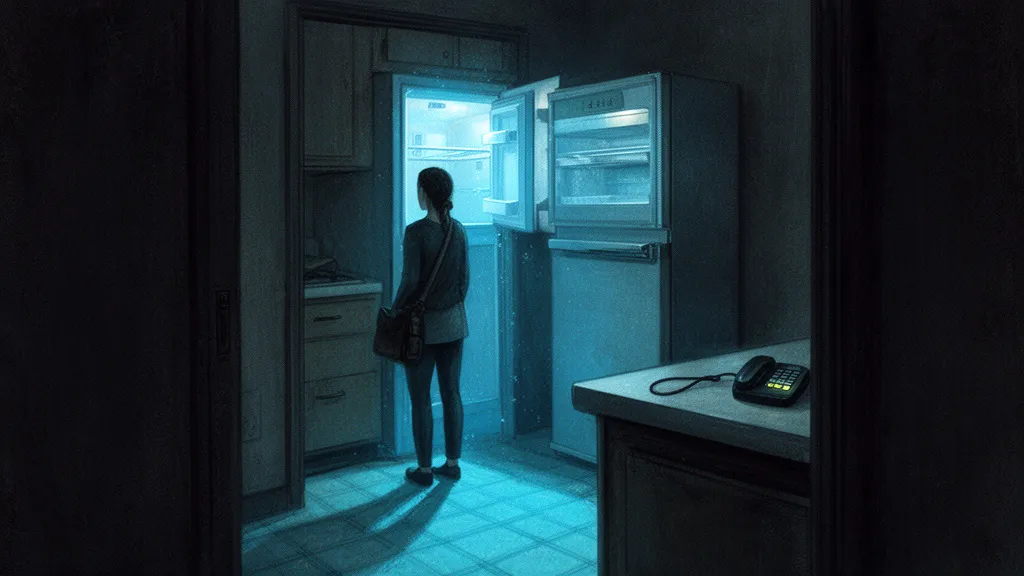
The freezer door is open three inches. She can tell from the hallway because the light is wrong — that particular underwater blue leaking across the linoleum, finding the baseboards, pooling.
She stands in the doorway with her bag still on her shoulder.
The apartment smells like something between a question and an answer.
The phone is dead. She knows this already but she plugs it in again, presses the button, waits for the screen to offer her something. It doesn't. It sits on the counter in its own faint blue glow, the charging icon a small lie: the cable has been unreliable for weeks. She adjusts the angle. Presses the connector in harder. Holds it.
Nothing.
She lets go.
The meat is sweating. That is the accurate word — not thawing, not leaking, but sweating, the way a body does. The plastic wrap on the chicken thighs has gone slack and wet. The ground beef, bought on sale three weeks ago, has darkened to a color she associates with something she does not want to name. The pork chops are the worst. They have released a pale liquid that has crept to the edge of the shelf and begun a slow migration downward, finding the vegetable drawer, pooling around a bag of frozen corn she forgot she owned.
She touches the shelf. It is the temperature of skin.
She closes the door. Opens it again.
The light inside is still on. At least that.
The power went out sometime while she was at work. She can tell because the microwave clock reads 12:00 in its patient, insistent way, and the living room fan has reset itself to the lowest setting, barely stirring. The humidity has gotten in. The windows are fogged from the inside, which should not be possible, but the apartment does what it wants in August.
She opens the freezer again.
The smell is already in the walls.
She finds a garbage bag under the sink. Black, the large kind, meant for yard work she does not do. She begins pulling things out.
Chicken thighs: $4.29. She remembers the sticker. She peels it off the wrap before dropping the package in the bag.
Ground beef: no sticker. She doesn't remember buying it. She puts it in anyway.
Pork chops. The corn. A sleeve of frozen waffles, soft now, the box disintegrating. A container of something unlabeled — soup, maybe, or stock, frozen months ago with good intentions.
She ties the bag. The apartment light flickers once, twice, and holds.
That is when the phone comes on.
Seven voicemails. All from the same number. She hasn't saved it as a contact, but she recognizes it the way she recognizes certain handwriting, or the sound of a door that belongs to a particular house.
She presses play.
First message. 6:47 PM.
Hey. It's me. I know you probably — look, I'm in the parking lot. I've been sitting here for twenty minutes trying to figure out how to say this without it sounding like I'm asking you for something. But I am asking you for something. So. Mom's storage unit. The estate company is clearing it at 6 AM. I need the key. I think you have the key. Call me back.
Second message. 7:12 PM.
Me again. You're probably still at work. I should have called earlier. I should have called in March. I know. I know that. Just — the key. The one on the blue keychain. If you still have it. If you haven't — I don't know. Call me.
She pauses the playback. Sets the phone on the counter. The charging cable slips and the screen dims.
She picks up the cable. Adjusts. Holds.
The screen brightens.
Third message. 7:38 PM.
The hospice has this smell. I don't know if you remember. You were here once, at the beginning, and I don't think you stayed long enough for it to get into your clothes. It gets into your clothes. I've been coming every day for two weeks and my car smells like it now. I leave the windows down in the lot and it doesn't help.
Anyway. The key.
Fourth message. 8:01 PM.
I found a receipt in her nightstand. For the unit. She's been paying $89 a month since 2019. I don't know what's in there. She wouldn't say. She kept saying you know, like it was obvious, like we'd been having a conversation about it for years. We hadn't. You know how she does that. Did that.
Does. She's still here. I should be more careful.
She opens the refrigerator. The regular part. Everything inside is fine — the milk, the eggs, the half-empty jar of olives she keeps moving but never finishes. The light is steady and clean. She closes it.
She opens the freezer.
The shelves are empty now, except for the liquid, which has spread into a thin film across every surface. She should wipe it. She should wipe it now before it sets, before it becomes the thing she smells every time she opens this door for the next six months.
She gets a towel.
The towel is white. Was white. She folds it into the sink when she's done and does not look at it.
Fifth message. 8:23 PM.
She asked about you today. She said your name like she was testing it. Like she wasn't sure it still worked.
I told her you were busy. Which is what I always tell her. I don't know if she believes it. I don't know how much she's tracking anymore. Some days she's right there, sharp, and she'll say something that makes me feel like I'm twelve and I broke the screen door again. Other days she asks me if Dad is parking the car.
Dad's been dead for nine years.
You know that.
She is sitting on the kitchen floor now. She doesn't remember deciding to sit. The linoleum is cool through her skirt, which is the first comfortable thing that has happened since she got home.
The garbage bag is by the door. She can smell it from here.
She should take it out. She should take it to the dumpster behind the building before the smell gets into the hallway, before Mrs. Campos in 4B opens her door and gives her that look, the one that is not a complaint but is shaped exactly like one.
She doesn't move.
Sixth message. 9:14 PM.
I'm still in the lot. My phone's at 12 percent. I'm going to go in soon — they let me sit with her after visiting hours, I don't know if they're supposed to but they do.
I keep thinking about the house. Not this — not the hospice. The house. The kitchen. The way she kept everything. Every bag, every receipt, every twist tie. Remember the drawer? The one that wouldn't close because it was so full of twist ties? I hated that. I hated all of it. I thought it was a sickness.
Now I'm paying $89 a month to keep a storage unit full of things she wouldn't throw away and I'm calling you at nine o'clock on a Friday to make sure nobody else throws them away either.
So.
There is a blue keychain in the drawer by the front door. She has not opened this drawer in weeks. It sticks — not because it's broken, but because she put too many things in it, the way a person does with a drawer by the front door. Menus. Batteries. A screwdriver she used once. Three pens, none of which work.
The keychain has one key on it. Small, brass, the kind that opens a padlock. Her mother gave it to her in 2020, in the parking lot of the storage facility, standing between their two cars with the engine still running.
Just in case, her mother said.
In case of what.
Her mother didn't answer. She put the key in her palm and closed her fingers around it, the way you give a child a coin and tell them to hold on tight.
She held on tight.
Seventh message. 9:41 PM.
Okay. My phone is about to die. I don't know if you're getting these or if your phone is off or if you just — I don't know.
I'm not angry. I want to say that. I know it sounds like I'm angry. I hear it in my own voice and I want to correct it but I don't know how to correct a voicemail. You just have to keep going forward.
If you have the key, bring it to the unit by 5. I'll be there. If you don't have it, or if you don't want to come, that's — that's an answer too.
I'll be there either way.
[End of messages.]
She replays the sixth one. The part about the twist ties.
She replays it again.
The garbage bag goes to the dumpster. She takes the stairs because the elevator has been unreliable since June, and the stairwell smells like concrete and heat and someone else's dinner. The bag bumps against her leg on each step. She can feel the weight shifting inside — the soft, wrong weight of things returning to what they were before she intervened.
The dumpster lid is heavy. She throws the bag in. It lands with a sound that is too quiet for what it contains.
She stands in the alley. The humidity is a hand on her chest.
Upstairs she washes her hands twice. Dries them on the towel in the sink, forgetting. Looks at her hands.
Washes them again.
The receipts are in a shoebox on the closet shelf. Not her receipts — her mother's. Three years of them, delivered in a grocery bag the last time she visited the house, her mother pressing them into her arms with the same urgency as the key.
Keep these for me.
These are grocery receipts, Mom.
Keep them.
Some are damp. Not from tonight — from before, from the bag itself, from the closet's small humid ecosystem. She spreads them on the bed. They curl at the edges like something trying to close itself.
She reads them. Milk. Bread. Bananas, always bananas, she cannot remember her mother eating a single banana. Soap. Paper towels. Roast, $11.47. Roast, $13.02. Roast, $9.89.
So much meat. Bought on sale, frozen, kept.
She folds the receipts into a pile. Some of them tear. She keeps the torn ones anyway.
The clock on the microwave still reads 12:00. She doesn't reset it.
At 2 AM she is awake. The apartment has cooled slightly, or she has stopped noticing the heat, which amounts to the same thing. The freezer hums. Empty now, clean, it hums differently — higher, with less effort. A body with nothing to carry.
She picks up the phone. The cable holds. The screen lights up.
She does not call.
She opens the drawer. Takes out the key. Holds it in her closed fist the way she was taught.
The drive takes forty minutes. The city is empty in the way that only happens between 3 and 5 AM, when the streetlights are performing for no one. She takes the highway because the surface streets have a way of pulling her past the house — not on purpose, but by habit, the way a hand reaches for a light switch in a room that has been rewired.
The storage facility is on a road she does not know the name of. She has been here once. She remembers the gate code because her mother said it was the year she was born and the year her brother was born, side by side, and she wondered if that was sentimental or just easy to remember, and decided it was both, which is probably the same thing.
The code works.
His car is in the lot. The windows are down. He is asleep in the driver's seat, tilted against the headrest, his mouth slightly open. He looks like their father, which she has never told him and will not tell him now.
She stands at the window.
She could put the key on the dashboard. She could leave it on the hood. She could slide it into the cup holder without waking him and drive home and that would be enough, that would be the answer, the key delivered, the task complete.
She knocks on the roof. Softly. The way you knock on a door you're not sure you want opened.
He wakes up.
He looks at her.
She opens her hand.
The unit is the size of a small bedroom. Floor to ceiling. Boxes, bags, furniture she half-recognizes. A lamp from the living room, its shade slightly crushed. A chair that used to be by the window. Things she thought were thrown away, kept. Things she forgot existed, saved.
They stand side by side in the doorway.
Neither of them goes in.
The sky behind them is beginning to change — not light yet, but the darkness thinning, becoming less sure of itself.
He says: I don't know where to start.
She says: I know.
She steps inside. Her hand finds the lamp. She straightens the shade.
Outside, the first truck pulls into the lot. 5:47 AM. They have thirteen minutes, or they have longer — she doesn't know the rules, she never read the paperwork, she is not the one who has been managing this.
She is just the one with the key.
He steps in after her.
The door stays open. The light comes in.