the labels facing out
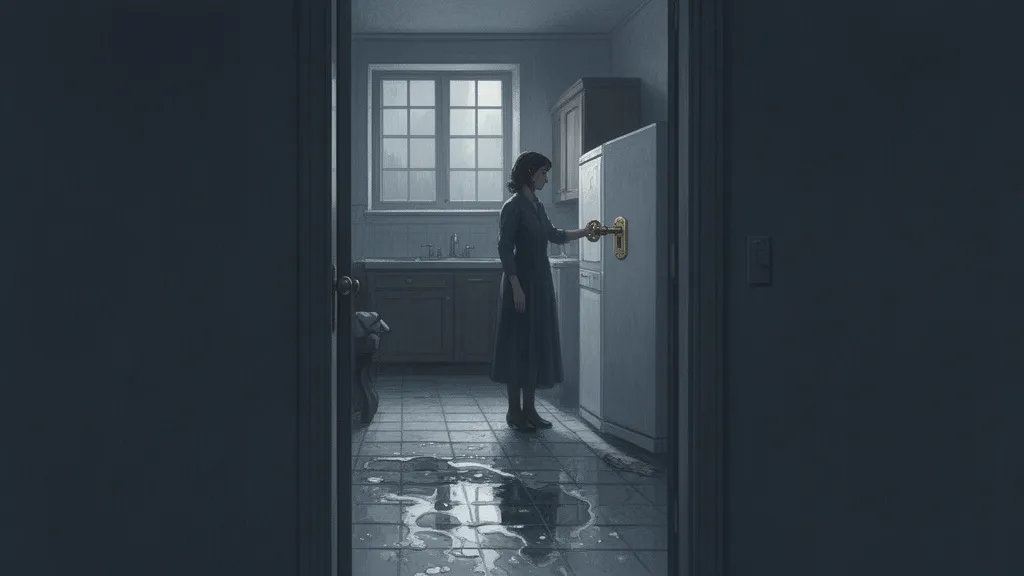
The key sticks. It has always stuck. She knows to lift the door slightly with her knee while turning, the way you learn a body's particular language — this lock needs pressure here, release there. The brass key is warm from her coat pocket, which was his coat pocket, which is a distinction she has stopped making.
She gets the door open.
The smell is the first thing. Not rot. Something flatter. The mineral smell of standing water, old ice, the inside of a machine left running past its purpose.
The kitchen tile is wet. A slow, clear spread from under the freezer — she can see the path it's taken, following the grout lines toward the baseboard. The superintendent called her at seven this morning. Water's coming through the ceiling into 4B. You need to deal with this today or I'm having it hauled out.
She said: I'll be there by nine.
It is nine-fourteen. She sets down the takeaway menus on the counter — she doesn't know why she brought them, they were in the coat with the key, a thick stack held together with a rubber band, menus from places she has never eaten, places that may no longer exist — and she opens the freezer.
The seal gives with a sound like a slow breath.
Inside: frost. Thick, white, built up in ridges along the walls of the compartment. The freezer is a small one, chest-style, the kind you buy secondhand when you've decided to start cooking in bulk, to become the kind of person who plans. He bought it in March. She remembers because he called her about it, pleased with himself, said he'd carried it up four flights with a neighbor he described only as the one with the dog.
She hasn't opened it since the last time she was here. August. She'd stood in this kitchen and looked at the freezer and not opened it, because the estate lawyer said the apartment could keep until October, and October felt far away, and the freezer was humming normally then. She had opened the cabinets instead. Taken the spices that hadn't expired. Left everything else.
Now the hum is wrong — labored, arrhythmic, a compressor losing its argument with entropy.
She pulls out the top layer. Two bags of frozen peas, welded together by frost. A ziplock of what appears to be chicken stock, dated in his handwriting: June 8. She sets these in the sink. A bag of frozen berries, store-bought, the plastic gone cloudy. A container of something brown — soup, maybe, or chili — without a label.
Underneath: two foil-wrapped packages. Heavier than she expects. Each one the size of a thick paperback, wrapped tight and neat, the foil smoothed down with care she recognizes. He wrapped things the way their mother wrapped things, folding the edges under, tucking the corners, making the outside precise because what was inside might not be.
On each package, a strip of masking tape. On each strip, his handwriting.
She can't read it. The frost has gotten under the tape, turned the ink into a blue-gray suggestion of letters.
She runs warm water in the sink. Holds the first package under the stream, just over the tape, watching the frost recede in a slow white line.
The letters surface like something coming up from deep water.
Eleanor's — Nov 17 — the good one
She turns off the water.
November 17th. Her birthday. Last November 17th. The last one before.
She holds the package and the water drips onto her shoes and she does not move for what feels like a long time but is probably eight seconds.
The second package. She runs it under the water too, slower this time, because she already knows.
Eleanor's — Nov 17 — in case she doesn't like the first one
He made her a birthday cake once when she was eleven and he was sixteen. Lemon cake from a box mix, frosted with something he'd improvised from powdered sugar and butter. It was terrible. The frosting slid off in sheets. They ate it with spoons from the pan while their mother was at work, and she has remembered this more often than she has told anyone, because some memories survive best unspoken, and she has always been careful with the ones that matter.
He never said he was making her something for her birthday.
But November 17th was three weeks before. Three weeks before the date she circles in her mind and then uncircles because circling implies a neatness, a boundary, and there is no boundary, there is only before and after, and she lives in the after and sometimes she forgets and sometimes she does not forget and the not-forgetting is not the hard part, the hard part is —
She peels back the foil on the first package.
Lemon cake. Frozen solid, two layers with something between them — a filling, pale yellow, firmer than frosting. The top is undecorated except for a dusting of powdered sugar that the cold has preserved perfectly, each grain distinct, like snow that hasn't learned to melt.
She stares at it.
The cake is beautiful. She wants to say this to someone. The cake is beautiful and he made it three weeks before he died and he wrapped it in foil and he labeled it and he put it in the freezer because her birthday was still coming, because he was still someone whose sister had a birthday in the future, because the future was still a place he was putting things.
The intercom buzzes.
She sets the cake down on the counter, on top of the takeaway menus, which absorb the meltwater in a slow, dark stain. She presses the button.
It's Ray. I'm coming up.
Ray is the superintendent. She has met him twice. He is patient in the way that building superintendents in this city learn to be patient — which is to say, not very, but enough.
She has maybe ten minutes.
She goes back to the freezer. Pulls out the remaining items — more stock, a bag of unlabeled something, a frost-covered ice pack — and stacks them in the sink. The bottom of the freezer is a pool of water, clear and still. She unplugs it. The compressor shudders, stops. The kitchen gets quieter than a kitchen should be.
She finds a towel in the bathroom — his towel, dark blue, still on the rack where he left it — and puts it on the floor to catch the water spreading from under the unit. She opens the cabinet under the sink for garbage bags. There are three left on the roll. She starts bagging the frost-damaged food, the things that have no labels, the peas, the berries. She works quickly. She does not bag the cakes.
The second package, still in its foil, sits on the counter beside the first.
In case she doesn't like the first one.
She thinks about this. He made two. Two different versions, she assumes, because that is what the labels imply — one attempt and a contingency, a backup, because he was not sure he'd gotten it right, because he wanted her to like it, because he was planning for her possible disappointment the way you plan for weather, not with worry but with readiness.
Or: he made two because making things was what he did in November, in the short days, when the light left early and the apartment got dark by four and he was — she doesn't know. She doesn't know what he was. She thought she knew. She had a version of those weeks that she'd constructed from the ordinary evidence — he called her on the 4th, texted her a photo of a pigeon on the 9th, missed her call on the 12th — and in her version those weeks were ordinary, were fine, and she has lived inside that version because the alternative is a room she cannot furnish.
But the cakes.
The cakes say he was standing in this kitchen — flour on the counter, the oven ticking as it cooled — and he was thinking about her birthday. He was thinking about lemon cake. He was thinking about what she would like and what she might not like and he was making two because one might not be enough, because he was someone who made backups, who planned, who put things in the freezer for later.
People who put things in the freezer for later expect a later.
She hears Ray's keys in the hallway.
She wraps both cakes back in their foil. Carefully. Tucks the corners under. Puts them in the cleanest garbage bag she can find, which is not a good bag for carrying cake but is what she has.
Ray knocks twice and opens the door — he has a master key, she forgot this.
"Unplugged it," she says. "Water's stopped. I'll have it removed by the weekend."
He looks at the towel on the floor, the bags in the sink, the wet tile. Nods slowly. "Saturday latest. The ceiling downstairs is already stained."
"Saturday."
He leaves. He doesn't ask about the bag she's holding. People carry things out of dead people's apartments. This is understood.
She stands in the kitchen. The freezer is open and empty and dripping. The takeaway menus are soaked through on the counter, the names of restaurants bleeding into each other, ink running in lines that look like something drawn on purpose.
She picks up the brass key. Puts it in the coat pocket. Picks up the bag with the cakes.
The apartment is quiet. The compressor is off. No hum. For the first time since March, the freezer is not keeping anything.
She closes it anyway. Habit, or respect, or the simple inability to leave something open that was meant to be closed.
She locks the door behind her.
The key sticks. She lifts the door with her knee. It catches. She walks down four flights with the bag against her chest, the cakes already softening in the warm stairwell, already beginning to become the thing he made them to be.