the marbles he never mentioned
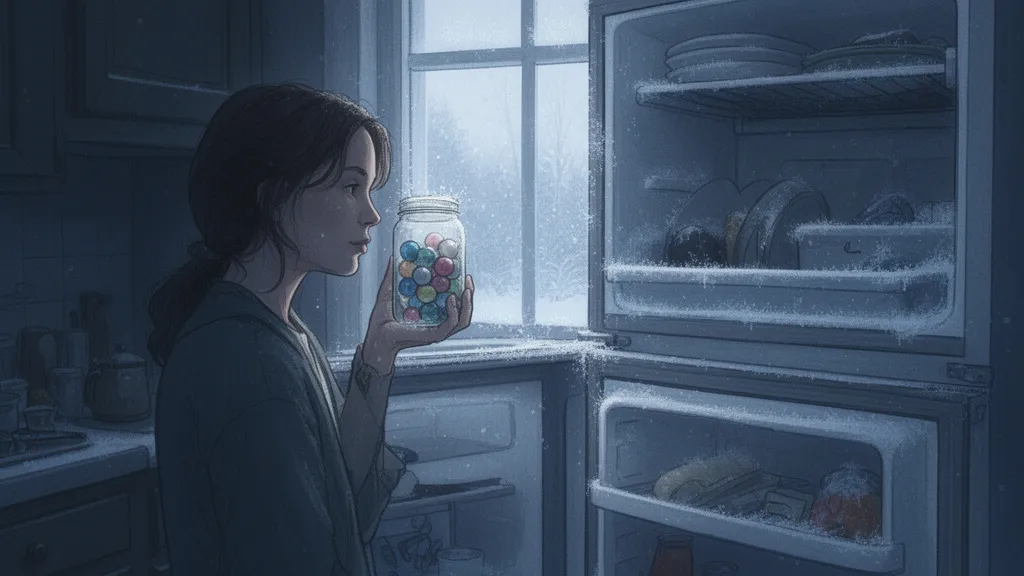
The freezer opens with less resistance than you expect.
Not you. Her. She is the one standing in the kitchen at 7:40 in the morning with the landlord's deadline like a hand on her shoulder. She is the one who has not slept.
Behind the peas — store brand, unopened, the bag stiff with frost — a jar. Mason. Pint-sized. The lid rusted at the rim where condensation settled and froze and settled again.
Marbles.
She holds it up to the light from the window above the sink. They are ordinary. Glass. Some cat's-eyes, some solids, one large shooter the color of ink. Cold enough to fog when she breathes near them.
She did not know he had these. She does not know why they were in the freezer.
The laundry basket is in the hallway between bedroom and bathroom. Three shirts. A pair of jeans soft at the knees. Two mismatched socks. One towel, thin, the kind motels leave behind when they upgrade.
She folds the shirts. Collar to hem. Sleeves crossed. The way their mother did it. The way he never did it.
She is making him neat. She knows this.
First knock: 8:15.
A woman. Mid-fifties, maybe. Housecoat. Hair pulled back but loosely, like she'd done it on the way to the door.
"I don't mean to bother you, but — is there — do you know about the smell?"
"What smell."
"In the hall. It's been — I thought maybe something in his fridge, maybe. I didn't want to say anything before. When he was."
She did not finish the sentence. Neither of them did.
There is no smell in the apartment. She has checked. She checked yesterday. She checked the fridge — nearly empty, a jar of mustard, two beers, a lemon going soft — and the trash, which he'd taken out, apparently, before. The bathroom is clean. Cleaner than she expected.
The smell in the hall is not him. Is not from him.
But the neighbor does not know that. The neighbor only knows the door, the silence after, the fact that someone is now inside.
She sets the marbles on the counter beside the stacked shirts.
Twenty-three. She counts them twice.
No note. No context. Nothing written on the jar. Just marbles in a freezer behind peas he never cooked.
The shirts are: one grey flannel, one blue oxford missing the second button, one black t-shirt with a faded logo she can't identify. A band, maybe. Or a 5K. Something he did once and wore until it became invisible.
She puts them in the donation bag. Then takes the black one out. Puts it back on the stack.
Then back in the bag.
Then on the stack.
Leaves it there. Moves on.
Second knock: 9:02.
Same woman.
"I'm sorry — I know you're busy — it's just, it's stronger today. My daughter's coming this weekend and I just — did you want me to call the building manager? I don't want to go over your head."
"It's not from this apartment."
"Oh. Okay. I just thought because—"
"It's not."
The neighbor stands there. She has the look of a person who wants to say something else. Something about him. Something like he was quiet or I never really or once he helped me with.
She doesn't say it.
The door closes.
What she knows about her brother:
He liked coffee black. He did not call on birthdays but remembered them — a text, always, at exactly midnight, as though he'd set an alarm. He worked in something adjacent to IT. He had a cat for two years in his twenties. He moved four times in six years. He did not explain.
He kept marbles in the freezer.
She does not know why. She will not find out why. This is not a mystery that resolves.
She opens the jar. Tips one marble into her palm. The shooter. Ink-colored, or almost — there's a ribbon of white through it, like a vein. It is warming in her hand. It is just glass.
She puts it back. Screws the lid on.
10:20. She is running out of time.
The apartment is small enough to clear in a day. She's done most of it. The books went yesterday — two boxes to the used shop on Clement, which may or may not be the name of the street; she was not paying attention to signs. The furniture stays. The landlord said so. What matters is the personal.
Personal.
As though a jar of marbles in a freezer is personal. As though it tells you anything. As though holding it makes you — makes her — closer to knowing what he carried and what he set down.
Third knock: 10:45.
She opens the door before the woman can finish knocking.
"I know you said it's not from here, but could I just — could I look? I don't mean to be rude, I know this is a hard time, I just—"
"There's nothing to see."
"I believe you, it's just—"
"He didn't leave a mess."
She hears herself say it. The edge in it. As though the mess is what this woman is accusing him of.
But the woman is still standing there. And behind her, the hallway does smell — faintly, sweetly, something old and organic. Not rot. Not yet. Maybe a bag someone left by the stairs. Maybe the building itself, its pipes, its memory of other tenants, other departures.
The woman says: "Was he — did he have family? Besides you?"
"No."
"I'm sorry."
"Don't be."
Pause.
"He was very quiet," the woman says. "I never heard him. Not once. In four years."
She means it kindly. She means: he was no trouble. She means: I did not know him. She means: I would like someone to tell me one thing so he is not just a door I walked past.
And here it is. The decision.
Not large. Not named. Just the question of whether to say: He kept marbles in his freezer and I don't know why. Whether to give this stranger one fact — small, strange, useless — or to keep it. To let his silence stand as it stood for four years, unbroken, perfectly maintained.
He would not have told her.
She is almost sure of that.
"He collected things," she says. Not quite a lie. Not quite true. "Small things. You wouldn't notice."
The woman nods. Seems satisfied. Seems — something. Softer.
"Thank you," she says. "I hope — I hope the rest of the morning goes okay."
The door closes.
She puts the jar of marbles in her bag. Between her wallet and a scarf she brought in case the apartment was cold.
She does not know why she is taking them. She does not know what she will do with them. She does not know if keeping them is love or just the inability to throw something away when it might have meant something to someone who can't confirm it.
The freezer is empty now. She unplugs the fridge. The motor sighs once and stops.
11:47.
She stands in the doorway with her bag over her shoulder. The apartment behind her is not empty — the furniture remains, the curtains, the marks on the wall where tape held something she never saw — but it is cleared.
Personal effects removed.
In her bag, twenty-three marbles click against each other with every step. They sound like something. She can't say what.
She pulls the door shut. Locks it. Slides the key under the mat.
The hallway smells like nothing now.
Or maybe she's gotten used to it.