the name still on the lease
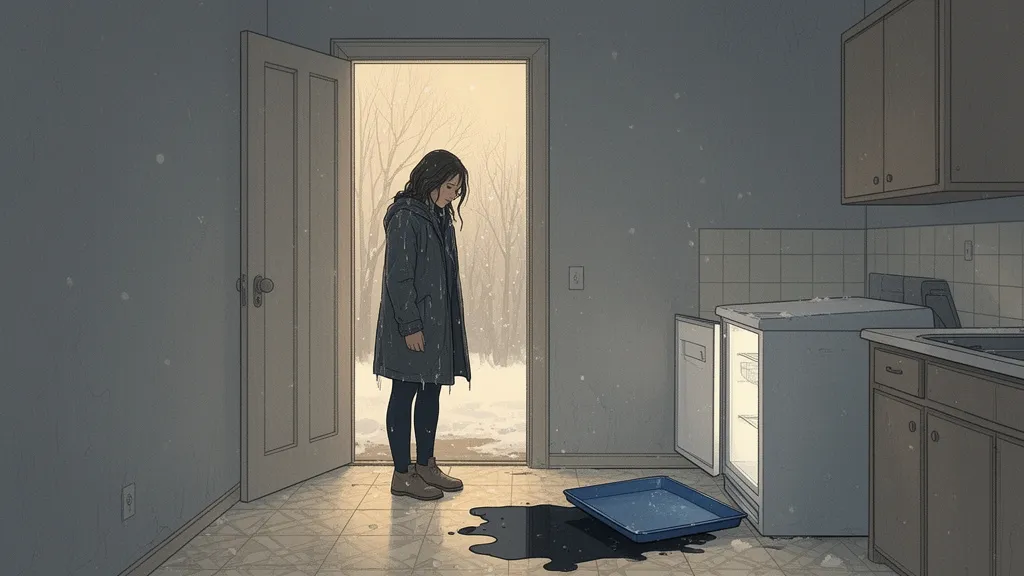
The puddle is smaller than she expected. That's the thing she will remember later — not the open freezer door, not the blue tray face-down on the linoleum like something dropped in surrender, but how little water a full tray of ice actually becomes. A dark oval the size of a hand. Her hand. She does not touch it.
She stands in the doorway with her jacket still wet from outside, keys in her right fist, the landlord's notice folded into her back pocket where it has been softening against her body for three hours. The apartment smells like stillness. Like air that has been holding its breath.
She steps over the puddle.
The freezer door is open at the angle of a person mid-sentence. Not flung wide. Not cracked. Just — open, the way a mouth opens when someone is about to say something and then doesn't. The light inside is off. She cannot remember if freezers have lights. His would have known. He knew things like that. Small mechanical facts. The wattage of bulbs. Which direction to turn a valve. How to bleed a radiator, which she has never learned, which she will now never learn from him, which means she will learn it from a stranger or from the internet or not at all.
She closes the freezer door. It seals with a faint sucking sound.
Then she opens it again, because closing it felt like a decision and she is not ready to make decisions in this room.
The notice:
Dear Tenant/s,
Per our communication of March 3rd and follow-up of April 11th, the lease for Unit 4B remains under the name of [REDACTED — she cannot look at the name, not because it hurts but because it is misspelled, they have misspelled it every single time, the second vowel wrong, and correcting it would mean calling the office and saying his name out loud to someone who would type it incorrectly again]. Power and utilities will be disconnected by 12:00 PM on the date below unless the lease is transferred or terminated.
We are sorry for your loss.
The last line in a different font. Added later, she thinks. Or maybe it is the same font and she is looking for evidence of insincerity because sincerity from a landlord would be unbearable.
It is 9:47 AM.
She has not been inside the apartment in eleven weeks. She has been paying rent from her own account, automatic transfer, the amount leaving her checking on the first of every month like a heartbeat she set up once and cannot bring herself to stop. She has her own place. Fourteen blocks east. A studio with a shower that takes nine minutes to get hot and a window that faces a wall. She has been sleeping there. She has been living there. She has been not-living here.
The milk in the refrigerator is from January. She does not open the refrigerator to check this. She knows because she bought it. The last time she was here. The last time she brought groceries to a person who could no longer eat them but who she could not stop feeding. Two percent. He preferred whole, but she bought two percent because the doctor said — because the doctor said things that no longer matter, because the body the doctor was advising is no longer a body, it is an absence shaped like a body, it is the space inside this apartment where sound doesn't land right.
She could call Mara.
Mara would come. Mara would drive the seventeen minutes from her office with her window cracked because Mara always drives with the window cracked, even in rain, even in February, some thermal preference Mara has never explained. Mara would stand in this kitchen and say okay, what do we need to do, and the we would be genuine, not performed, and that is exactly why she cannot call Mara.
Because Mara would do it. Mara would call the landlord's office and say his name — correctly — and spell it, and not cry, and fill out whatever form exists for turning a dead person into a line item resolved. And then she would make tea from whatever tea is still in the cabinet and sit at the table that is still his table and talk in her low steady voice about next steps, and next steps after that, and at some point she would say you don't have to keep this place, and she would be right, and being right is not the same as being tolerable.
She does not call Mara.
She picks up the ice tray. It is dry now. Ordinary blue plastic. The kind that costs two dollars and lasts forever and you never think about and then one day it is the last object your dead brother touched and you are holding it like it might tell you something.
It does not tell her anything.
In the living room, his coat is on the back of the chair. She has seen it every time she has stood in this doorway over the past eleven weeks — four times, she has stood in this doorway four times without entering, each time telling herself she was checking something, the stove, the windows, some practical errand that did not require crossing the threshold into the room where he actually lived.
The coat is brown. Corduroy. Too warm for the season he died in but he wore it anyway because it had the right pockets. He had a theory about pockets. Depth, angle, the way a pocket should hold a phone without the screen pressing against the thigh. She had found this amusing. She had not told him she found it amusing. She had said it's March, take the lighter one, and he had said this one's fine, and that was a conversation that happened in a life, ordinary, ordinary, and now it is the last thing she remembers saying to him about something that didn't matter, which means it is the last thing she said to him that was honest, because the things she said later — in the hospital, in the bright room with its smell of plastic and its machinery — those were not honest, those were words she assembled from the parts of herself that could still function, and they sounded like I'm here and it's okay and you can rest, and none of them were lies exactly, but none of them were what she meant.
What she meant was: don't.
The clock on the microwave says 10:12. It has been blinking since the last power flicker, weeks ago probably, so 10:12 means nothing, but she watches it blink as though it is counting down to something real.
She could let them cut the power.
She could let the apartment go dark, let the refrigerator stop its humming, let the milk finally become whatever milk becomes when you abandon it long enough. She could let the lease expire under his misspelled name and never correct it and walk away and the apartment would become someone else's problem, and then someone else's home, and the particular way the kitchen light hits the counter at this hour would still happen every morning but it would happen for a stranger and the stranger would not know that a man once stood here in a too-warm coat and talked about pockets.
She could do that.
Or she could pick up the phone.
She sits on the kitchen floor. Not dramatically. Not a collapse. She simply sits, the way a person sits when standing has become one task too many. The linoleum is cold through her jeans. The puddle has almost dried. A faint ring where the edge was, already disappearing.
She takes the notice from her back pocket and unfolds it on the floor in front of her. The paper is damp, her body heat and the rain having worked it into something soft, almost cloth-like. His name — the misspelled version — is right there.
She could correct it.
She could call the office and say: the second letter is an A, not an E, it has always been an A, and I know this because I have been saying his name since before I could say my own, and you will get it right this once, this last time, because after this there will be no more forms with his name on them and I need the final one to be correct.
She could do that without Mara. She could do that alone.
She picks up her phone. The screen is bright in the dim kitchen. She dials the number printed at the bottom of the notice. It rings twice.
A voice answers. Young. Professional. A person for whom this is Tuesday.
"Hi," she says. "I'm calling about unit 4B."
"Yes, let me pull that up. And the name on the lease?"
She says his name.
Correctly.
The person on the other end types. She can hear the keys. Each one a small, bearable sound.
"And you're looking to — "
"Transfer," she says. "I'm looking to transfer it. To my name."
She had not known she was going to say that. She does not know if she means it. But the word is out now, transfer, and it sits in the air between her and the stranger on the phone like something she will have to decide whether to pick up or step over.
"Okay," the voice says. "I can start that process. Can you come in before noon?"
"Yes," she says.
She hangs up. She puts the phone down on the floor next to the notice. She stays sitting.
The freezer hums.
She does not know yet if she will keep the apartment. She does not know if transfer means stay or only means not yet. But his name will be spelled correctly in whatever file they keep, and the power will stay on, and the coat will stay on the chair a little longer, and the light will keep hitting the counter the way it does, and she will be the one who knows what it means.
For now that is enough.
For now is all she has promised.