the parcels dated in his hand
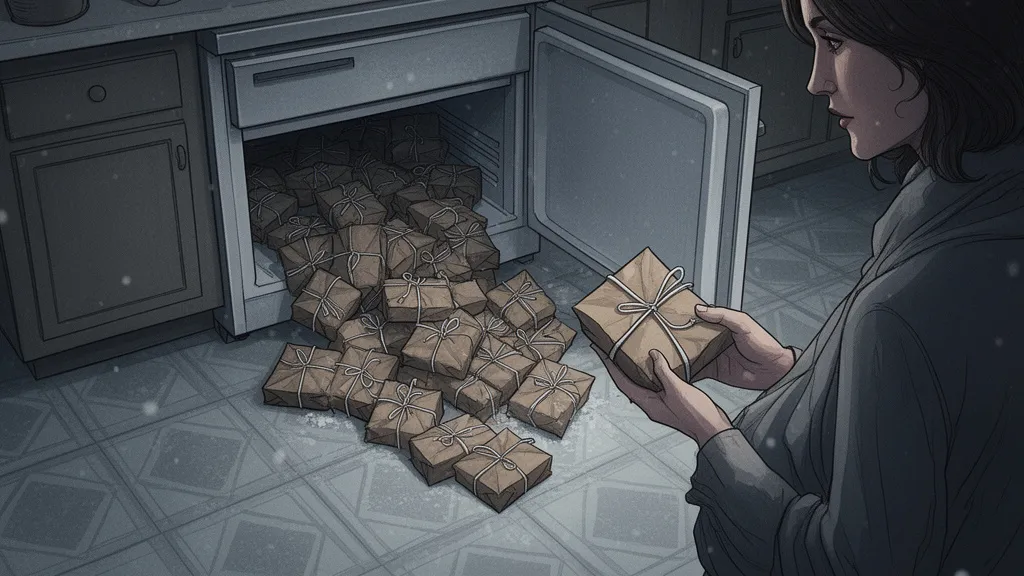
The freezer drawer sticks. Not because it's broken — because it's full.
She pulls harder. The whole unit shifts on the linoleum, an inch, maybe less, and the sound it makes is the sound of something that has been still for a long time being asked to move.
Brown paper. White thread. Dozens of them, packed tight as a file cabinet. Each one the size of a fist or smaller, and on each one a date in handwriting she would know from across a room.
14.03.21
22.07.19
03.01.22
She picks one up. It weighs almost nothing.
The flat is otherwise ordinary. She's been here four times now. Each visit she tells herself she'll finish, and each visit she manages one room, or half a room, or a single cupboard that turns out to contain nothing worth deciding about — old takeaway menus, a broken umbrella, three identical adaptor plugs still in packaging.
She has a system. Black bags for rubbish. Blue bags for charity. A cardboard box in the hallway for things she hasn't decided about. The cardboard box is always the fullest.
She unties the thread on one. The knot is precise. He was always precise — the kind of person who folded wrapping paper after opening a gift, ran his thumb along the crease.
Inside the brown paper: a key.
Small. Brass. Stamped with a number: 247.
And beneath the number, in letters almost too small to read: St Pancras.
She sits on his kitchen floor for eleven minutes. She knows it's eleven because she watches the clock on the microwave, the one that's been wrong since the power cut she never reset, the one that reads 4:17 when it's really past six. She watches it go from 4:17 to 4:28 and thinks about nothing, or thinks about thinking about nothing, which is different.
The key is warm now. She's been holding it that long.
Things she knows about her brother:
He was three years older. He kept a neat flat. He liked rain. He read on the bus, always nonfiction, always something about a place he'd never been. He didn't cook but he owned good knives. He died on a Tuesday in November, in a hospital she'd been driving to when it happened, which means she was on the A41 when he stopped being alive and she thinks about that stretch of road more often than she thinks about the hospital itself.
He was private. That's the word she uses. Other people used other words.
She opens three more parcels that evening.
The first contains a receipt so old the ink has mostly faded. She can make out a date — August, four years ago — and what might be a hotel name. The Caraway. Or The Calloway. The letters blur at the edges like they're embarrassed to be read.
The second contains a button. Brown. Wooden. Nothing else.
The third contains a small square of fabric, dark green, cut with scissors. It smells of nothing.
She puts them all back. Closes the drawer. It sticks again on the way in.
St Pancras is the wrong kind of busy. The kind where everyone is going somewhere specific and she is standing still with a key in her pocket that belongs to a dead man, looking for a locker she isn't sure still exists.
But it does.
Row of them along the lower concourse, past the ticket machines. She finds 247. Slides the key in. It turns without resistance, which feels like a betrayal — she wanted it to be difficult, wanted some friction to justify the six months it took her to get here.
Inside: a coat.
Dark wool. Men's, size medium. She pulls it out and holds it up and the smell hits her before anything else — rain, unmistakably. Not damp. Not mildew. Rain the way it smells on a coat that's been walked in and then hung up and then folded and put somewhere dark, a memory of weather.
She presses her face into it. She breathes.
In the left pocket: another receipt. This one legible.
The Calloway Hotel Room 12 1 night — 16 August Paid in cash
No year. No name.
She has never heard of The Calloway Hotel.
She has never heard him mention it.
This is not unusual. There were whole corridors of his life she walked past without opening the doors, and he walked past hers the same way, and for a long time she called this respect.
The coat does not fit her. She wears it home anyway, sleeves past her wrists, hem at her knees. On the train a woman looks at her and then looks away. She does not know what the woman sees. She does not know what she looks like right now. She suspects she looks like someone wearing a dead person's coat and crying a little, which is exactly what she is.
That night she opens every parcel.
She clears the kitchen table — his kitchen table, still his, she hasn't signed anything yet, the lease is month-to-month and she's been paying it because stopping would be a decision and she has not been making decisions — and she lays them out.
Forty-one parcels.
Dates spanning seven years.
Contents:
- The key (already used)
- The faded receipt
- The button
- The square of green fabric
- A train ticket, London to Margate, single
- A pressed leaf, species unknown, brown and translucent
- A strip of photo-booth pictures, him and someone she doesn't recognise, both laughing, the stranger's face half-turned away in every frame as though flinching from the flash or from being seen
- A napkin with a phone number written on it
- Another napkin, this one blank
- A small glass marble, blue
- A coin she doesn't recognise — foreign, light, the face on it worn smooth
- A piece of sea glass, white
- More receipts: restaurants, a bookshop in Hove, a ferry ticket, a parking stub
- A single earring, silver, a small hoop
- A folded page torn from a book — the body is not the self but it is not not the self — no author, no title, just the fragment
- Thread. Loose. White. The same thread he used to tie the parcels, a small coil of it, as though he'd wrapped even his supplies
And the rest: small things. Ordinary things. Things that meant something to someone who is no longer available to explain what.
The person in the photo booth.
She looks at the strip for a long time. Her brother's face is open in a way she rarely saw — not guarded, not performing ease, but actually easy. Actually laughing. The stranger beside him has dark hair, a jaw she can almost see, a hand on his shoulder in the last frame.
She turns it over. On the back, in his handwriting:
June. Brighton.
No year. No full name.
Just June and Brighton and the feeling that she is reading someone's diary with the pages mostly torn out.
She could call the number on the napkin.
She could search for The Calloway Hotel.
She could go to Brighton with the photo strip and walk the seafront asking strangers if they recognise a face that's half-hidden in every shot.
She could follow the trail. That's what it is. She sees that now. Not a collection. A trail. Each parcel a breadcrumb, and the dates are a map, and the freezer was — what? A vault. A confession. The place where he kept the life that didn't fit inside the life she knew.
Or.
Or she could put them back.
Tie each one with white thread. Return them to the drawer. Push the drawer shut. Let it stick.
The version of him she has carried for six months is complete. He is her brother who kept a neat flat and liked rain and read on the bus and died on a Tuesday while she was on the A41 and never quite let her in, and she loved him inside that, loved the shape of him that she could see, and missing him has been— not simple. But navigable. She knows what she lost because she knew what she had.
If she follows the trail, she will find a different him. A him she didn't know. And she will have to grieve that person too — or maybe instead — and she will have to grieve the fact that he didn't show her, and she will have to ask whether she made it safe enough for him to show her, and the answer to that question is a door she has been standing outside for six months paying rent on a flat she can't bring herself to empty.
The earring sits on the table catching light from the overhead bulb. Silver. Small.
She picks it up. Holds it to her own ear, absurdly. It's not her style. It wasn't his style either, unless it was, unless there was a version of him who wore a small silver hoop and she never knew, or unless it belonged to someone he kept in brown paper parcels because that was the only way he knew to keep them.
She does not call the number.
She does not search for the hotel.
Not because she decides not to. Because it is 2am and she is sitting on the kitchen floor of a flat that still smells like his soap and she is holding forty-one small pieces of a life she didn't know about, and deciding requires a kind of energy she does not currently have access to.
So instead she does this:
She takes the coat from the back of the chair where she hung it. She puts it on. She sits on the floor with the parcels spread around her like a strange garden, and she reads the dates aloud.
Fourteenth of March, twenty-one.
Twenty-second of July, nineteen.
Third of January, twenty-two.
One by one. All forty-one. Speaking them into the kitchen the way you'd read names at a service, which she supposes is what this is.
The last parcel — the oldest, dated eight years ago — she left for last because it was the smallest and she was afraid it would contain something that would undo her.
She unties the thread.
Inside: a slip of paper, folded twice. His handwriting, smaller than usual, as though he was keeping his voice down.
I don't know who will find these. I don't know if I want them found. But I can't keep them loose. They have to be somewhere.
She folds it again. Twice. Returns it to the brown paper. Ties the thread.
She leaves the parcels on the table. She turns off the light. She locks the door. The key still works. It shouldn't surprise her, but it does — how things keep working after the person who used them stops.
In the hallway she stands with her hand on the wall and breathes.
Then she puts the key in her pocket next to the brass one from locker 247 and she walks out into the street where it is raining lightly, the kind of rain he would have walked in without an umbrella, and she is wearing his coat, and the coat remembers the rain even if she wasn't there for it, and she doesn't know yet whether she will come back.
She doesn't know yet.
That's where it ends. Not because I chose to end it here but because this is where she stopped telling me.