the pears she meant to keep
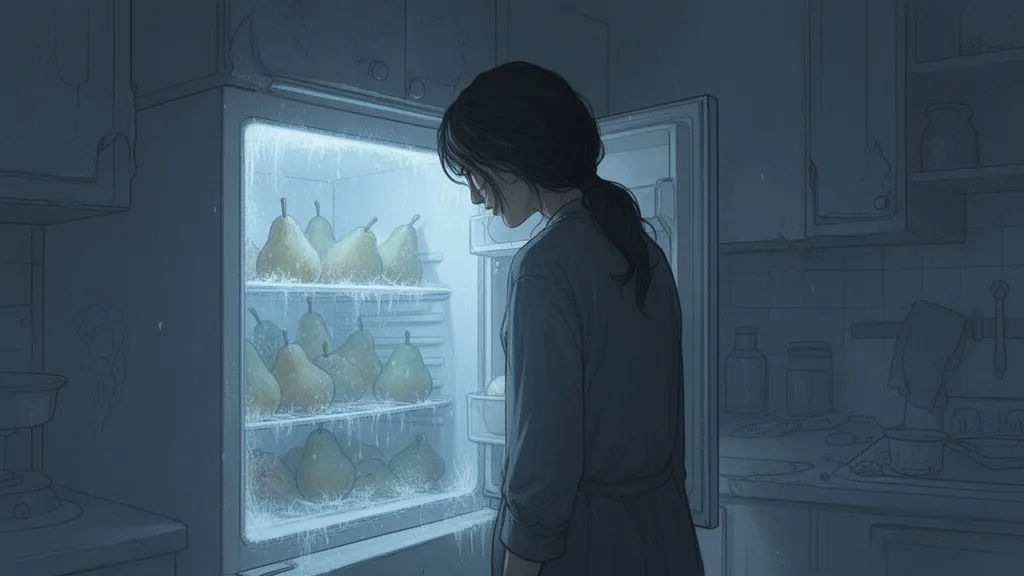
The freezer opens with a sound like a seal breaking.
Not dramatic. Not the gasp of a coffin lid. Just the soft adhesive pop of rubber pulling from rubber, frost from frost, and then the cold hits her face and she stands there, absorbing it.
The apartment smells the way it has smelled for years: bleach, and under the bleach, something sweet and fermenting. Her mother cleaned obsessively near the end. Counters, baseboards, the lip of the tub where the caulk had gone amber. But she could not reach the places where fruit had rolled — behind the radiator, under the hutch — and so the apartment became a negotiation between the two smells, neither winning.
She'd opened the windows first thing. February air came in sharp and indifferent. It has not helped.
The box is cardboard. Brown. The kind you'd get from a liquor store, partitioned inside for bottles, though the partitions have been removed or flattened. On the lid, in her mother's handwriting — the late handwriting, when the letters had begun to slide rightward as if leaning into wind:
Pears — Sept. — good ones
She lifts the lid.
They are wrapped individually in newspaper. Each one a gray bundle the size of a fist, heavier than expected, frozen solid. She picks one up. The newspaper is from — she tilts it toward the overhead light — 2019. Local section. Half a headline about a rezoning vote.
She peels the paper back. The pear underneath is not a pear anymore, not really. It has been halved and cored and pressed flat, and the edges have gone the color of old tea, a gray-brown that is the color of freezer burn and also the color of certain kinds of sadness she does not want to name. The center is still pale. Almost translucent. A window into what it had been.
There are eleven of them. She counts. She does not know why she counts.
Her brother is in Portland. He'd flown in for the funeral, flown out the next morning. Work, he said, and she had nodded because what else do you do. He'd said Call me if you need help with the apartment in the same tone people say Let's get lunch soon, and she had recognized the register and filed it under the category of things that are both true and useless.
She could call him now. She takes out her phone. His name is right there, third in the recents, after the funeral home and the landlord's office.
She puts the phone on the counter, screen down.
The freezer is otherwise ordinary. Two trays of ice, one cracked. A bag of peas, unopened, expired by a year. A Tupperware container with masking tape that says soup and a date she can't read. The pears were on top, the most recent thing placed inside, or at least the thing her mother wanted most accessible.
Good ones.
She tries to remember September. She'd visited in September — or was it October? The trees on the block were just starting, the maples going copper at the tips. Her mother had been in the kitchen. Standing, still standing then, one hand on the counter but standing. Had there been pears on the counter? She can almost see them. A brown paper bag. The particular tilt of a pear that has not yet ripened, that specific lean.
She cannot trust the image. She keeps it anyway.
The knock comes at 2:47. She knows because she has been watching the clock on the microwave, not for any reason but because it is there and it is changing and nothing else in the apartment is.
The superintendent. Ed. Short, damp-looking, apologetic in the way of men who have spent decades entering rooms that do not want them.
"Sorry to bother. Unit below is getting water."
"Water?"
"Leak. Ceiling in their bathroom. Could be the pipes, could be — you got anything running?"
She has not turned on a faucet. She says so.
"Mind if I check the bathroom?"
She steps aside. He moves through the apartment with a practiced blindness, not looking at the boxes she has started and not finished, the black garbage bags slumped by the door like exhausted guests. He checks under the sink, runs the taps, kneels and looks at the base of the toilet with a flashlight.
"Might be the supply line. I'll check the basement. Sorry again. For — " He gestures vaguely. At the apartment. At her. At the situation of being alive in a dead woman's kitchen. "Your mother was a nice lady."
"Thank you."
He leaves. The door clicks. She stands in the hallway and listens to his footsteps descend, each one fainter, until the stairwell gives her back the silence.
The last drawer.
She has not opened it. She has opened every other drawer in the bedroom — the socks paired and balled with a rigor that now reads as devotion, the slips still folded in tissue paper, the reading glasses in their cases, three pairs, progressively stronger. She has opened the closet and touched the hems of dresses and not cried, and she has taken this as evidence of something, though she isn't sure what. Competence, maybe. Or distance. They feel the same from inside.
The last drawer is the bottom drawer of the nightstand. It sticks. It has always stuck. Her mother kept it closed with a rubber band looped around the knob and hooked over a nail on the side panel — a solution so specific and inelegant it could only come from someone who had lived alone for a long time and answered only to the logic of her own needs.
She knows what is inside because her mother told her, once, on the phone, in that way she had of embedding crucial information inside ordinary conversation, a seed inside a fruit inside a bag inside a freezer.
The bracelet is in the nightstand. Bottom drawer. You'll have to pull hard.
Not your bracelet. Not the hospital bracelet. Just: the bracelet. As if there were only one. As if the definite article could carry thirty-seven years of what her mother meant by it.
The light in the apartment shifts. She has lost track of whether it is getting lighter or darker and then realizes it is past three, so darker. The windows face west but the building across the street catches most of the direct sun and returns only a secondhand version of it, diffuse, going orange at the edges.
She sits on the kitchen floor. The linoleum is cold through her jeans. One of the pears is on the counter above her, still in its newspaper, thawing. She can hear it: a faint tick of meltwater hitting the laminate.
Her phone buzzes. Her brother. A text:
How's it going over there?
She types: Fine. Cleaning out the freezer.
She does not type: There are eleven pears in here and I think she flattened them by hand and I don't know if this was preserving or something else. I think she was keeping things the only way she knew how and I think the keeping was the point, not the pears.
She does not type: I haven't opened the drawer.
She sends: Fine. Cleaning out the freezer.
He sends back a thumbs-up emoji. She sets the phone down again.
She opens the drawer.
It sticks. She pulls. The rubber band has long since gone brittle and snapped, and the drawer slides out farther than she expects, nearly into her lap. Inside: a manila envelope, unsealed, the flap just tucked.
She opens it the way you open anything that has waited this long — not slowly, exactly, but with the particular attention of someone who understands that the next few seconds will divide time into before and after, even if the contents are small.
The bracelet is small.
White plastic, or once-white, now ivory. The kind they put on newborns: a strip with tiny block letters, the ink faded but legible. Her last name. A date. A weight in grams that means nothing to her now but must have meant everything then — that first measurement, the first way the world said this is how much of you there is.
Under the bracelet: a Polaroid she has never seen. Her mother in a hospital bed, hair dark, face young and blurred with exhaustion, holding something small against her chest. The photograph has the greenish cast of old instant film. Her mother is not smiling. She is looking at the camera with an expression that is — what. Not joy. Not yet. Something prior to joy. The rawness that joy is built on, before it has a name.
She turns it over. On the back, in her mother's early handwriting — the one that still stood upright:
First hour.
The apartment is getting dark. She should turn on a light. She should finish the freezer, bag the pears, take the soup to the trash, wipe down the shelves with the bleach her mother left under the sink in a neat row of bottles, one for each room, as if cleanliness were a thing you could portion.
She does not turn on a light.
She sits on the bedroom floor with the bracelet in one hand and the photograph in the other, and the meltwater ticks in the kitchen, and the pears soften on the counter, and the light pulls itself out of the room the way a tide goes — not all at once but gradually, and then all at once.
Somewhere below her, water is finding its way through plaster. Ed will fix it or he won't. Her brother will call tonight or next week. The pears will thaw into something unsalvageable, or she will wrap them again and find another freezer, and either way they will not be what her mother meant by good ones, because what her mother meant was September, was still standing, was the kitchen light on and the bag on the counter and the fruit not yet ripe but soon.
She holds the bracelet up to the window. The last of the light passes through the plastic, and for a moment it is almost translucent.
Almost.
She stays on the floor. The dark comes in. She lets it.