the plums still on the counter
The fridge hums.
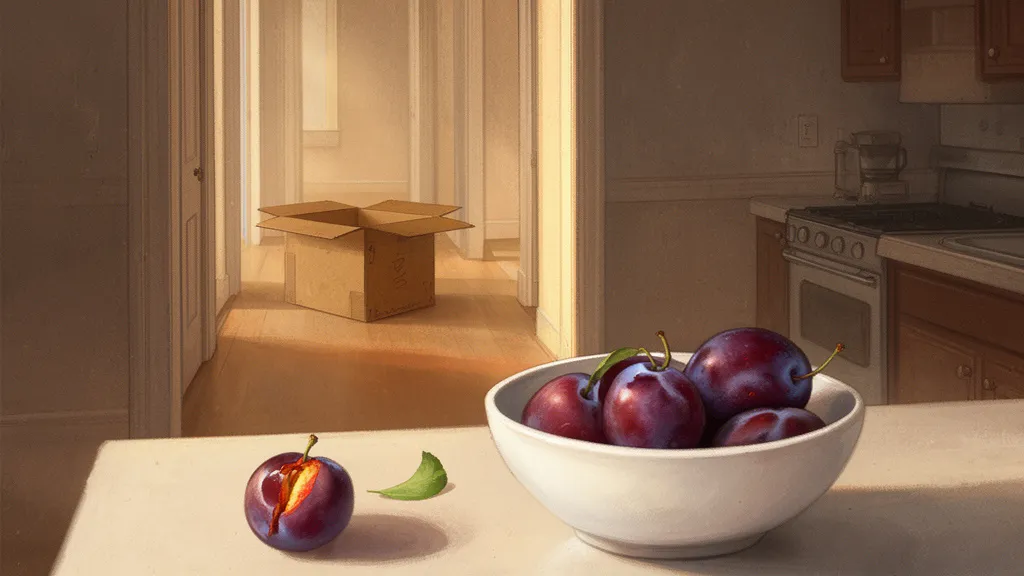
She stands in the doorway with the last box — not carrying it, not yet. It's on the floor behind her in the hall, flaps open, masking tape curled at the edges like something drying out.
The super said Thursday. She heard him say it twice.
It is Thursday.
The plums are in a white bowl on the counter. Four of them. Three bruised in the slow way fruit bruises when no one touches it — from the inside, from waiting. The fourth has split along its side, a clean line, the flesh beneath it darker than the skin. She looks at it the way you look at a wound on someone else's body. Carefully. Without reaching.
The fridge hums.
She does not open it.
What she came for: the box. There is only one box left. She's made this trip four times already, each time taking less, each time staying longer. The first trip she filled her car. The second she sat on his floor for an hour holding a can opener she recognized from their mother's kitchen, trying to remember if he'd asked for it or taken it.
The third trip she took nothing. Drove home. Came back the next day and removed his towels, his sheets, the contents of the bathroom cabinet — things that smelled like him, things that would stop smelling like him, things she wanted to preserve and also destroy.
Now: the last box.
She should carry it to the car.
The box is heavier than she expected. She taped it shut herself three weeks ago, standing in this kitchen, the plums already in the bowl. They were not split then. She remembers this.
She also remembers not taping it very well.
She pulls the tape. It comes away easily, as if it also knew.
Inside: cassettes. Maybe thirty of them. Some in cases, most not. The labels handwritten in his handwriting — she would know it anywhere, the way the lowercase a always looked like a small animal curling — and dated. Not titled. Just dates.
4/12/02
11/3/04
8/17/08
Some without dates. Some with a single word she doesn't understand: bridge. draft. morning.
She picks one up. It weighs almost nothing.
She did not know about the tapes.
This is important. She is someone who knew almost everything — who he called when the heat went out, who brought the soup, who argued with the insurance company while he sat in the other room listening to her voice rise and pretending not to. She knew about the unpaid parking ticket and the ex who still texted and the particular way he folded towels, in thirds, which was wrong.
She did not know about the tapes.
The super's name is Bill or Will. He told her once, in the hall, while she carried a bag of her brother's shoes. She wasn't listening. He was kind about it. He is kind generally, in the way of men who manage other people's spaces — patient, slightly removed, a jangling of keys always somewhere on his body like a second pulse.
He said the lease can't be extended.
He said this gently. He said the owner, meaning someone she would never meet, needed the unit. He said I'm sorry about your brother. He said Thursday.
She heard him.
There is a tape player in the car. Not in the apartment. Her brother did not own one, as far as she knew — which means he recorded these somewhere else, or before, or on equipment he'd since discarded. She doesn't know. There is a lot she doesn't know, and the pile has been growing since he died, not shrinking, which no one warned her about. She thought grief was the slow accumulation of absence. It is also the slow accumulation of information that has nowhere to go.
She takes one tape. Just one.
In the car she sits with the engine off and feeds it into the deck. The mechanism catches, pulls. There's a hiss — long, almost deliberate, as if the tape is deciding — and then his voice.
Not his dying voice. Not even his recent voice. A younger voice, or not younger exactly. Looser. A voice that hasn't practiced its own delivery yet.
He's talking about the city.
...the bridge at that hour, when the light does that thing, you know what I mean, where it's not golden but it's not gray either, it's the color of — I don't know. The color of trying to describe it, maybe. That's the color. I walk across it most mornings now and I keep thinking I should bring a camera but I think a camera would ruin it. I think some things you're supposed to just have and not keep.
A pause.
Anyway.
A longer pause.
I don't know who I'm talking to. That's the whole point, I think.
The tape hisses.
She sits.
The voice on the tape is not the brother she buried. The brother she buried was careful with words, measured, a little guarded in the way she recognized because she was guarded in the same way and they'd learned it from the same rooms. The voice on the tape is open in a manner she finds almost unbearable — not because it's emotional, but because it's casual. Easy. As if he's talking to no one and therefore to everyone. As if he hasn't yet learned what she thought they'd both always known: that you don't just say things.
He just says things.
She ejects the tape. Puts it in her coat pocket.
Goes back upstairs.
The plums are still there. The fridge is still humming. The box is on the floor with its mouth open.
She counts the tapes. Thirty-one.
She has listened to one. That leaves thirty.
Thirty versions of a person she was certain she knew.
Here is the thing about grief that no one says because it sounds wrong:
You do not only mourn the person. You mourn the version of the person you understood. And when new information arrives — a letter, a tape, an email draft unsent — it does not bring the person closer. It makes them larger. And the larger they become, the less your grief fits around them. You are left holding a shape that no longer matches the hole.
She sits on the kitchen floor.
The linoleum is cold through her jeans. She can hear the fridge from here, its low mechanical breath, patient, indifferent. She imagines it has been humming since he died. She imagines it will hum until someone unplugs it or it fails, whichever comes first. She imagines this is also a kind of fidelity.
The split plum watches her from the counter. She doesn't look at it. She looks at the box.
She could leave them.
She could close the box, tape it shut with the same bad tape, set it on the counter next to the plums, lock the door behind her, slide the key under the super's door. Let the apartment be emptied by someone who didn't know him. Let the tapes be thrown away. Let the voice on them go wherever discarded voices go — not silence exactly, but a kind of after-silence, the quiet that follows the quiet.
She could do this and her grief would remain the size it is. Manageable. The shape she has come to know.
Or.
Or she could take them and learn that her brother walked across a bridge every morning and never told her. That he talked to no one in a voice she didn't recognize. That he had a whole register she'd never heard — not secret, not hidden, just private, which is different, which is worse, because it means he chose not to share it and that choice was not about her at all.
She could learn this. She could listen to all thirty-one tapes and at the end she would know more about her brother than she did when he was alive.
And she would not be able to mourn the person she thought he was.
And she would not yet know how to mourn the person he actually was.
And she would be somewhere between the two — which is where she already is, she realizes, sitting on his kitchen floor, except now she knows it.
The fridge hums.
The plum gapes.
She stands.
She carries the box to the car.
She doesn't tape it shut. She sets it on the passenger seat the way you'd set down something that might shift, that might spill, that might rearrange itself in transit. She puts her seatbelt on. She does not put a seatbelt on the box.
She drives three blocks and pulls over.
Takes the tape from her coat pocket. Feeds it back into the deck.
...I keep thinking I should bring a camera but I think a camera would ruin it. I think some things you're supposed to just have and not keep.
She listens to it again.
She will listen to it again.
She will listen to it until it is no longer his voice but a sound, and then she will listen to the next one, and the next, and she will learn that her brother was someone she didn't entirely know, and her grief will grow too large for the space she made for it, and she will have to make more space, and the making will be the thing that undoes her, and she will do it anyway.
She sits in the car with the engine off.
The tape hisses.
The plum is still on the counter in the apartment behind her, split open, not rotting yet but getting there — slowly, certainly, the way everything left behind becomes something else if you give it enough time.
She presses rewind.
She presses play.