the stamps from towns he passed through
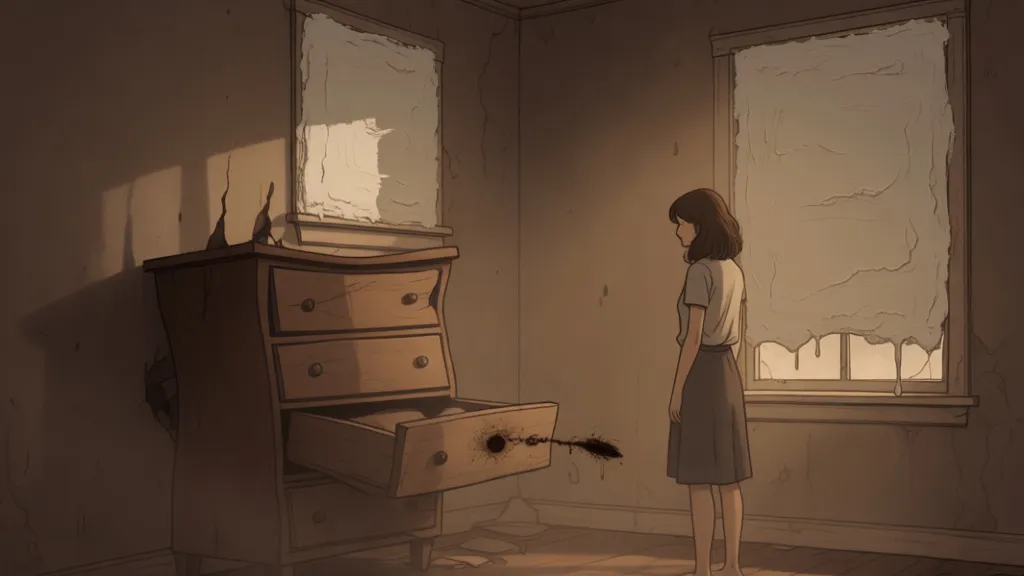
The dresser has warped away from the wall. Not dramatically — an inch, maybe less. But enough to change the geometry of the room, to create a space where a space should not be.
She notices it only because she is looking for the outlet.
The heat is the kind that makes decisions for you. She has been in the apartment forty minutes and already she has removed her cardigan, her watch, her earrings. Each subtraction a small concession. The windows are painted shut. She knew they would be. He mentioned it once, on the phone, in passing, the way he mentioned everything — as weather.
The windows don't open but I've stopped minding.
She hadn't asked what he meant by that.
What she knows so far:
The kitchen is mostly clean. Two plates, one mug, a cast iron pan seasoned to black. The fridge holds mustard, soda water, a sleeve of American cheese. The bathroom is ordinary. The closet contains seven shirts on hangers, spaced evenly, like a museum of someone pretending to live simply.
The bedroom is the problem.
Not because it is cluttered — the opposite. The bed is made. The nightstand holds a glass of water, still half full, a paperback turned face down. She picks it up. A book about long-distance hiking she is certain he never attempted. Dog-eared at chapter three.
The dresser, though. The dresser has pulled away from the wall in the heat. The wood is cheap, laminate over particle board, and the humidity has done something to its joints. It lists gently to the left like a person falling asleep standing up.
Behind it: a brown paper bag, lunch-size, folded shut.
She reaches for it the way you reach for something in a dream — knowing, before you touch it, that the weight will be wrong.
Postcards.
Twenty-three of them. She will count later, at the kitchen table, her hands leaving damp prints on the Formica. But for now: a stack. Addressed. Stamped. Unsent.
The stamps are real. The addresses are real — she recognizes some. Aunt Margot. A college friend whose name she also knows. Their mother, at the house on Devereaux Street, which their mother sold in 2019.
The postmarks are from towns she has never heard him mention. Eureka, Nevada. Thermopolis, Wyoming. Cut Bank, Montana. Deming, New Mexico. Places that sound like descriptions of damage.
Each card is smudged. Salt — she can feel it, a faint grit — and something darker. A thumbprint, heavy, pressed into the margin or the lower corner, not deliberate exactly, but not accidental. As if he'd been eating something. As if he'd been crying. As if he'd pressed his thumb into the card to prove he was there, in the body, holding it.
The first one she reads:
Margot — Drove through here on the way to nowhere specific. The motel had a pool but it was drained. There was a dog tied to the fence that I almost stole. I'm fine. I didn't steal the dog. I think about the summer you taught me to make bread and how you said patience is just controlled disappointment. I didn't understand then. — D
He signed them all D. Not Daniel, not Danny. D, like a grade. D, like the shape of something half finished.
She sits on the kitchen floor because the chair is too far from the outlet and she needs to charge her phone, and because the floor is tile and cooler by a few degrees, and because sitting on a dead brother's kitchen floor feels like the right altitude for what she is doing.
The second:
Mom — I stopped here because the gas station had your brand of cigarettes in the window display and I thought that was funny. You quit in 2006 and they still make them. I bought a pack and smoked one and it was disgusting and I understood you better for thirty seconds. I'm in Wyoming. I don't know why. The mountains here look like they're leaning away from something. I'll call Sunday. — D
He didn't call Sunday. She knows because their mother kept a calendar on the fridge and marked the days he called with a small star, and there were long empty stretches their mother explained as he's busy, he's always been independent, you know how he is.
What she is beginning to understand:
He traveled. Not the way people talk about traveling — not for destinations, not for photographs, not to arrive. He drove through. Town after town, buying postcards at gas stations and drugstores and motel lobbies, writing them in parking lots or diner booths, addressing them carefully, stamping them, and then — not sending them.
Bringing them home. Folding them into a paper bag. Placing the bag behind a dresser.
Like letters to a version of his life that almost existed.
The third, to someone named Paul, an address in Philadelphia she does not recognize:
Paul — You probably don't remember me. We shared a table at the laundromat on 40th Street for about three months in 2017. You were writing a dissertation on something I pretended to understand. I'm in Montana now. The sky is so wide here that I keep looking for the edge of it, like a page. I wanted to tell you that the conversation we had about whether loneliness has a sound — I think about it. I think the answer is yes and it sounds like a refrigerator in an empty apartment. — D
She reads it again.
She puts it down.
She picks it up.
The landlord is coming at two. She knows this because he called her — found her number in the lease as emergency contact — and said, We need to assess the unit. He said unit. He said assess. He said, The painters are coming and we need to know what stays and what goes.
As if that distinction is ever simple.
As if staying and going are opposites and not, as she increasingly suspects, the same motion seen from different rooms.
A postcard to her. There are four to her, actually, scattered through the stack. The first:
Lena — I'm in a town called Deming. Look it up, it's real. There's a park here with a sign that says "City of Sunshine" but the sign is faded almost to nothing and I think that's the most honest advertising I've ever seen. I wanted to tell you something on the phone last week but the moment passed and then it was too late to go back for it. That happens a lot. I don't mean with you specifically. I mean in general. The moment passes and the thing stays in your mouth like a coin. — D
She tries to remember the phone call. Last week, last month, she doesn't know when he wrote this. The dates — there are no dates. Only postmarks, and some of those are smudged past reading.
She tries to remember what he might have wanted to say.
She cannot.
This is the worst part, or it will become the worst part later, when the initial numbness gives way to the more specific pain of inventory: she cannot remember the sound of his pauses. She remembers him talking. She does not remember him stopping. She does not remember what lived in the stops.
Another, to their mother:
Mom — I found a diner that serves pie the way you used to make it, which is to say: too sweet, crust underdone, absolutely perfect. I sat in the booth for an hour. The waitress called me honey. I almost cried. I did not cry. I want you to know I am not sad exactly. I am something adjacent to sad that doesn't have its own word yet. I think the Germans probably have one. I'll look it up. — D
He was living a second life. That's not right. He was living in the margins of his one life, in the addresses he copied carefully from a notebook she can see now on the nightstand, small and black and soft with handling. Names and addresses. Some crossed out. Some starred.
The starred ones match the postcards.
He was not hiding. That's important. He was not fleeing. He was — adjacent. Living in the space between sending and not sending, between arriving and staying, between the self that writes I'm fine and the self that presses a salted thumb into the cardstock hard enough to bruise the paper.
She lines them up on the kitchen floor. Twenty-three postcards. Grand Canyon (he went to the Grand Canyon?). A desert highway at sunset. A wolf in snow. A neon motel sign. A cactus with a cartoon face. A black-and-white photograph of a town that no longer exists.
Twenty-three attempts to reach someone without arriving.
One more, to her:
Lena — Do you remember when we were kids and you found that bird in the yard, the one that wasn't dead but wasn't flying, and you put it in a shoebox with a washcloth and sat with it for three hours? You didn't try to fix it. You just sat with it. I've been thinking about that a lot. I think some people are shoeboxes and some people are washcloths and some people are the bird and some people are you, sitting there, not trying to fix it. I don't know what I am in this metaphor. Maybe the yard. — D
She reads this one three times and then holds it against her sternum, which is a thing she didn't plan to do and cannot explain, except that the body sometimes knows before the mind what constitutes an emergency.
It is 1:47.
The landlord will arrive in thirteen minutes, or twenty, or whenever landlords arrive, which is always either too soon or not soon enough. He will bring painters. The painters will assess. There will be a conversation about the lease, about the deposit, about the walls — are they damaged, can they be covered, what is cosmetic and what is structural.
She will need to answer questions about what she wants to keep.
She puts the postcards back in the paper bag.
She folds the top shut.
She puts the bag in her purse.
The rest of it — the shirts, the books, the cast iron pan, the glass of water still sitting on the nightstand catching light like something devotional — the rest of it can be assessed. The rest of it can be sorted into keep and donate and discard, the way grief is supposed to work, the way the living are supposed to metabolize the dead: by category, by function, by whether the thing still has use.
But the postcards are hers now. Not because he addressed four of them to her. Because she found them. Because she reached behind the warped dresser in the heat and her hand closed around the paper bag and she felt the weight of twenty-three unsent messages, each one a small failure of nerve that was also, she is beginning to think, its own kind of courage — the courage to write the thing and not send it, to hold the words in your hands and choose not to let them go, to believe that the writing was enough, that the stamp and the address and the thumbprint were enough, that somewhere between the intention and the act there was a place to live.
Knock on the door.
She stands. She wipes her hands on her jeans. She checks her face in the dark of her phone screen — no tears, but something rearranged, something the painters will not notice.
She opens the door.
The landlord is shorter than she expected. He carries a clipboard. Behind him, two men in white, waiting.
"You're the sister?"
"Yes."
"We'll start with the walls," he says. "You can tell us what goes."
She steps aside. The painters enter. They look at the walls the way doctors look at charts — professionally, without grief, noting damage.
She stands in the kitchen doorway with her purse against her hip, the paper bag inside it, twenty-three postcards pressed together like a held breath, and she watches them decide what can be saved.
They don't ask about the dresser.
They don't look behind it.
There is nothing there.