Everything Must Be Accounted For
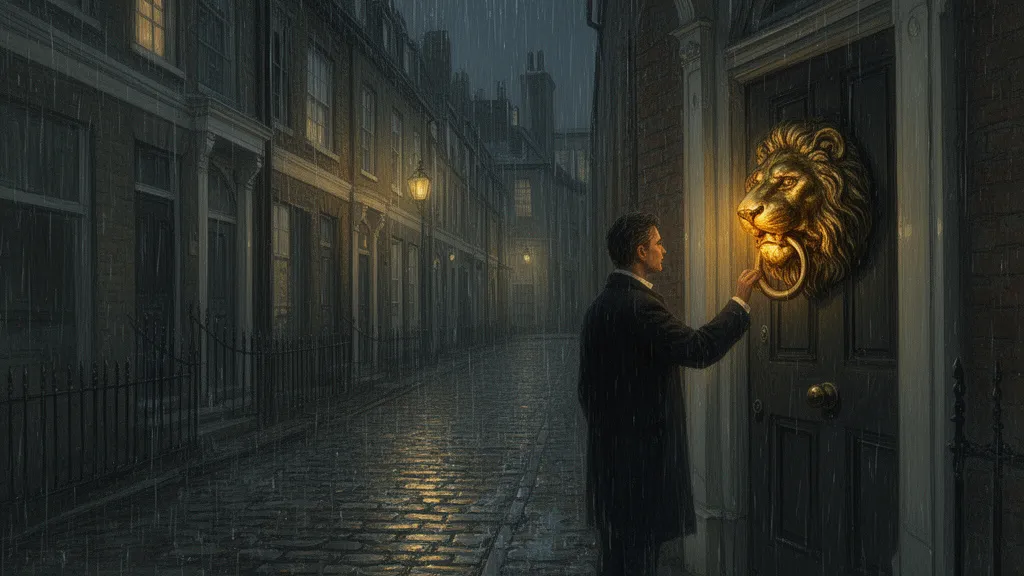
The brass knocker was warm.
Mr. Cecil Podmore stood on the step of Number Fourteen, Craven Mews, on a Thursday evening in the second week of November, with rain coming in sideways off the river and his coat already wet through at the shoulders, and he could not account for it. He had touched the knocker — a lion's head cast in brass, its expression one of considerable personal grievance — out of habit rather than necessity, since the door had been left on the latch by the constable who had preceded him. The warmth was not the warmth of a recently handled object. It was the warmth of something that had been attended to. Something that had been held.
He withdrew his hand. He consulted his notebook, which said only: Widow. Craven, E. Deceased or absent, unconfirmed. Goods to be inventoried per instruction of the Parish Council. Do not delay.
He did not delay. He pushed the door open and went inside.
Mr. Podmore was, by profession and by temperament, a man of lists. For eleven years he had served as clerk to the Parish Council of St. Agatha-Without-the-Wall, and in that time he had inventoried the contents of fourteen deceased or abandoned properties, catalogued the annual accounts of three charitable trusts, and once — during a period of particular civic enthusiasm — produced a complete census of the ornamental ironwork in the churchyard. He was not a man given to imagination. He considered imagination a luxury that the properly employed could not afford.
The hallway of Number Fourteen was narrow and smelled of beeswax and something underneath the beeswax that he could not name. The gaslight was lit — which was notable, since no one had lit it — and burned with a colour that was not quite white. It was, he thought, writing nothing down yet, a greenish colour. The sort of colour that suggested gas impurity, or a fault in the mantle. He made a note of it only because completeness was a professional obligation.
The staircase rose ahead of him into the dark. The dining room was to his left.
He went left.
INVENTORY OF THE EFFECTS OF MRS. EDITH CRAVEN Number Fourteen, Craven Mews, Parish of St. Agatha-Without-the-Wall Commenced: Thursday, 14th November. Approximately 7 o'clock in the evening. Clerk: C. Podmore
Item 1. One dining table, oak, seats six. Set for one. Place setting includes: one dinner plate (white, no pattern), one soup bowl, one side plate, one butter knife, one soup spoon, one dessert spoon. Table linens pressed and clean. No food present. No candles burning. The single wine glass is empty but not clean — there is a residue at the bottom of a colour he associated with port, though the smell, when he leaned close, was not port. He wrote dark residue, contents unidentified and moved on.
Item 2. One sideboard, mahogany. Atop: one mantel clock (stopped, hands at 3:17), one ceramic dog of the spaniel persuasion, one framed photograph of a couple he presumed to be Mr. and Mrs. Craven at some earlier and apparently less troubling time in their lives. Contents of drawers: two sets of silver cutlery (tarnished), one box of candles (unused), one ledger, locked.
He paused at the ledger. It was a standard household account book, bound in green cloth, with a small brass lock of the kind that required a key he did not have. He shook it. It made a sound — papers, or something thinner — and also another sound that was not papers, something with more weight to it, something that settled after the first sound rather than simultaneously, as though the second thing had been startled.
He set the ledger down and noted it without opening it and went back to the dining table to complete his count.
The dessert spoon was gone.
He looked at the table for some time. He had written one dessert spoon not three minutes before. He crossed it out. He wrote setting incomplete — dessert spoon absent or misplaced. He noted the time: 7:14.
He went upstairs.
The landing was dark beyond the reach of the hallway's greenish light, and Mr. Podmore had the presence of mind to bring a lamp from the kitchen, which he did before ascending, taking longer than necessary in the kitchen partly because it was at the back of the house and further from the staircase and partly — though he would not have phrased it this way — because he was not anxious to reach the top.
The kitchen was orderly. He noted it briefly: one range, cold. One kettle. One cup, washed and inverted on the draining board. One chair pulled out from the table at an angle, as though someone had just risen from it.
He did not sit in the chair. He took the lamp and went back through the hall, and as he passed the dining room door he looked in without meaning to.
The dessert spoon was back.
There was now also a fork that had not previously been there.
He stood in the doorway for what he estimated to be forty seconds, during which the gaslight shifted slightly — not flickering, simply moving, as though something adjacent to the flame had drawn breath — and the shadow of the place setting stretched across the tablecloth in a direction that did not correspond to any available light source he could identify.
He wrote: dining room — recheck required. He went upstairs.
A note on the staircase, appended to the inventory in a different hand — marginally smaller, as though conserving space on the page:
The staircase at Number Fourteen contains seventeen steps. I have verified this three times. It contained seventeen steps on my ascent. It is possible — I record this not as fact but as observation, the way one might record a measurement one has taken but cannot explain — that it contained a different number on my descent. I did not count on the way down. I will not say that I ran. I will say that I did not stop to count.
Items 3 through 11. The upper landing. One linen cupboard, contents: bed linens in reasonable order, three extra pillows, one hot water bottle (rubber, perished). One bathroom: standard appointments. One W.C., which he inspected only briefly and found unremarkable, except that the window, though latched, admitted a draught of considerable force and of a temperature that was not November cold but something colder than that, something from further away than outside.
Item 12. Master bedroom. One bed, made with military precision. One wardrobe, mahogany, empty — the smell inside it was lavender and beneath the lavender something that reminded him, unpleasantly and without logic, of the residue in the wine glass downstairs. One dressing table with mirror. The mirror was covered with a black cloth, as is sometimes done in houses of mourning. Mrs. Craven was not, to the Parish Council's knowledge, mourning anyone. She had, to the Council's knowledge, been alive until approximately six days ago.
He did not remove the cloth.
Item 13. One escritoire, walnut, in the corner of the bedroom. Drawers: correspondence, bundled. He allowed himself to read only the topmost letter, which was addressed to Mrs. Craven from a firm of solicitors and concerned the settlement of her husband's estate. It was dated four years ago. Beneath it was a second letter, in a different hand — not typed, not from a firm — that he read despite himself, because it began with the words you must not let it finish the count and ended, three lines later, without completing the sentence it had been building toward.
The letter had no signature. It had no date. The ink was dark and the handwriting was entirely controlled up to the point where it was not, the final words — once it reaches the first step, the door will not — written at an angle that suggested the author had been interrupted, or had suddenly and urgently needed to be somewhere else.
Mr. Podmore put the letter down. He put it down with more care than he had picked it up with, the way one replaces a stone one has turned over and immediately regretted.
That was when he heard it from the floor below.
It was a sound he classified, in the first moment, as the natural settling of an old house in a cold season. In the second moment, as the building's plumbing. In the third moment — when it came again, more distinctly, from the direction of the staircase — he classified it as a sound made by something that was not the house.
It was methodical. That was the word he found for it. Each repetition was separated from the last by an interval of approximately four seconds, and the sound was of something in contact with a surface — not quite footsteps, not quite the creak of old wood, but something with the same intention as footsteps: forward motion, proceeding at a pace that was neither hurried nor uncertain.
He went to the bedroom doorway and looked along the landing toward the top of the stair.
The lamp he had brought up was burning at the edge of the landing where he had set it, and in its light he could see as far as the third step down, no further. The sound continued. It was closer than the bottom of the staircase. It was perhaps halfway up.
He looked at his notebook. He had not meant to look at it. The reflex of eleven years was stronger than his present better judgment, and so he looked at it, and he saw that his last written entry — Item 13, the escritoire — had been followed, in handwriting that was not his, in ink that was wet enough to have smeared slightly at the edges of the letters, by a new entry:
Item 14. One parish clerk, standing in a doorway. Fully dressed. Expression: instructive.
Below it, in the same hand:
Item 15.
Nothing followed Item 15. The entry was unfinished. There were four seconds between each sound from the staircase, and he had counted, since looking at the page, perhaps twelve of them, which was to say that something had climbed, in the time it had taken him to read two sentences, six steps closer to the top.
There were seventeen steps.
He had been on the upper landing for — he checked his watch with hands that he considered admirably steady — thirty-one minutes.
Something was counting the contents of this house. It had been counting since before he arrived. It was counting still, item by item, working its way upward from the bottom of the staircase with the relentless patience of a process that did not intend to leave anything out.
The question — the one that arrived fully formed in the precise moment he understood what was happening, the moment he would have preferred not to understand it — was not what it was counting, or why.
The question was what came after Item 15.
He looked at the page. He looked at the staircase. He looked at the door behind him, which was the bedroom door and which opened onto the landing and therefore toward the staircase and not away from it.
The sound reached the top step.
It stopped.
Four seconds passed in a silence so complete that he could hear the lamp flame and the rain on the window and the tight, careful sound of his own breathing, and then, in the notebook still open in his hands, the pen he was not holding moved across the paper beneath Item 15 and completed the entry in a hand that was steady, unhurried, and entirely satisfied with what it had found.
Mr. Cecil Podmore, clerk to the Parish Council of St. Agatha-Without-the-Wall, read what had been written.
He did not delay.