Something Lives in the Plaster
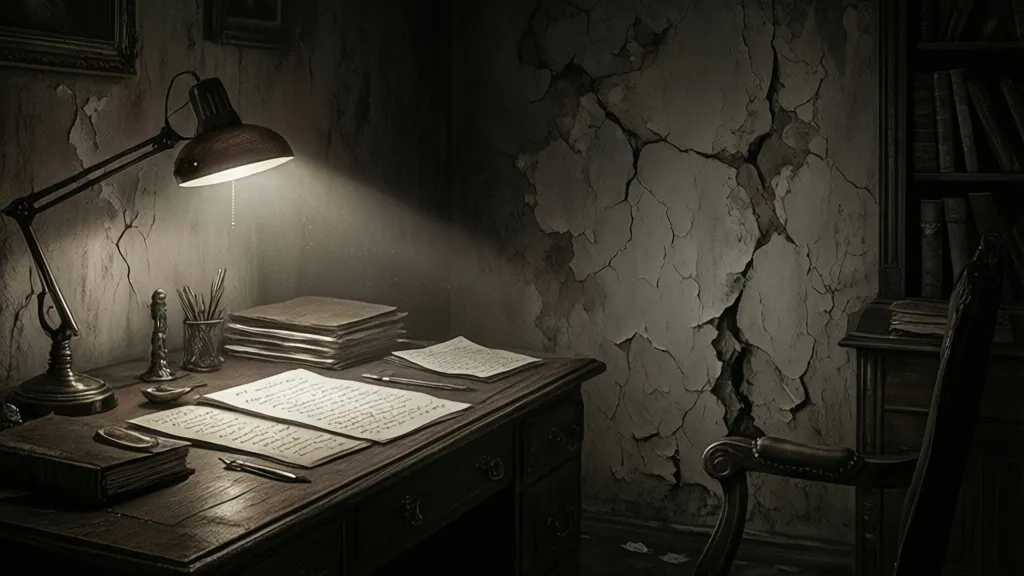
From the private case-notes of Dr. H. Ashford, Physician, 14 Cavendish Square. The following account was entered not as a clinical record — for no clinical category then existed, nor, to my knowledge, exists now, which might adequately receive it — but as a document of conscience, that I might read it again in sober daylight and satisfy myself that I had behaved with appropriate professional rigour throughout.
The note arrived on a Thursday evening, delivered by a boy who could not describe the person who had given it to him — or rather, who described that person differently each time he was asked, settling finally, with the unassailable logic of childhood, on the assertion that there had been no person at all, only the envelope, which he had found propped against the iron boot-scraper outside his mother's house in Marchmont Street. I gave him sixpence. He looked at it with an expression I did not care for and went away.
The envelope was sealed with plain wax, no impression. Inside, a single card, the handwriting cramped and listing slightly to the left, as though the writer had been obliged to compose it in some haste, or in some darkness:
Dr. Ashford — You will remember me. I was your patient in the winter of 1899, the matter of the sleepwalking, which you resolved to your satisfaction if not entirely to mine. I am at Number 7, Aldwick Terrace. I have not left the house in eleven days. I cannot explain further in writing. Please come tonight if you are able. If you are not able, please come tomorrow. If you cannot come tomorrow, I think it will not matter.
— E. Haverford (Miss)
I remembered her immediately, which was itself somewhat remarkable, as I am not by temperament a sentimental man and Miss Eleanor Haverford had been, when I knew her, almost deliberately unmemorable: a quiet, composed woman of perhaps thirty-two, employed as a cataloguer at one of the smaller Bloomsbury libraries, who had come to me in the January of that year reporting episodes of nocturnal locomotion that she could not account for and did not wish to discuss at length. I had prescribed a mild sedative. She had attended three appointments and then written to discharge herself from my care, thanking me in the same cramped leftward script for my assistance, which she described as considerable, a word I found, even then, faintly qualified.
I put on my coat. It was raining in the particular London manner that suggests the rain has always been there and the dry intervals are the aberration.
Aldwick Terrace was not, in the strictest geographical sense, lost — it appeared on my map of the Clerkenwell district, wedged between two rather more confident streets — but it had the quality of a place that did not especially wish to be found. The houses were mid-Victorian, the sort built in confident expectation of a prosperity that had not quite arrived, their facades slightly too elaborate for their actual dimensions, pilasters applied with more optimism than structural justification.
Number 7 had all its curtains drawn.
Miss Haverford opened the door before I had finished knocking, which suggested she had been standing immediately behind it for some time. She looked, I noted with professional detachment, considerably worse than when I had last seen her: thinner about the face, the eyes carrying that particular fixity which in a patient I would have noted as vigilant affect, persistent; query exhaustion or ideation, fixed. She was dressed as though she had slept in her clothes and then reconsidered whether sleeping had been worth the risk.
"You came," she said.
"You asked me to," I replied, with what I considered admirable directness.
She stood aside and let me in.
The hallway was lit by a single gaslight turned very low, and it was here that I noticed the first clock — a bracket clock on the hall table, its hands positioned at eleven minutes past eleven, its pendulum motionless. A second clock, a long-case article of some age, stood against the far wall in similar arrested condition. When I looked more carefully, holding my hat and becoming rather damp about the shoulders from the still-open door, I observed that a small carriage clock on the third stair also read eleven-seventeen. I will confess I checked my own watch. It read twenty minutes to ten.
"All of them," Miss Haverford said, answering a question I had not yet asked. "Every clock in the house. I didn't stop them. I want to be precise about that. I woke one morning and they had all stopped, and they all read the same time, and I have not wound them since because I — " She paused with the care of someone selecting a word from a diminishing supply. "Because I did not wish to know what time it would become."
I followed her into the front parlour.
The wallpaper, a pattern of dark green vine on cream ground that might once have been considered tasteful, was detaching from the walls in long vertical ribbons, curling away from the plaster with a slow, damp deliberateness that put me in mind, uncomfortably, of something peeling rather than merely peeling. The room smelled of standing water and something else — organic and close, in the way that the air in a very old building sometimes carries a memory of all the organic processes that have occurred within it over the decades, distilled into something that is not quite rot and not quite earth and is not, one feels, entirely accidental.
"You've had a damp problem," I said.
"Yes," she agreed, with a composure that I found, in context, rather more alarming than hysteria would have been.
She sat. I sat opposite her. Between us, the fireplace — an elaborate Victorian construction of green-veined marble, the grate cold — occupied the wall with what I can only describe as an air of suppressed significance, which I recognised even as I noted it to be a fundamentally absurd thing to say about a fireplace.
"Tell me," I said.
She had moved into Number 7 in the October, inheriting it from an aunt whose name she mentioned only once and did not repeat. The first weeks had been unremarkable. In December, she had begun to hear sounds from the wall cavity behind the chimney breast — not the settling noises of an old house, which she said she knew well and had catalogued as a librarian catalogues anything, by type and frequency and source — but something with pattern. A slow, lateral sound. Movement in a space that the architecture did not, strictly speaking, provide room for.
"I measured the room," she said. "I measured the hallway on the other side. There are approximately nineteen inches unaccounted for. Behind the chimney breast."
I noted this in my case-book: Patient reports anomalous cavity dimensions. Possible structural explanation; follow up re. original plans.
"And the gaslight," I said, because she had mentioned it in her note.
"When the gaslight is full," she said, "there is nothing. No sound. When it is low — at night, or when I am economising — it moves."
I considered several medical responses to this and discarded them all.
"Three weeks ago," she continued, "I was sitting in this chair, in the evening, the light low, and I heard — from behind the hearth — my voice. Speaking."
I opened my mouth.
"Not words I recognised," she said, preempting me. "Not anything I might have said at any point and forgotten. My voice, but arranged around a grammar I do not have. Do you understand the distinction I am making?"
I understood it perfectly, which I found quite inconvenient.
"It spoke for approximately four minutes," she said. "I counted. I have — " she reached into the pocket of her dress and produced a small notebook, which she held out to me — "written down what I could transcribe phonetically. I was a cataloguer. Transcription is not difficult for me. I transcribed it and then I did not sleep for two days, and then I wrote to you."
I did not open the notebook. I am not certain, even now, that I wish I had.
At half past eleven — by my watch; by the clocks of the house it was, perpetually, eleven-seventeen — I stood before the chimney breast with a fireplace poker and Miss Haverford's considered, stated permission to open the plaster if I judged it professionally necessary.
She stood in the doorway. She had turned the gaslight to its full extent. In full gas the room was ordinary: the peeling wallpaper was merely damp damage, the marble fireplace merely cold, the silence merely the silence of a house at night in the rain.
"If you turn it down," she said quietly, from the doorway, "it will begin."
"I am a physician," I said, with what I believe was considerable dignity, "and I do not propose to investigate a wall cavity in semi-darkness."
I tapped the plaster with the poker. Solid, at first. Then, as I moved further left — toward the edge of the chimney breast, toward the nineteen unaccounted inches — a different register. Not hollow, precisely. Occupied is the word that presented itself to me and which I spent some time trying to replace with a better one.
I raised the poker.
From behind the plaster — not behind the hearth, not from the grate, but from the cavity wall itself, from the space that should not have been large enough to contain anything capable of producing sound — I heard breathing.
Not animal. Not mechanical. Breathing in the manner of a person who has been very still for a very long time and is deciding whether to continue being still.
And then — and I set this down with the full understanding that it represents the limit of my professional usefulness in this matter — I heard my own name spoken, in a voice that was not Miss Haverford's and not mine, but was assembled from the qualities of both, as though something had been listening to us all evening and was only now attempting the pronunciation.
I lowered the poker.
I turned toward the doorway.
Miss Haverford was looking at me with an expression that contained, in equal and terrible measure, validation and despair.
"Well," she said.
"We are leaving," I said.
"Yes," she agreed, with the composure of someone who had already considered this option and had spent eleven days building toward the moment of someone else's agreement.
I retrieved my hat and bag. She took nothing — a fact I noted and then deliberately stopped noting, because to note it was to follow its implications somewhere I was not, at that moment, prepared to go.
At the door she paused with her hand on the latch and looked back toward the parlour, where the light still burned full and the room was, by all visible evidence, empty.
"It knows the way out," she said. "I want you to understand that. I am not telling you this as a patient reports a symptom. I am telling you as one rational person informs another of a fact which both of them will need to account for."
I opened the door. The rain had not stopped.
"Then we should not be here when it uses it," I said.
We went out into the street.
I did not look back at the house. I have given this considerable thought since, and I remain of the view that not looking back was the correct decision, and that my certainty on this point — absolute, physical, the certainty of a man who understands at some level below reasoning that the verification of a thing may itself constitute a form of invitation — was the first moment in that long, damp, thoroughly unreasonable evening in which my professional instincts served me with anything approaching adequacy.
Behind us, through the closed door and the drawn curtains and the cold rain, I heard the gaslight — though I could not have heard the gaslight, through a closed door, in the rain — gutter and drop.
Case closed. No diagnosis offered. No prognosis possible.