The Artist Requires One More Sitting
The key was on her person when she went to bed.
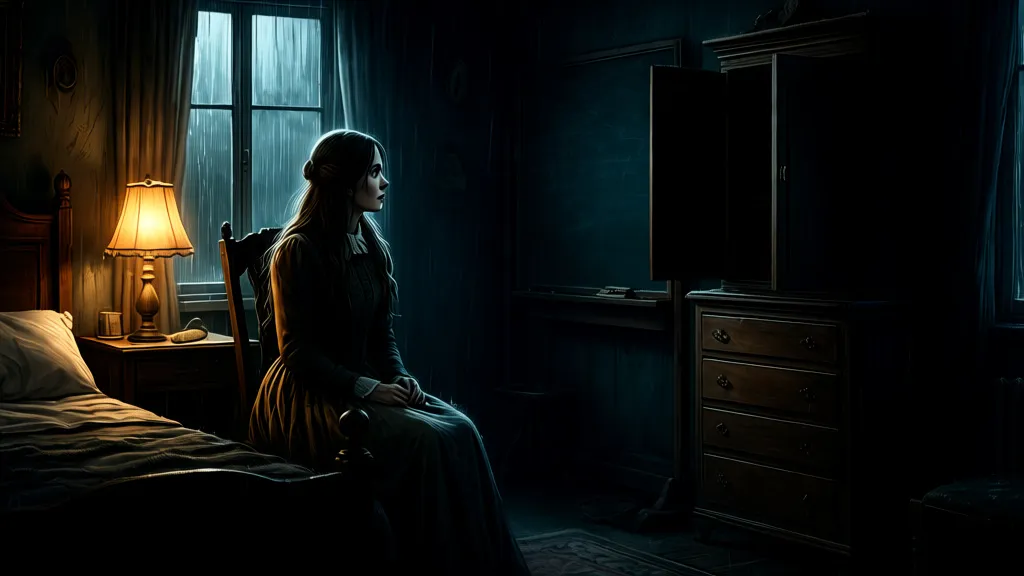
Miss Eunice Fallow was certain of this — as certain as a woman of thirty-two years and modest but rigorous education could be certain of anything — because she had placed it herself on the nightstand, had heard the small brass weight of it knock against the painted wood, had lain for some minutes in the dark listening to the rain find its way through the window frame before sleep took her. The key was hers. It unlocked the schoolroom cabinet where she kept the pencils and the nibs and the three volumes of illustrated natural history she had brought from her previous employment. It was not a significant object. It was not, by any reasonable measure, a remarkable one.
She found it missing at twenty minutes past midnight.
She knew the time because the long-case clock at the bottom of the stairwell struck the quarter-hour just as she reached the corridor, having risen to check — she told herself — whether the schoolroom window had been left open in the rain. This was the reason she gave herself. She did not examine the reason too closely.
The corridor ran the full width of Thrale House's upper storey, and in daylight it was merely dim. At this hour, with the rain pressing against the single window at the far end, it was the kind of darkness that has texture — that seems to lean toward one. The oil lamp she carried threw orange light against the wainscoting and, as she turned from the schoolroom door, against the portrait.
The portrait had hung in the upper corridor for as long as anyone at Thrale House could remember, which was to say for as long as anyone at Thrale House was willing to discuss. It depicted a child of perhaps eight years — a boy, by the dress of the period, which Miss Fallow had always taken to be mid-century — seated in a high-backed chair against a background of artful shadow. The painter had been competent, no more. The boy's expression was the studied blandness of a child instructed to remain still, and his hands rested on the chair arms with the particular self-consciousness of small hands that have been told where to go.
She had passed it twice daily for four months. She had formed no special opinion of it.
The lamp-light found it now, and she stopped walking.
Around the boy's neck, on a black ribbon that had not been there at any previous point in her acquaintance with the canvas, hung a small brass key. It was, to all visible purposes, her key. The proportions were correct. The particular wear on the bow — she had dropped it once on flagstones — was rendered faithfully, if one could be said to render faithfully something that had not existed in the painting until this evening.
The boy's hands were no longer resting on the chair arms with self-conscious delicacy. They were raised slightly, turned outward, and they were dark with something that had not dried.
Miss Fallow stood in the corridor for a period she could not afterward estimate with confidence. The rain continued. The lamp did not waver. She did not scream, which she considered, in retrospect, a matter of some credit to her composure, though she was not entirely certain that the failure to scream had been voluntary.
Then she went to wake the household.
Mrs. Arabella Thrale received her in the sitting room off the main landing, wrapped in a dressing gown the colour of old claret, her expression the precise mixture of concern and mild exasperation that Miss Fallow had come to associate with the family's responses to anything inconvenient.
"You are certain," said Mrs. Thrale, "that you were not dreaming."
"I am standing before you in the corridor," said Miss Fallow, "holding a lamp, and I have been standing thus for some minutes. I am not dreaming."
Mrs. Thrale made a small noise that conceded the technical point while reserving judgement on the broader one, and accompanied Miss Fallow back along the upper corridor to where the portrait hung.
The lamp illuminated it.
The key hung at the boy's throat. The hands were raised and dark.
"I see nothing unusual," said Mrs. Thrale.
Miss Fallow looked at her. Mrs. Thrale's face was composed in the particular way that faces are composed when their owners are looking directly at something they have decided not to see, which is subtly but importantly different from looking at something that is not there.
"The ribbon," Miss Fallow said. "The key."
"The portrait has always had the ribbon," said Mrs. Thrale. "The child is wearing it in memory of his mother. Cornelius painted it so."
"And the hands?"
"The hands," Mrs. Thrale said, after a pause that lasted somewhat longer than a simple denial would have required, "have always been thus. You are overtired, Miss Fallow. The journey from London, the new position, the damp — Thrale House is very damp in spring, I have always said so — these things together can unsettle the most capable of women." She turned from the portrait. "I will have Mrs. Dane bring you warm milk."
Miss Fallow said nothing further that evening. She went to her room. She did not sleep.
The following extract is reproduced from a letter discovered in Miss Fallow's writing box, addressed to her sister in Cheltenham. The letter bears no date, but evidence of the paper and the postal history of the household suggests it was written the morning following the events described above. It was never sent.
Dearest Clara —
I write this quickly and in the knowledge that I may not complete it, not from any dramatic presentiment, but simply because the youngest boy, Master Edmund, will be awake within the hour and I cannot account for what may occur thereafter.
I have made enquiries of the housemaid, Agnes, who has been at Thrale House for eleven years and is less careful about what she says than Mrs. Thrale would prefer. Cornelius, whom Mrs. Thrale names as the portrait's painter, was one Mr. Arthur Cornelius, a local man who worked in oils and watercolours and who died in the winter of eighteen-eighty-four — which is to say, twenty years ago and some months. Agnes was a child at the time but recalls the death as a matter of some local significance. He had been working, she said, on a commission for the Thrale family. A portrait. A boy.
I asked whether the portrait upstairs was that commission. Agnes looked at her hands and said she did not know. She then said: "He finished it after he died, is what Cook used to say." She then excused herself and did not return for the remainder of the morning.
The key is still in the painting. I confirmed this at first light. My own key remains missing from the nightstand. I have not gone back to bed.
Clara, I think you should know that Master Edmund is eight years of age and has, in all material particulars, the same colouring as the boy in the portrait.
At eleven o'clock that morning, Mrs. Thrale summoned Miss Fallow to the drawing room.
A man was present whom Miss Fallow had not previously met: Mr. Frederick Thrale, the husband, who had been in London on business and had returned, so it appeared, at some point during the small hours. He was a tall man with the kind of face that had once been handsome and had since become merely authoritative. He shook Miss Fallow's hand with the confidence of a man who expected the world to arrange itself to his convenience and found, on the whole, that it did.
"My wife has told me of your disturbance last night," he said.
"I would characterise it somewhat differently," Miss Fallow replied.
"Yes." He smiled the smile of a man who has been told many things and chosen to retain very few of them. "The portrait has been in the family for decades. My own father sat for it, as a boy. It has always been as it is. We have had other staff remark upon it — the mind plays tricks in a house this old, particularly in the upper corridor, where the light is poor." He paused. "Edmund is to sit for a portrait of his own. The artist arrives Thursday."
Miss Fallow felt the floor of the moment become uncertain beneath her, in the way that floors in dreams are uncertain — not moving, precisely, but no longer to be relied upon.
"Which artist?" she said.
"A Mr. Cornelius," said Mrs. Thrale, from behind her teacup. "He came very highly recommended."
What Miss Fallow did next occupied, by the clock on the mantelpiece, approximately four minutes.
She excused herself. She walked, not rapidly but without pause, along the main passage and up the rear stair to the kitchen, where she requested, in terms that permitted no negotiation, a quantity of lamp oil and a box of matches. The cook, Mrs. Danby — a phlegmatic Yorkshirewoman who had seen, in her estimation, rather more than her share of the world's peculiarities — gave them over without remark, then added, almost as an afterthought, "Mind the east end of the corridor. The boards is rotten there. I said so to the master two years running."
Miss Fallow thanked her and went upstairs.
The portrait hung in its accustomed place. By daylight — thin, grey, insufficient daylight, the kind that Thrale House's windows seemed designed specifically to diminish — the key gleamed dully at the painted child's throat. The hands, still raised, were dark with something that had continued not to dry through the night and the morning.
She uncapped the lamp oil.
The painted boy's eyes had not changed. This she noted with the detached observational faculty of a woman who has decided upon a course of action and declined, on principle, to be deterred from it by atmospheric considerations. They were the flat eyes of portraiture, fixed on some middle distance that the painter had populated with intention and the viewer could not access. They did not follow her. They were not doing anything so mundane or legible as watching her.
They were, instead, waiting. Which was, if anything, worse.
She poured the oil along the lower edge of the frame.
Behind her, from the direction of the nursery at the far end of the corridor, she heard Master Edmund's voice — the clear, carrying voice of a boy of eight who has not yet learned that the world requires lowering — say, with the particular brightness of a child who has just remembered something pleasant: "Oh, I know where to go. He told me."
She did not turn to look.
She struck the match.
The following is reproduced from a letter written by Mrs. Arabella Thrale to her sister, Mrs. Constance Peel of Bath, dated the 16th of April, 1904.
…I cannot account for it, Connie, save to say that the woman was obviously unwell from the beginning, though I chose to attribute it to the journey. She burned the portrait at half past eleven in the morning — in the corridor, if you can imagine, with Mrs. Danby apparently standing by as an accomplice — and then gave notice on the spot and was gone before luncheon. Frederick is furious. The corridor wall is scorched and will require repainting.
The strangest thing — though I confess I hesitate to write it, as it sounds so very foolish — is that Mr. Cornelius did not come on Thursday as arranged. I wrote to his address in the village to confirm, and the postmaster returned the letter with a note to say that no one of that name had resided there within living memory, and that the address I had written to is, and has been for some years, a derelict building.
Edmund has been quite unlike himself since the business with Miss Fallow. He sits very still and does not play. Yesterday I found him in the corridor, standing where the portrait used to hang, looking at the scorched wall. When I asked what he was doing he said, in the most peculiar voice — not his own voice, Connie, or not quite — "He says he can work from memory."
I have since had the wall repainted. I did not wish to look at the scorch mark any longer.
I must close as it grows late and Edmund has gone upstairs. He was carrying a chair.
The new governess arrived on the Tuesday. She had come from a very respectable household in Wiltshire and brought excellent references.
On her third evening at Thrale House, passing through the upper corridor with a lamp, she paused before the place where the new paint still held the faint smell of fresh work, and noticed, with the mild puzzlement of a woman encountering something she cannot quite explain, that a small rectangular shadow was beginning, at the edges of the plaster, to resolve itself.
It looked very much as though something was pressing through from the other side.
She held the lamp closer.
In the centre of the pale rectangle, rendered in fine brushwork that had not been there yesterday and would not, she somehow understood, be there by morning — not fully, not yet — was the dim outline of a high-backed chair, and in the chair, a child, and at the child's throat, a small bright key.
The new governess looked at this for a long moment.
Then she went downstairs to inquire about the local postal service, and the precise address of the nearest coaching inn, and whether a conveyance might be arranged for first light.
She did not, to her credit, look back at the wall.
She did not need to. She could hear, quite distinctly through the silence of the house and the thin sound of the rain, the careful, patient sound of someone working.