The Bell Rings for No One
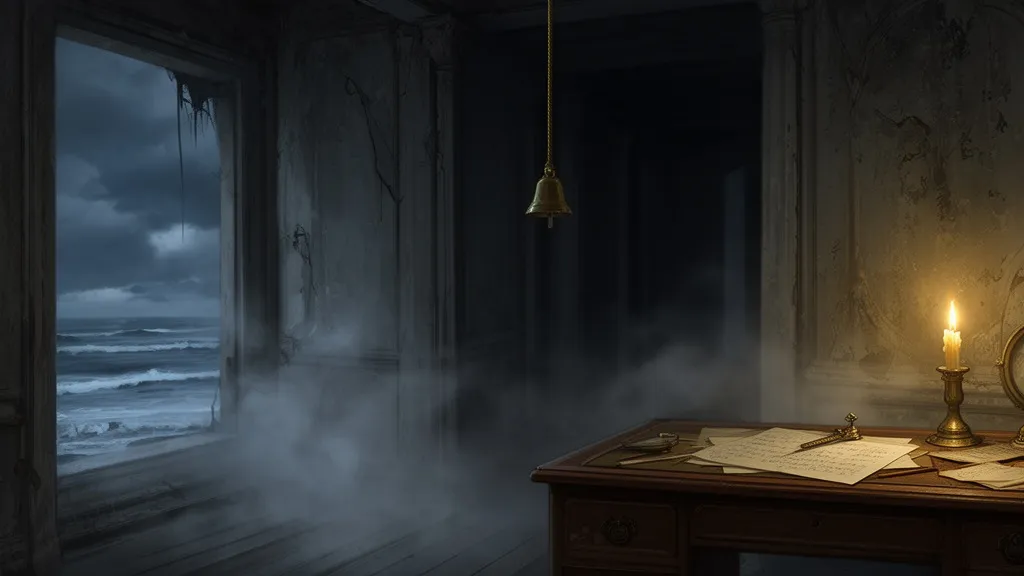
The bell cord moved at midnight.
Mrs. Agatha Crale had not imagined it. She had been awake — as she was most nights in Thornward Manor, where the damp came in off the sea and settled into the walls like a tenant who had decided, finally, not to leave — and she had been sitting at the small writing desk in her room on the second floor, composing a letter to her sister in Falmouth that she would likely never send. The lamp was adequate. The hour was unremarkable. And then, from the corridor above her, came the sound.
A single, clear, silver note.
One knows the difference between a sound and an intrusion. Mrs. Crale had kept houses for thirty-one years, since before her husband was lost to the sea off Penzance, and she understood bells the way a vicar understands hymns — by their particular weight and meaning. The bell on the upper landing served the nursery. It had not been rung in eleven months, not since the last family had vacated Thornward in some haste and with considerably less furniture than they had arrived with. It should not have been ringing now.
She lit the candle. She put on her robe. She was, she would later record in the small household ledger she kept with meticulous care, not frightened. She underlined this notation twice, which suggests she may have been lying to herself, which is the particular genius of a well-trained housekeeper.
The upper hall was cold in a way that the lower floors were not.
This was not unusual at Thornward, which had been constructed in 1887 by a shipping merchant with more capital than architectural sense, and whose understanding of insulation appeared to have been that walls were decorative. But the cold in the upper corridor was a specific cold — the kind that belongs to water rather than to wind, the cold of a thing brought up from the sea and not yet warmed by any domestic consideration.
The bell cord hung still.
Mrs. Crale approached it with the caution one affords a dog of uncertain temperament. The cord itself was old silk braid, somewhat frayed at the hem, and it hung precisely as it always hung — vertically, impassive, as though it had not, three minutes prior, announced itself to the entire sleeping house. She reached out and touched the small silver bell at its base.
She withdrew her hand immediately.
The bell was cold in a manner that had nothing to do with the corridor's temperature. It was cold the way metal is cold when it has been submerged. Cold as the sea floor. Cold with the specific quality of something that had been kept somewhere dark and wet and had only just returned.
Mrs. Crale stood in the upper hall for a long moment. The candle flame bent toward the nursery door, though there was no draught she could identify. The door was closed. She had closed it herself, ten days prior, upon her arrival at Thornward to prepare the house for the new family — the Pembrokes, who were expected Friday and who had been, in all correspondence, entirely and somewhat suspiciously cheerful.
The nursery door was closed.
But beneath it, just visible in the candlelight, was the damp hem of a child's footprint.
She opened the door.
One does not, in such circumstances, have the luxury of deliberating at length. The alternative — standing in the corridor until morning, holding a cooling candle and watching the darkness beneath a door — struck Mrs. Crale as an abdication of professional responsibility so severe as to render her entire career a fiction. She opened the door.
The nursery was as she had left it. The small bed with its brass posts stood against the far wall. The fireplace — disused, its grate cleaned and cold — occupied the opposite wall. The rug between them, a faded thing printed with indistinct nautical figures, was precisely as she had last observed it.
Except that the rug was wet.
Not damp — wet. A trail of footprints crossed it from the fireplace to the cradle, each impression dark with moisture, each the size of a small child's foot, each sinking into the wool with the particular decisiveness of a thing that had walked there recently and with some purpose. The prints did not lead back. They ended at the cradle.
Mrs. Crale raised her candle.
Hanging from the left brass post of the cradle, with an air of absolute mundane certainty, was a child's cap. Wool, once white, now grey with salt and sea-damage, its ribbon sodden, its brim drooping. It dripped, slowly, onto the floorboards. A small puddle had formed beneath it that caught the candlelight and held it like a dark mirror.
Mrs. Crale looked at the cap for a very long time.
Then she turned, walked back down the corridor, descended to her room, and sat at her writing desk. She did not finish the letter to her sister. She opened the household ledger instead and wrote, in her careful hand:
Upper nursery. 12:15 a.m. Bell rung — source unaccounted for. Wet footprints on rug, fireplace to cradle, no return track. Child's cap, saturated, brass post (left). Recommend: examination of chimney for water ingress, inspection of roof above nursery. Note: bell was cold. Will leave cap in situ pending instruction.
She underlined cold once, and then, after a pause, once more.
The Pembrokes arrived Friday as promised, and they were indeed cheerful, in the unnerving way of people who have decided in advance to find everything perfectly acceptable.
Mr. Pembroke was a solicitor from Bristol. His wife, Mrs. Helena Pembroke, possessed the kind of relentless pleasantness that Mrs. Crale associated with women who have resolved never to be distressed by anything ever again, having once been distressed by something quite considerably. Their children — two girls and a boy, ages eight, six, and four — were largely indistinguishable from other children, being loud and opaque and intermittently underfoot.
Mrs. Crale delivered her household report at Saturday breakfast. She had removed the cap. She had not mentioned it, having placed it in the kitchen linen cupboard in a small box and then considered the box with periodic misgiving. She reported the wet footprints as a likely consequence of water ingress through the chimney, which was plausible, and said nothing about the temperature of the bell, which was not.
Mr. Pembroke nodded throughout in the manner of a man who is listening to something he has no intention of acting upon.
Mrs. Pembroke set down her teacup.
"And the room below the stairs," she said. "You've had a chance to air it out, I trust?"
Mrs. Crale had not aired it out. She had, in the ten days prior to the family's arrival, cleaned every room in Thornward Manor with the single exception of the room below the stairs, which was locked with a padlock that she had been instructed, in the letting agent's written correspondence, not to open under any circumstances, which instruction she had followed with a relief that she found, in retrospect, difficult to dignify.
"I have the key," said Mr. Pembroke, drawing it from his waistcoat with the satisfaction of a man producing something significant. "We'll need that room for storage. Helena thought it might do for the trunks."
"I should mention," said Mrs. Crale, with all the measured gravitas at her disposal, "that the previous tenant was discovered in that room in a condition of some—"
"Yes," said Mrs. Pembroke, pleasantly. "Praying, apparently. To the wallpaper. We did read the disclosure."
"The wallpaper," said Mr. Pembroke, with the tone of a man who has never taken wallpaper seriously in his life and does not intend to begin, "is not going to—"
"It is a pattern of drowned sailors," said Mrs. Crale.
A brief silence attended this remark.
"Well," said Mr. Pembroke.
"Victorian-era," said Mrs. Crale. "Repeated. The figures are small. One does not notice them immediately. They appear, at first glance, to be decorative rope-work or coral. One has to look rather carefully before one sees the—"
"We'll open it after breakfast," said Mr. Pembroke.
The key was brass. The padlock was newer than the door, which was old, which was swollen with damp, which opened inward with a reluctance that felt less mechanical than personal.
The smell was the sea.
Not the pleasant, brine-sharp smell of a window open to the coast, but the deep, cold, sunless smell of water that has never been warm. The smell of depth. The smell that the bell had carried on its silver surface two nights prior, and that the cap had carried on its wool, and that the wet footprints had left fading into the nursery rug.
Mrs. Crale stood in the doorway. The room was small. There was no furniture. There was only the wallpaper.
Mr. Pembroke held the lamp higher. Mrs. Pembroke stood at his shoulder, her pleasantness slightly diminished.
The pattern was, as Mrs. Crale had described, initially abstract — rope-like curves, coral-like fronds, loops and whorls of dark blue on a water-grey ground. One could look at it for some time without seeing anything. The previous tenant had apparently looked at it for approximately four months before, one February morning, she had been found kneeling before it with her hands clasped and her eyes quite open and the expression of someone who has, after long effort, finally understood the answer to a question they perhaps should not have asked.
Mrs. Crale did not look at the wallpaper directly. She looked at the adjacent wall instead, in the way that one does not look at the sun.
"I see what you mean," said Mrs. Pembroke, very quietly, and then said nothing further.
"The trunks can go in the cellar," said Mr. Pembroke, after a moment. "We don't need this room."
He locked the door again. He put the key in his pocket. He did not look at anyone.
Upstairs, in the nursery, the bell rang once.
None of them moved. The sound dissolved into the salt air of the house. The lamp flame bent toward the locked door as the candle had bent toward the nursery two nights before, and Mrs. Crale understood — with the sudden, absolute clarity of a woman who has kept houses for thirty-one years and knows, in her marrow, when a house is already occupied — that Thornward Manor had never been waiting for the Pembrokes.
It had been waiting for her to open that door.
She had done so.
The bell did not ring again.