The Catalogue of Inevitable Persons
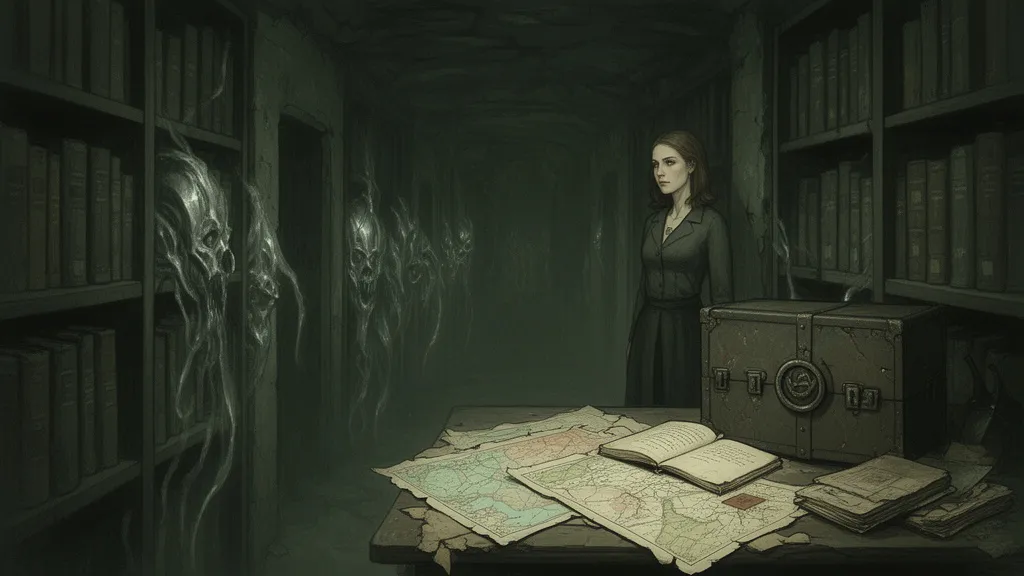
The smell reached her before the light did.
This is what Mrs. Ruth Ellery recorded in the notebook she kept in her cardigan pocket — the small green Silvine that she had carried since Gerald's death, filling it with nothing more remarkable than grocery lists and the occasional observation about sizing tissue — and it is from this notebook, recovered from the floor of Sub-Level C approximately six inches from the sealed case designated WA/CART/1847/MISC, that the following account has been assembled.
She wrote: Iron. Not rust. The other one.
She did not explain the distinction. She did not need to. Anyone who has worked with antique documents long enough comes to know the smell of old blood on paper. It is an occupational familiarity one does not discuss at dinner.
The call had come at a quarter past seven, when Ruth was already in her coat.
Dr. Fenwick, the Archive's Head of Collections, had the particular tone of a man who has convinced himself that asking a favour is actually issuing a reasonable professional instruction. He informed her — not requested, informed — that the sealed case in Sub-Level C had been flagged by the environmental monitors. Unusual moisture readings. The glass, apparently, had been fogging.
"From the inside," he added, and then seemed to regret having done so, and moved on very quickly to discuss access codes.
Ruth had been the Archive's sole map conservator for eleven years. She had been, before that, the wife of Gerald Ellery, surveyor, who had died of what the death certificate described as cardiac failure of undetermined origin, and who had been, as she had told Dr. Fenwick exactly once, the most methodical man she had ever known. Gerald had not been the kind of man things happened to without explanation. This had not prevented them from happening.
She went back downstairs. One does.
Sub-Level C was not, strictly speaking, a pleasant place under ordinary circumstances. The Archive's lower stacks occupied what had been, in the building's earlier life as a Victorian municipal court, the holding cells. The conversion was thorough and professional. The ceilings were lit by long fluorescent panels. The shelving was modern, climate-controlled, entirely appropriate. None of this made the slightest difference to the way the air sat differently down here — heavier, one thought, and with a quality of attention that the upper floors did not share, as though the room had developed, over many decades, the habit of listening.
Ruth had worked in worse. She kept her torch on regardless.
The case was at the end of the third row: a flat, sealed specimen case, the kind used for documents too fragile or too anomalous for standard housing. The label read WA/CART/1847/MISC — DO NOT OPEN WITHOUT AUTHORISATION — CONSERVATOR ACCESS ONLY. Beneath this, in smaller type, the original cataloguing note: Contents unverified. Provenance disputed. Referred for specialist inspection (pending).
Pending, Ruth knew, was Archive shorthand for we did not know what to do with this and hoped the problem would resolve itself.
The fog on the inside of the glass was real. She pressed two fingers against the surface and felt, quite distinctly, warmth.
She wrote in the notebook: Glass warm to touch. Condensation interior surface only. Smell stronger here. Should note: sealed cases do not fog from the inside. There is no mechanism by which this occurs.
She opened it anyway. She was a conservator. It was her job.
The document inside was not a map.
This was, professionally speaking, irregular. The case had been catalogued — however vaguely — under the cartographic collection. Ruth had assumed she would find a chart, a survey fragment, a coastal rendering with salt damage. She had brought the appropriate tissue and the appropriate gloves.
What she found was a single sheet of paper, heavy, cream-coloured, covered in columns of names written in a small and meticulous hand. The ink was brown with age in the upper portion. Lower, it darkened. The final entry — she counted, afterwards, forty-seven names above it — was in ink so fresh that it had not entirely dried, and left a faint mirror impression on her glove when she, exercising a professional lapse of judgment she could not subsequently explain, touched it.
She did not immediately read the names. She looked at the handwriting.
One knows one's own visual vocabulary. Ruth had spent eleven years examining documents, and had developed an intimate familiarity with the idiosyncrasies of individual hands — the characteristic pressure, the particular formation of ascenders and descenders, the way a person holds a pen when they believe no one is watching. She had seen Gerald's handwriting every day for nineteen years. She had seen it for the last time on a card attached to a hospital form, and then on a death certificate, under Next of kin declaration, where he had written her name in his careful surveyor's script, each letter measured and precise.
The hand on this document was identical.
She sat down on the floor. This was undignified. She did it anyway.
The notebook entries become less regular at this point.
There are observations about the paper stock — laid, probably mid-nineteenth century, inconsistent with the lower entries which show no aging — and a brief, abandoned calculation about the ink's viscosity, and then a long gap represented by a blank page, which Ruth appears to have sat with for some time before writing, in letters considerably larger than her usual hand:
The newest name is mine.
And then, below it, the question that would occupy her for the remainder of the night:
The board meets at nine. They will want the document logged. To log it is to date it, describe it, enter it into the permanent record. The entry would read: single sheet, unattributed, list of persons, most recent addition undried at time of discovery. They would send it for analysis. They would find the ink. They would find the hand.
Gerald has been dead for three years.
To destroy it is the other thing.
At 2:14 in the morning, the environmental monitors on Sub-Level C recorded a brief spike in temperature, followed by a return to baseline. The duty log for that evening shows Ruth Ellery signed in at 7:52 PM and signed out at 2:19 AM. The duration of her visit — six hours and twenty-seven minutes — is not addressed anywhere in the Archive's records, because no one thought to ask.
She submitted her inspection report the following morning before the board convened. It read:
Case WA/CART/1847/MISC: inspected as requested. Contents assessed. Document identified as non-cartographic material, likely misfiled during a previous cataloguing exercise. No conservation intervention required at this time. Recommend continued standard monitoring. Contents: single sheet, damaged. Writing illegible. No further action advised.
The case, when Dr. Fenwick checked it that afternoon, was empty.
He noted this in the margin of Ruth's report with a question mark, and set it aside to discuss with her at their next scheduled meeting, which was to take place the following Thursday.
Ruth Ellery did not come in on Thursday.
She did not, in fact, come in again.
The green Silvine notebook was found during the subsequent inventory of her desk. It has been retained here as the only document that bears on the matter, pending a specialist inspection that has not yet been scheduled.
Pending, as previously noted, is the word the Archive uses when it does not know what to do.
It has always found the problem resolves itself, eventually.