The Coroner Certifies the Hour
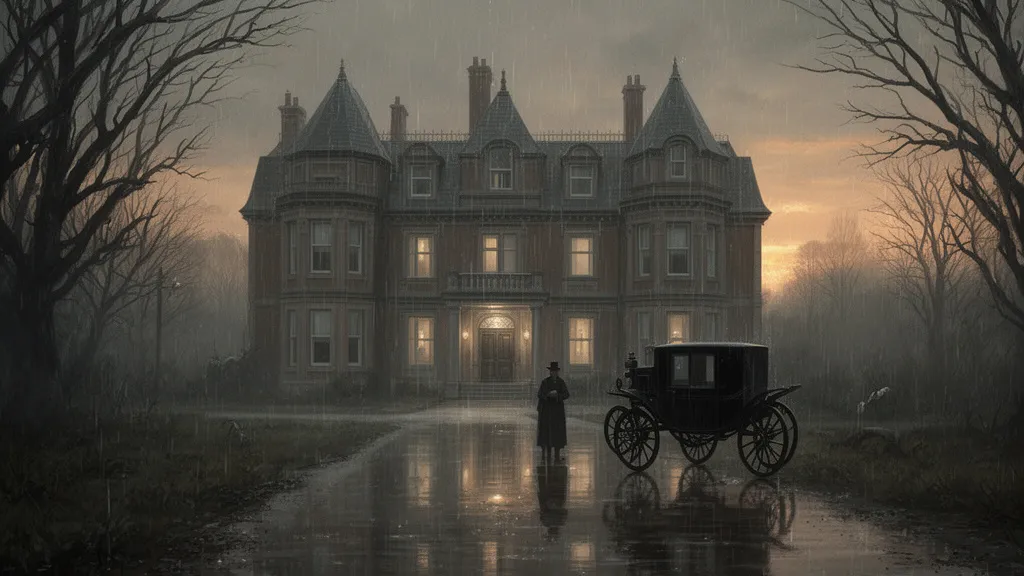
The body had been found at half past seven in the morning, which was, in Mr. Aldous Pemberton's considerable professional experience, an entirely acceptable hour to die. It was the manner of the finding that troubled him as his hired coach laboured up the long gravel drive of Thurlow Hall, the wheels cutting deep into standing water that had not been there, the housemaid who'd summoned him had insisted, as recently as the previous afternoon.
Pemberton was the county coroner for Hartwell and its surrounds, a man of forty-three years, an adequate education, and an absolute conviction that the dead had no capacity to surprise him. He held certificates in medicine and jurisprudence. He had attended one hundred and fourteen inquests. He had seen men drowned in shallow puddles and women discovered in circumstances that defied, briefly, all rational account. Briefly. The rational account had always, eventually, presented itself.
He stepped down from the coach into four inches of rainwater and said something uncharacteristic under his breath.
The widow, a Mrs. Helena Gault, met him in the entrance hall with the particular composure of a woman who had rehearsed her grief and found it somewhat inadequate to the occasion. She was perhaps sixty, dressed already in full mourning, which struck Pemberton as either admirable foresight or something he could not immediately name.
"He was at his writing," she said, before Pemberton had removed his coat. "The servants found him at the desk. He had been there since two in the morning, at the very least — I heard the scratch of his pen when I passed his study on my way to bed."
"You did not find his posture unusual at that hour, Mrs. Gault?"
She looked at him as one might look at a footstool that had spoken. "My husband kept irregular hours when engaged in legal matters. He had been revising his will."
Pemberton noted this with his pencil in the small green notebook he carried for precisely such confidences.
"There is a solicitor involved?"
"Mr. Fenn, of Hartwell. He is expected. The storm" — she gestured toward the windows, where the rain moved in long, grey curtains — "has delayed him."
The storm had delayed everyone, it seemed. The coach that had brought Pemberton could not now safely return. He had been told this by the driver with a cheerfulness that Pemberton found entirely inappropriate.
"If you would show me to the study," he said.
The corridor that led from the entrance hall to the late Mr. Gault's study was the sort of corridor that made a professional man feel his profession was insufficient. It was long, and dim, and panelled in wood of a colour that suggested neither warmth nor any particular decade. Portraits observed him from both walls — generations of Gaults, one presumed, their painted eyes collectively suggesting that Pemberton was not the first visitor they had found wanting.
It was in this corridor that he first noticed the clocks.
There were four of them: two bracket clocks on their respective tables, one longcase clock of venerable age, and a small carriage clock placed, for reasons Pemberton could not fathom, on the floor beside a closed door. Each had stopped. He slowed his pace without meaning to, and checked his own watch against the nearest bracket clock. The stopped hands read two thirteen. His watch read twenty past nine.
"The clocks," he said.
"Yes," said Mrs. Gault, without turning.
"They have all stopped at the same hour."
"They require winding," she said. "The servants have been distracted."
Pemberton looked at the longcase clock, which was the sort of mechanism wound weekly by tradition and necessity. It had, by the evidence of its pendulum, stopped mid-swing. He wrote 2:13 — all four — corridor — coincidence? in his notebook and then stood for a moment regarding what he had written.
The door beside the carriage clock was, he noticed now, not a door to any room he had been shown. It occupied the space between two portraits in a way that seemed almost apologetic — narrow, its frame slightly recessed, its keyhole dark.
"What room is this?" he asked.
Mrs. Gault paused. Her back remained to him for a moment longer than was natural.
"The nursery. It has been sealed for some years."
"Ah," said Pemberton.
He was not certain what had prompted him to crouch beside the door, and he would not, in later years, describe having done so. But he did crouch, and he did observe, in the thin gap between door and floor, the faint and rhythmic movement of air — a breath, as one could only call it, though one preferred not to, pressing slowly outward and then drawing slowly back.
He stood. He walked on. Mrs. Gault had not waited for him.
The study was a room that smelled of old paper, lamp oil, and something underneath those things that Pemberton's professional training insisted was the early work of decomposition and his personal instinct insisted was something else entirely.
Edward Gault sat upright in his writing chair.
This was, in itself, unremarkable. Men were found dead in chairs with some regularity; the chair made no greater moral claim upon death than the bed. What was remarkable — what caused Pemberton to stand in the doorway for rather longer than his professional dignity could easily justify — was the quality of the uprightness. Most men, dying in chairs, subsided. They listed. They achieved, in death, the boneless compliance of the truly relaxed. Gault had achieved nothing of the kind. He sat as though receiving a visitor. His left hand rested on the arm of the chair with a composed deliberateness. His right hand was pressed flat to the blotter.
The blotter was stained: a broad darkness of ink, and within that darkness, an elongated smear of a different quality entirely, brown at its edges and still, at its centre, a deep and emphatic red.
"He was found thus?" Pemberton asked the housemaid, who stood at the doorway's other edge and appeared to be keeping herself as far from both Pemberton and the room as the narrow space would allow.
"Yes, sir. Miss Eleanor found him first, and then we — that is, Mr. Harwick and I — we came and found him the same."
"And no one moved him. No one adjusted his position, turned his chair, or in any way altered his arrangement."
The housemaid said nothing, which was, in Pemberton's experience, an answer of considerable volume.
The family had gathered in the drawing room by the time Pemberton completed his preliminary examination. The storm outside had reached the particular pitch that precedes no immediate improvement; the fire had been built high; and gathered around it, in the over-furnished intimacy of inherited furniture and mutual suspicion, sat the Gault family in its assembled parts.
There was Eleanor, the eldest daughter, who was perhaps thirty-five and who had the look of a woman who had spent thirty-five years being more capable than anyone around her had found convenient. There was Geoffrey, the son, who was younger by several years and dressed with the careful extravagance of a man who has expectations he would prefer not to specify. There was an aunt — a Mrs. Partridge, introduced as such and no further — who seemed to exist at a slight remove from the proceedings, as though attending a theatrical performance she had seen before and found moderately diverting.
Above them, on the wall above the chimneypiece, hung a portrait in an ornate gilt frame that was too large for it by some margin. The subject was a Gault of some earlier generation, painted in oils that had darkened with the years until the figure emerged from shadow as though reluctant. The eyes were the particular achievement of whatever artist had executed the piece: painted in glass, Pemberton realised — actual glass, set into the canvas — which caught the firelight and gave the portrait a quality of attention that he found he was unable to entirely dismiss.
He had encountered glass eyes in portraits before. He had not encountered the sensation that they were tracking the position of his notebook.
"Your father," Pemberton said to Eleanor, because it seemed necessary to begin somewhere, "was engaged in revising his will at the time of his death. Mrs. Gault has confirmed this. Are you aware of the nature of the revisions?"
The silence that followed was the kind produced not by ignorance but by the simultaneous decision of several people not to be the first to speak.
Geoffrey spoke. "We were not taken into his confidence."
Eleanor said, at the same moment, "He had spoken of certain changes."
They looked at each other. The portrait looked at Pemberton.
"I must ask," Pemberton said carefully, setting his notebook on his knee with the precision of a man placing a small fact between himself and a larger unknown, "whether any member of this household entered the study between the time of Mr. Gault's death and the time of his discovery."
Again, that silence.
It was Mrs. Partridge who broke it, from her position of theatrical remove. "The body has been moved," she said, with the conversational ease of someone observing that it had come on to rain. "Twice, I should think, from the marks on the carpet."
Pemberton looked at her.
"I notice things," she said pleasantly. "It is a habit I have found to be socially inconvenient but practically useful."
"You are certain of this."
"The chair sits on a carpet of some age, Mr. Pemberton. The indentations of its legs are well established. The chair is presently some four inches from those indentations, and the indentations themselves show evidence of having been disturbed on two separate occasions — the older disturbance filled somewhat with dust; the more recent, not."
Pemberton wrote chair moved — twice — carpet evidence — Mrs. Partridge and then sat regarding what he had written for rather longer than the task required.
At eleven o'clock, Pemberton excused himself from the drawing room under the pretext of re-examining the study. He did, in fact, return to the study. He did, in fact, re-examine it. He confirmed that the chair had been moved. He confirmed that the right hand, pressed to the blotter, had been pressed there after death — the pooling of blood in the tissues made this, if not certain, then strongly probable. He confirmed that the will, which lay open on the desk, had been signed and witnessed, the witnesses being two names he did not recognise, the signature being Gault's own, and the final revision — added in a hand that grew unsteady toward the end — altering the disposition of the estate in ways that would, he suspected, produce in this household a sustained and intricate misery.
He also confirmed that the pen on the desk was dry, and had been dry for some time, and that the ink stain on the blotter was cold, and the blood at its centre was not.
This was the fact that he stood with for some time in the inadequate light of the study's single remaining lamp.
At half past eleven, returning through the corridor, he stopped outside the sealed nursery.
The carriage clock on the floor beside it — he noted now what he had not noted before — was not merely stopped. Its case had been opened. Its mechanism was intact. Its hands had been manually set to two thirteen and then, with some deliberateness, snapped from the spindle entirely.
From behind the door, in the silence between one gust of wind and the next, came a sound.
One could describe it as the settling of old wood. One could describe it as the movement of a house under the pressure of a storm. One could describe it as these things, and Pemberton, who was a man of certificates and notebooks and one hundred and fourteen inquests, was entirely capable of doing so.
What he could not account for — what he stood before in the half-dark of a corridor while the rain pressed at every window and the clocks held their stopped hour like a door held shut — was the scratch.
It came from low on the door. The height of a child, or of a grown person kneeling. A slow, deliberate scratch, the kind made not by panic but by patience. It came once, and paused, and came again.
And then it stopped.
And in the silence that followed, Pemberton heard, quite clearly, the sound of pen meeting paper — the very specific scratch and drag of someone writing — emerging not from the sealed nursery, and not from the study behind him, but from the corridor itself, from the empty air between the stopped clocks and the watching portraits, from nowhere and everywhere and the exact centre of the space in which he stood.
He looked at his notebook.
On the page beneath his last entry — chair moved — twice — carpet evidence — Mrs. Partridge — in a hand that was not his own, in ink he did not possess, in letters formed with a deliberate and practiced precision, were written three words.
Do not certify.
Pemberton stood in the corridor of Thurlow Hall for a long time after that. The storm continued. The fire in the drawing room cast its light under the door at the corridor's far end, and in that light the family's shadows moved, and above them the glass eyes of the portrait caught the flame and held it, and the clock on the floor said two thirteen, and would say nothing else.
He was a man of one hundred and fourteen inquests.
He stood in the corridor and understood, at last, precisely what that number signified.
It meant he had never, until this moment, attended the hundred and fifteenth.