The East Room Keeps Its Own
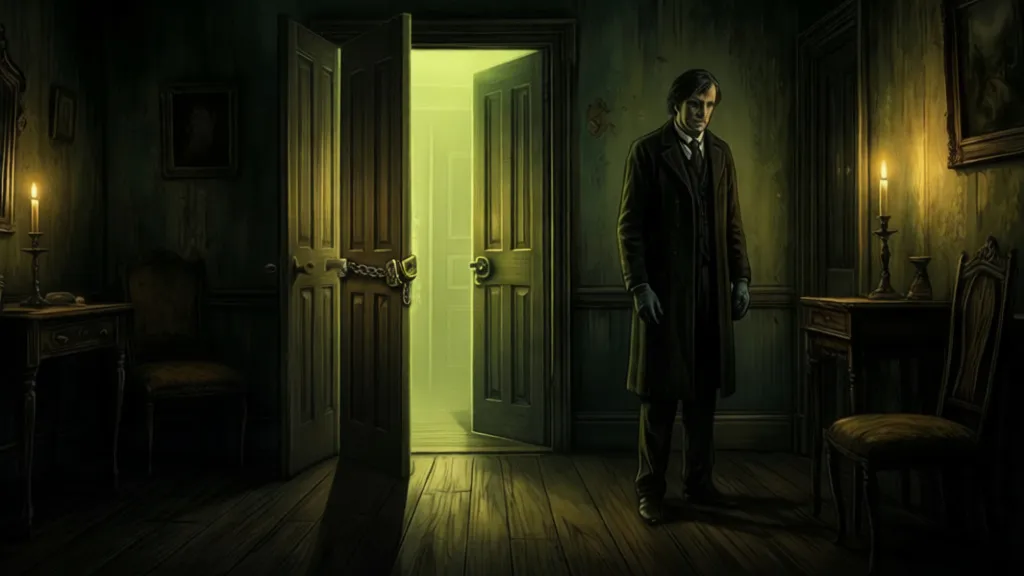
From the private diary of Dr. Edmund Caswell, 7th November, 1902.
7th November — past midnight — Thornbury Grange, Wiltshire
I arrived at the Grange at eleven o'clock, having been summoned by urgent telegram from a Mrs. Aldous Vane, whose husband — a man of sixty-three and, by all prior accounts, robust — had suffered a cardiac failure some hours before my arrival. The roads from Marlborough were abysmal. I record this not as complaint, but as explanation for the particular irritability with which I received, upon crossing the threshold, the intelligence that I had not, in fact, been summoned to certify a death.
I had been summoned because the death appeared to be reconsidering itself.
The housekeeper, a woman named Pryce whose face had settled into an expression of permanent and practised resignation, led Dr. Caswell through corridors that smelled of damp plaster and extinguished candles. The Grange was the sort of house that had been added to without plan across three centuries, so that one passed from a Georgian hallway into an Elizabethan passage without warning, the ceilings dropping six inches in a single step, the floors asserting unexpected gradients. Caswell had attended patients in worse places, though he struggled, in that moment, to recall precisely where.
Mrs. Vane was waiting outside the east room on the first floor. She was a tall woman, dressed already in black — already, Caswell noted, as though the mourning clothes had been prepared in advance of the event they marked — and her composure was of the particular variety that is indistinguishable from suppression.
"Dr. Caswell," she said. "Thank you for coming at such an hour."
"You indicated some urgency," he replied. "Your telegram described the body as—" He consulted his memory rather than the telegram itself, which remained in his coat pocket. "—restless." He allowed the word to occupy the air between them for a moment, in the hope that she might find it as peculiar as he did.
She did not flinch. "My husband is in the east room. I would ask that you examine him, and then I would ask that you do nothing further until dawn. Those are my two requests."
"Madam, if your husband—"
"Until dawn," she repeated, with a quietness that foreclosed argument more effectively than volume might have done.
Pryce opened the door.
Continued — the same entry — I estimate three o'clock in the morning, though the clocks on this floor have begun to disagree with one another in ways I find professionally concerning.
Aldous Vane lay on the room's central table — not a bed, I noticed, but a table, heavy oak, the sort one associates with libraries or the signing of documents of consequence — beneath a black wool shroud that had been arranged with considerable care. The room was cold. There were no candles burning. The only light came from a lamp I had brought myself.
I drew back the shroud.
I am a physician of twenty-two years' standing. I trained at Edinburgh. I have attended deaths in circumstances ranging from the squalid to the ceremonial, and I hold a rational view of the body's post-mortem processes that I should, on any ordinary occasion, be prepared to defend at length.
The fingers of Aldous Vane's right hand were not in the position in which they had, evidently, been arranged. Two of them were raised slightly at the middle joint, bent inward, as though reaching toward the palm. As though, one might say — though one hesitates — trying to close around something no longer there.
His skin was warm.
Caswell pressed two fingers to the man's wrist and held them there for a full minute, measuring against his pocket-watch. Nothing. He pressed his ear to the chest — a procedure he recognised was beneath his usual professional dignity, but which the circumstances seemed to warrant — and heard only the silence that follows the cessation of everything.
Aldous Vane was dead. The warmth was not the warmth of life.
It was something else.
Caswell replaced the shroud, straightened, and turned to observe the room properly for the first time. It was large — larger than the external dimensions of this wing had suggested to him as he approached, though he attributed this impression to the distortions of lamplight and fatigue. The furnishings were sparse: the table, two chairs, a writing desk against the far wall, and, occupying almost the entirety of the east-facing wall, a mirror in a gilt frame of considerable age and hideous ornamentation, its glass rising from floor to ceiling.
The mirror had been papered over.
The paper was not decorative. It was ordinary brown packing paper, affixed with glue that had been applied in haste — or, perhaps, in the kind of methodical urgency that resembles haste from a distance — in overlapping sheets from the top of the frame to the bottom. The paper was old. Not tonight's work. Not last week's, either.
Caswell stood before it with his lamp held up and studied, as a physician studies symptoms, what the paper's condition could tell him.
The paper had been applied from the inside.
He understood this because the edges at the mirror's frame were folded inward, tucked behind the gilt lip rather than glued against it. Someone had stood on the other side of the glass and pressed the sheets into place from within.
Which was, he reflected, standing very still in the cold east room with a warm corpse behind him, not possible.
The clock on the mantelpiece struck three. Somewhere below — the ground floor, the hallway, the library perhaps — another clock struck in answer, fractionally delayed, as clocks in old houses will. Then a third.
And then, from behind the paper, something tapped.
Once. Twice. Three times. Precisely timed to the last stroke of the third clock, so that for a moment Caswell almost persuaded himself that the sound had been an echo, a trick of the Grange's particular acoustics.
He did not move.
The clocks finished. Silence returned. The tapping did not repeat.
Still 7th November — I cannot determine the hour with precision.
I found Mrs. Vane in the corridor where I had left her. She had not gone to bed. I do not believe she intended to.
I asked her, with the directness that the situation seemed to me to demand, about the mirror.
She was quiet for long enough that I wondered if she intended to answer at all.
"The east room has always had particular properties," she said at last. "My husband understood them. He managed them. That is — that was — his role in this house."
"Managed them," I repeated.
"You will want to know the family history," she said. "Everyone who reaches this room wants to know the family history. I shall tell you that it is longer than would be useful to relate at this hour, and that its salient point is simply this: the mirror was placed over the window that was in this room before it was remodelled, in 1743, by my husband's great-great-grandfather, a man of scientific inclinations and, I think, very poor judgement." She paused. "The window looked onto nothing. Nothing that should have been there. He had the window replaced with the mirror, believing that reversal would — correct something. It did not correct it. It merely — redirected it."
I asked what it was.
"I don't think it has a name," she said. "The family has always called it the east room, and left the room to speak for itself."
I asked about the paper.
"My husband papered it thirty years ago, after his father died in that room. He said the mirror had begun to — he used the word answer. Things happening in the house, and the mirror answering them. He found it more manageable with the paper."
I asked whether, on the occasion of Aldous Vane's own death, it had occurred to her that the paper might no longer be adequate.
She looked at me with an expression I could not interpret as anything other than confirmation.
Caswell returned to the east room at what he estimated was four o'clock.
He had, in the corridor, experienced a period of deliberation that he would not, in any record meant for professional circulation, describe as fear. The logical position was clear enough: a man of medicine, confronted with a papered mirror in a draughty country house, had two rational options. He could open it — that is, remove the paper — and determine once and for all what the glass contained or reflected or answered to. Or he could leave it sealed, complete his certification at dawn as Mrs. Vane had requested, and remove himself from the Grange by breakfast.
The logical position held for several minutes.
Then Aldous Vane, through the closed door of the east room, moved.
Not violently. Not with the dramatic convulsion of the penny-dreadful. Caswell heard only the soft sound of wool shifting against oak, the faint drag of weight adjusting itself across a hard surface. It lasted perhaps four seconds. Then it stopped.
He opened the door.
The shroud was undisturbed. The body was in its original position, hands composed, face covered. The room was exactly as he had left it, save for one particular: the paper on the mirror had developed, in the upper left quadrant of the frame, a long vertical tear. The tear had not been there before. Through it, perhaps three inches of dark glass was visible.
Caswell crossed the room and held his lamp to the tear.
He had expected to see the room reflected: the table, himself, the lamp. Mirrors reflect what is before them. This is the settled and unremarkable principle upon which their utility depends.
The glass showed him a room. It was not the room he was standing in.
The proportions were wrong in a way he struggled to articulate — not dramatically wrong, not the stuff of theatrical horror, but wrong in the way a familiar face is wrong when seen from an unfamiliar angle, producing a recognition that is simultaneously certain and deeply unwilling. The table in the reflected room was positioned differently. There were more chairs. And the figure standing at the reflected room's mirror — the mirror within the mirror, which should by all geometric logic have shown an infinite recession of reflected rooms — was not Caswell.
It was looking at him.
He could not see its face. He was not certain it had a face, precisely, though it had the approximate shape of something that ought to. What he could see was that it was standing very close to the glass, close enough that its presence — he refused, in the interest of professional self-respect, to use the word breath — was producing a slight condensation on its side of the mirror, a faint clouding that spread and receded with rhythmic regularity.
And its hand was raised.
One finger extended, pressed flat to the glass.
Ready to tap.
Caswell set down his lamp, turned, and walked to the table. He replaced the shroud where it had shifted. He straightened the hands. He did not look at the mirror again. He sat in one of the chairs and opened his bag and found his notebook and wrote down — legibly, he hoped, though his hand was performing in a manner he found disappointing — everything he had observed since his arrival.
He remained in the chair until the light changed in the strip of window visible above the curtains. When it had changed sufficiently to constitute dawn by any reasonable interpretation, he closed his notebook, picked up his lamp, and went to find Mrs. Vane.
He did not tell her what he had seen through the tear.
He understood, in the particular way that understanding arrives not as illumination but as the slow, irreversible closing of an exit, that this was because it would not have surprised her.
8th November — Marlborough — my own rooms
The death certificate has been signed. Cardiac failure, as indicated.
I have not slept. I find that when I close my eyes I am in the east room, and the clocks are striking, and something behind paper is waiting with one finger raised, patient as anything that has had thirty years to practise patience.
There is a mirror in my own rooms. A perfectly ordinary mirror, Georgian, oval, good silver backing. I have had no cause to consider it previously.
I find that I am considering it now.
I find that I cannot quite recall whether, in all the years I have lived here, I have ever examined closely what it shows.