The Handprint in the Lime
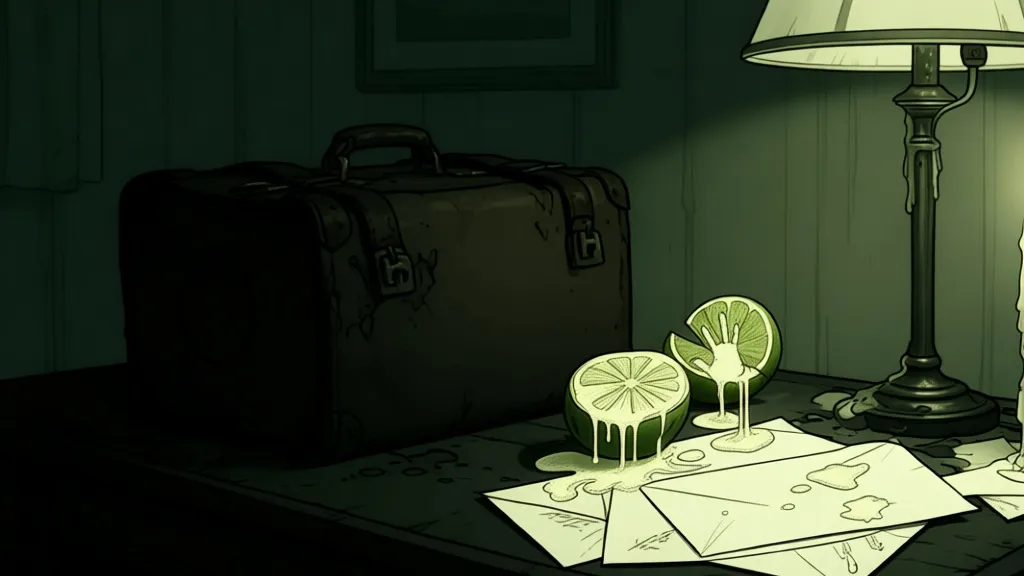
The following correspondence was recovered from the effects of Dr. Edmund Carver, formerly of Ashwick-on-Dene, Shropshire. The letters were found in a leather wallet, folded twice and sealed with candle wax of an unusual ivory colour. Dr. Carver has not been heard from since the morning of the seventeenth. His medical bag was returned by post. It contained no instruments.
Letter the First Dr. Edmund Carver to his colleague, Dr. James Fallow, Shrewsbury. Dated: the evening of the sixteenth, written at the Ashwick Arms, prior to departure.
Dear Fallow,
I write in haste, as the trap is being brought round and Mrs. Grubb, who keeps this establishment, is giving me looks of profound disapproval for lingering over my supper. Nevertheless, I wish to note the evening's peculiarities for your amusement, since you have always maintained that country practice in Shropshire provides material for the pen as readily as it does for the lancet.
At half past eleven — that is to say, at the precise moment I had committed myself to a second glass of the Arms' surprisingly tolerable claret — I received a message by way of a boy who could not have been older than twelve and who refused, with an obstinacy I found disproportionate, to wait inside the door. The note itself was written in a hand I can only describe as excessively careful, as though each letter had been considered at length before being committed to the page. It requested — and I use that word generously, as the note had something of the character of an instruction — my attendance at a property called Vayne House, some four miles along the Gorsham road, on a matter of medical urgency.
The widow who resides there, a Mrs. Aldren, is not known to me personally. I am told she took the house following the death of her husband some eighteen months ago and has since received very little company. My colleague Whitmore attended her on two occasions in the autumn, you may recall, and described her thereafter as a woman of formidable composure — which, coming from Whitmore, who once set a man's femur without changing expression, strikes me as a remark worthy of some attention.
The urgency stated in the note — she is going was the precise formulation — presumably refers to some other member of the household, as Mrs. Aldren herself is understood to be in excellent health. There is a servant or two, I believe. Perhaps a relation.
I go as a matter of professional duty. I shall be back before breakfast and will write to you properly then with whatever unremarkable conclusion this business has arrived at.
Yours in some haste, Edmund Carver
P.S. The boy who brought the note smelled very strongly of fresh plaster. I note this only because it struck me as peculiar for the hour.
Letter the Second Dr. Edmund Carver to Dr. James Fallow. Undated. Written, by internal evidence, in the early hours of the seventeenth. The handwriting is Dr. Carver's, but it exhibits a quality of compression — the lines pressed close together, as though space were running short.
Fallow,
I must be methodical. I have found a candle and I am sitting in what I believe to be the second-floor study, and I am writing this because the act of writing appears to be, at present, the only useful thing available to me. The house is very quiet. I shall not dwell on what I mean by that.
I arrived at Vayne House at approximately twenty minutes past midnight. It is a long low building of grey stone, older than its plain Georgian facade suggests, set back from the road behind a line of elms that blocked what little moonlight there was. There were lights in the upper windows. The front door stood open.
There was no one on the step. I tied the horse to the post provided and knocked, and after a moment a woman came to the door whom I took, initially, for a servant, as her dress was dark and without ornament and she wore her hair in an arrangement better suited to labour than to reception. She introduced herself as Mrs. Aldren.
She was, I should say, perhaps fifty years of age, though something in the fixedness of her expression made it difficult to judge with any confidence. She was courteous. Her voice had the quality of a woman accustomed to speaking quietly in rooms where quiet was important. She thanked me for coming and led me directly into the hall.
It was here that I first observed the smell. It was not an unpleasant smell precisely, but it was a present one — damp stone and lime and something beneath that I could not immediately identify and which I found myself reluctant to pursue to a conclusion. There was a ledger lying open on the hall table, the kind used for household accounts, and I mention it here because I glanced at it as one does when one finds an open book in a stranger's house, and I saw my name written there. Dr. E. Carver. Inscribed in the same careful feminine hand as the note. I did not remark on it at the time. I remark on it now with considerably more feeling.
Mrs. Aldren led me past the staircase toward the front parlour. The door, I then noticed, was not merely closed but sealed — a line of fresh plaster run smooth along the frame from top to bottom, the lime still damp and very white against the older paintwork. I noted this and said nothing, as one sometimes declines to name a thing in the hope that silence will render it less real.
"It is not the parlour," she said, before I could ask. "I require you upstairs."
I followed her to the first floor, where she showed me into a bedroom at the back of the house. The room was empty.
By empty I mean it contained furniture — a bed, a wardrobe, a washstand — but it contained no patient. No one lay in the bed. No one occupied the chair beside the window. There was a cup on the nightstand, recently used, still faintly warm to the touch, and a spoon laid beside it in the manner of a thing carefully replaced. The indentation in the bedclothes described a form that had been there quite recently. But the room held no person.
"She has gone," said Mrs. Aldren, and there was a quality of satisfaction in her voice that I could not account for. "I need the certificate signed tonight."
I explained to Mrs. Aldren, with what I hoped was appropriate patience, that I could not sign a death certificate for a person I had not examined, had not attended in life, and could not, at the present moment, locate. She looked at me with an expression of mild, settled disappointment, as a schoolmistress might regard a pupil who has misunderstood a simple instruction.
"She is in the house," she said.
We searched the room together. Then the corridor. Then the second bedroom, which contained nothing of note except a smell of plaster considerably stronger than that in the hall. It was here that I became aware of a sound I had not previously registered — low, and rhythmic, and beneath the floorboards, and of a character that I will not attempt to describe except to say that it was the sort of sound one would, under ordinary circumstances, associate with something breathing.
I said: "Mrs. Aldren. Who is in the parlour."
She did not answer immediately. She went to the window and looked out at the dark garden and was silent for long enough that the sound from below the floor shifted register slightly, as though whatever produced it had become aware of the conversation.
"My daughter," she said, finally, "does not do well with visitors."
Fallow, I want you to understand that I am a man of science and practical habit, and I have been a surgeon for twenty-two years, and I have attended deaths both terrible and peaceful and have never, in that time, found any of it particularly difficult to explain. I tell you this so that you will credit the following account.
I asked her when the parlour had been sealed.
She told me: the night of her daughter's last visitor, who had come from Ludlow in September, and who had subsequently — she paused here — declined to return.
I asked: how long the daughter had been in the parlour.
She said: "Since before I came to this house."
I asked — and I confess the question surprised me as it left my mouth — what she had been feeding her.
Mrs. Aldren turned from the window then and looked at me with an expression that I can only describe as fond, and said: "The house provides. I only make the arrangements."
I went back to the hall. I looked again at the ledger. My name was the most recent in a column that extended some way up the page, each entry in the same hand, each with a date beside it. The most recent before mine was the Ludlow man, dated September as she had said. Above his name were others, some with dates going back four years, some without. There was a column beside the names that I did not look at for more than a moment.
I returned to the front parlour door.
The plaster was damp but had been applied with great thoroughness. Someone — and the care of it argued for considerable patience — had laid it very smooth. One would not, from the outside, have known it for anything but the original wall.
Except that in the centre of it there was a handprint. Pressed from inside, into the lime while it was still soft. A woman's hand, I judged, by the proportion, the palm broad, the fingers long. The plaster had dried around it perfectly, preserving the impression down to the lines of the knuckles.
As I stood looking at it, the plaster beneath my own hand — I had placed my hand flat against the wall without quite deciding to do so — was warm.
I stepped back. The warmth remained where my hand had been, suffusing the plaster outward in a way that was not consistent with any thermal property of lime I have encountered in my professional or personal experience.
Behind me, in the hall, one of the servants — there are two, a man and a woman, both elderly, both of the uncommunicative variety — was locking the front door.
I turned and asked him to leave it open, as I had a horse outside.
He looked at me with the particular blankness of a man who has been instructed, and said: "It's before dawn, sir. We lock the doors before dawn."
I said: "I require my bag from the trap."
He said: "I'll fetch it in, sir."
I said: "I would prefer to fetch it myself."
He said, with absolute pleasantness: "We lock the doors before dawn."
I went to the hall table and took up the pen that lay there — a good pen, well-maintained, of the sort one keeps ready for use — and I wrote this letter. I do not know whether I shall be able to send it. The nearest train went at half past eleven, and the boy with the trap has long since been sent away, and the house is very quiet, and the smell of plaster is, if anything, stronger than it was when I arrived.
Mrs. Aldren has gone upstairs. She left a plate on the hall table — the plate contains bread and what I believe to be potted meat — and she has left it, I notice, near the parlour door.
Not on the table. On the floor, against the baseboard. Pushed close to where the plaster meets the boards.
Fallow, I am going to insert this letter into my wallet and put the wallet in my coat. If I am able to depart in the morning I will post it myself and we will laugh about it over dinner and you will say that Shropshire is not so different from a ghost story after all and I will agree with you and order another bottle.
But I want you to know — and I write this with the composure appropriate to my profession and my years — that the handprint in the plaster is no longer one.
There are two now. The second is larger than the first. Its fingers are spread. Its position, relative to the first, is that of a hand reaching toward a hand.
The plate is empty.
I did not see anyone take from it.
The pen is very good. The candle is nearly down. The house is quiet, as I have said, and the door is locked, and behind the plaster something has understood — or has always understood, and has only now decided to make that understanding known — that I am standing
The letter ends here. The final sentence is completed by a second hand, in that same careful, feminine script, pressed firmly into the page:
still here.