The House That Was Counting
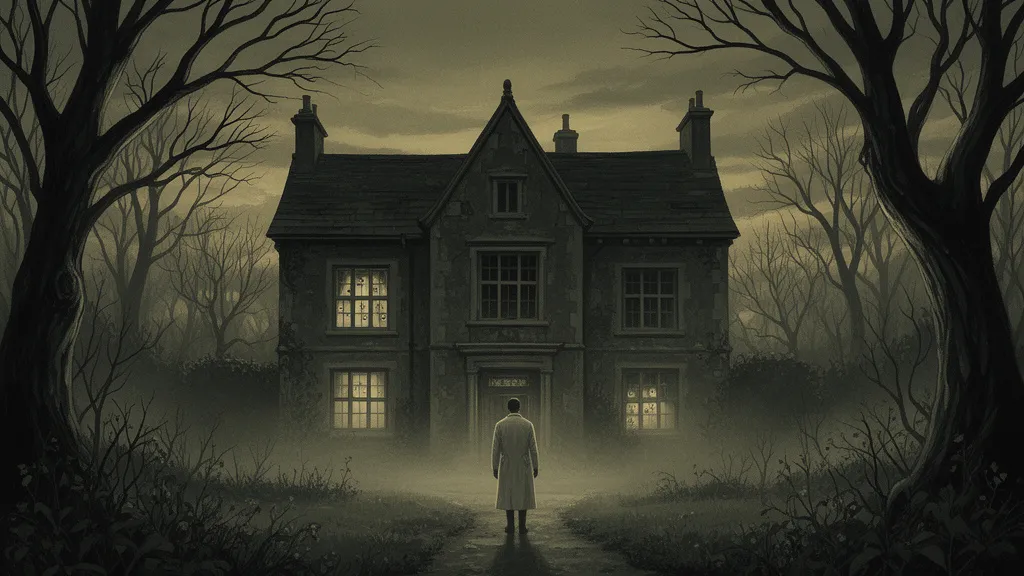
The telegram arrived at half past two on a Thursday afternoon, which meant that Dr. Ashford had already committed the sin of removing his boots and settling into the chair by the fire with a volume of Browning and a glass of something adequately fortifying. The telegram did not care about any of this. It read, in the clipped, anxious shorthand of a man who had paid by the word and regretted every one of them: NURSERY WRONG STOP CHILDREN UNWELL STOP COME AT ONCE STOP HAVELOCK STOP.
The name Havelock was sufficient. Dr. Ashford had attended the family for twelve years — the father's gout, the mother's persistent melancholy, the children's various and ordinary complaints — and in all that time Gerald Havelock had never once sent a telegram. He wrote letters. Careful, measured letters with proper salutations and adequate postscripts. That he had resorted to the telegraph indicated either that something was genuinely wrong, or that Gerald had taken leave of his senses, and Ashford was not entirely certain which possibility alarmed him more.
The house sat on the Suffolk coast, at the end of a lane that the sea had been attempting to reclaim for several decades. It was called Dunmore, and it had the look of a place that had been grand once and had not forgiven the passage of time for proving otherwise. By the time the hired trap deposited Ashford at the gate, the rain had been falling for three hours in a steady, purposeful manner, and the house stood dark against a sky the colour of old pewter, its upper windows reflecting nothing.
Gerald met him at the door himself, which was the first indication that the household had come somewhat undone.
"Thank God," he said, though he did not look as though God had much to do with anything at present. He was a tall man made smaller by whatever had been happening, his collar loosened, his hair — ordinarily immaculate — lying flat against his head in a way that suggested he had been pressing his hands to it repeatedly. "Come in. I'll explain as we go."
They went.
"It began six days ago," Gerald said, as they climbed the stairs. "The wallpaper in the nursery. Maud noticed it first — she said it had gone wet, which I took to mean the usual damp, you understand, the house gets it in October — but it wasn't damp. Or rather, it was, and it wasn't."
"You'll need to be more precise than that, Gerald."
"I know I will. I'm trying." He paused on the landing. "The paper was peeling away in strips. Long strips, from about waist height down to the floor. And beneath it —" He stopped walking. "I'd rather you see it yourself."
The nursery was at the end of the upper corridor, and the corridor itself was wrong in a way that Ashford could not immediately articulate. It was too long, perhaps. Or the proportions of the ceiling were not quite what one expected of a house this age. He had visited Dunmore perhaps a dozen times and had walked this corridor on each occasion, and yet he found himself unsure, now, of where precisely the nursery door fell in relation to the others.
The door at the far end was locked. He noticed this without knowing how he noticed it, the way one sometimes apprehends the presence of something at the periphery of vision without being able to say what it is.
The nursery itself was occupied by two of the three Havelock children: Thomas, eleven, who sat at the window with a book he was not reading, and Eleanor, nine, who was asleep in a manner that seemed less like rest and more like withdrawal. The youngest, Clara, was not present. Ashford noted this and said nothing.
He looked at the walls.
The paper — a cheerful pastoral scene of considerable ugliness, shepherdesses and improbably clean lambs — had peeled away in long, curling strips from the lower third of the room, precisely as Gerald had described. What lay beneath it was not plaster.
That is to say, it was plaster, technically, but the plaster bore marks. Not water stains, not the ordinary grotesquerie of Victorian subsidence. Marks. Small, irregular, arranged in loose clusters that repeated at intervals with something approaching — one did not wish to say rhythm, and yet.
Ashford crouched and looked at them more closely than he wished to.
They were the size and approximate shape of the fingers of a very small hand, pressing repeatedly, insistently, from the other side.
"How long," he said, "has that door at the end of the corridor been locked?"
Gerald said: "What door?"
The grandfather clock stood in the downstairs hallway, a massive mahogany affair that had come with the house and that Gerald had always found oppressive and had never removed because one did not remove such things. It had, until six days ago, kept excellent time. It now stopped, reliably and without mechanical explanation, at eleven seventeen, and resumed of its own accord some forty minutes later.
"Every night?" Ashford asked.
"Every night. I had the clockmaker from Aldeburgh come out. He said there was nothing wrong with it. He said that with considerable emphasis, actually. He has not returned our subsequent correspondence."
Ashford spent the remainder of the afternoon making himself useful in the ordinary ways — he examined Thomas, who was physically well but watchful in a manner that sat uneasily; he looked in on Eleanor, whose sleep had deepened into something he did not like; he was told, when he asked after Clara, that Clara was in her room and was resting and was quite all right, really, though she had been running a small fever since Tuesday.
He asked to see Clara.
There was a pause before anyone took him.
She was seven years old, and she had the particular calm of a child who has understood something that the adults around her have not yet managed to approach. She was sitting up in bed when he entered, her dark hair loose, her eyes following him with an attention that was, in its way, more unsettling than the marks on the nursery wall.
"Are you the doctor?" she asked.
"I am."
"Good," she said. "You need to open the door."
Ashford sat down in the chair beside the bed and opened his bag with the deliberate calm of a man who has decided, in advance, to be deliberate and calm. "Which door would that be, Clara?"
"The one at the end," she said. "At the end of the corridor. It needs to be opened before the clock stops again."
He examined her. The fever was mild — unremarkable, had it occurred in isolation. Her eyes were clear, her pulse steady, her breathing even. There was nothing physically wrong with Clara Havelock. She was simply sitting in her bed being seven years old and telling him that a door needed to be opened, in the tone of voice one might use to remind an adult that the kettle was boiling.
"Why," he said, "does it need to be opened?"
She considered this with great seriousness. "Because if it isn't," she said, "it'll take the next room. It took the room behind the nursery wall already. That's why the paper's wet."
"What is it, Clara?"
But she had already looked away, toward the window, and the rain, and the early dark of the October coast, and she did not answer.
At eleven o'clock, Ashford stood in the upper corridor with a lamp and Gerald Havelock's increasing distress as accompaniment, and watched the door at the end of the passage.
Gerald could see it now. He could not explain why he had not been able to see it before, and Ashford elected not to try to explain it for him, because he did not have an explanation that would have served either of them.
The clock, downstairs, was still running. He could hear it — the low, mechanical insistence of it, ticking through the fabric of the house.
At eleven fourteen, the corridor changed temperature. Not dramatically. Not the theatrical chill of sensation fiction. Simply a drop of perhaps four degrees, as though a door had been opened somewhere that opened onto a much larger darkness than any door had a right to open onto.
The wallpaper at the far end of the corridor had begun to soften. Ashford watched a long strip of it detach from the wall and fall, with a sound that was distressingly organic, to the floor.
"Gerald," he said, very quietly, "where is Clara?"
Gerald turned. The door to Clara's room, fifteen feet behind them, stood open. The room was empty. The bedclothes lay folded back with a neatness that was somehow the most frightening thing Ashford had yet encountered.
He turned back to the locked door.
Clara was standing in front of it.
She was not sleepwalking — her eyes were open, her expression precisely as it had been when he sat beside her bed. She had simply arrived there, in the way that water arrives at the lowest point of a room, without apparent transition.
She looked at him over her shoulder.
"Before it stops," she said.
Downstairs, the clock struck eleven seventeen.
And stopped.
The silence that followed was not an absence of sound. It was the presence of something that had been waiting underneath the sound all along, something patient and architectural, something that had been organising the geometry of this house around a fixed point for longer than the Havelocks had lived in it, longer perhaps than anyone had lived in it, counting down in the dark through wallpaper and plaster and the slow tidal ingress of the Suffolk damp, taking rooms the way a tide takes ground — not violently, not quickly, but with the absolute assurance of a thing that knows it has all the time there is.
The marks on the wall beside the locked door were not small.
Ashford understood, in that moment, that he had misread them entirely. They were not the prints of small hands pressing outward.
They were the prints of something very large indeed, pressing its fingers down to a fine and narrow point.
He reached into his coat pocket. He did not know what he expected to find there. He found nothing that was of any use.
Clara reached up and put her hand to the door.
The handle turned.