The Knock Below the Dead
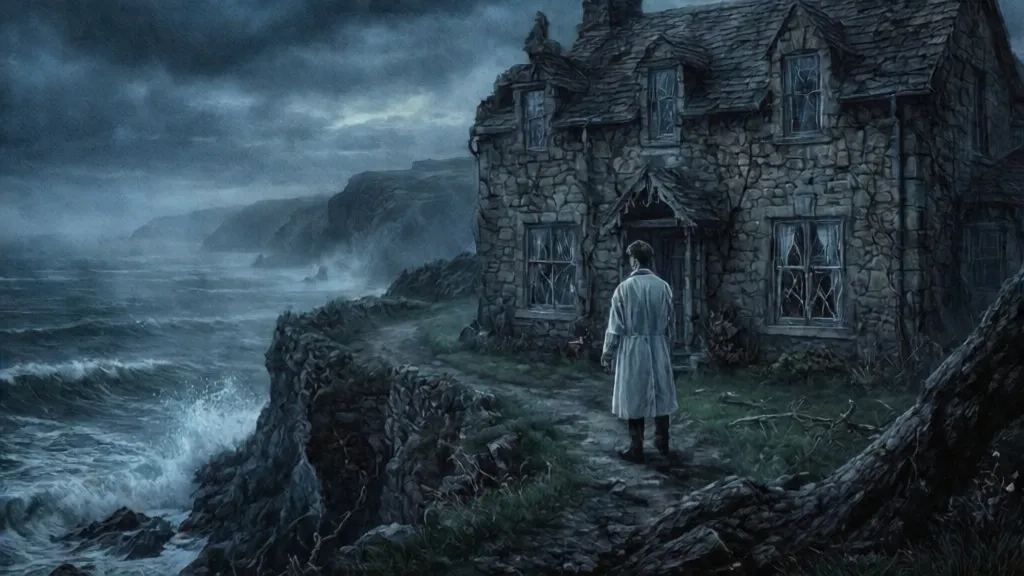
The tide was coming in when Dr. Silas Morrow arrived at Carrow House, and the wind off the sea had a quality he could not immediately name — not cold, precisely, but expectant, as though the air itself had been waiting for someone to walk into it.
The house stood at the edge of the bluff above Dunmore Cove, three storeys of grey stone with salt crusting the windowpanes like a second skin grown over blindness. It was not, Morrow noted with professional detachment, a house that inspired confidence in the constitution of those who lived within it. The damp alone would account for half a dozen pulmonary complaints. The isolation would account for the rest.
He had been summoned by telegram. The message had been brief to the point of discourtesy:
Mrs. PARR deceased. Upstairs room. Come at once. Housekeeper Elsey will admit. — G. Parr.
Morrow had attended to the deaths of strangers before. It was, in the taxonomy of his profession, unremarkable work: the examination, the certificate, the quiet closing of a door. He had no particular reason to feel, as he raised the iron knocker, that this occasion would distinguish itself from the several hundred that had preceded it.
The housekeeper who admitted him was a small woman of perhaps sixty, dressed in black that had faded to the colour of old ash. Her name, she confirmed, was Elsey. She did not offer a surname. She held a lamp at chest height, and its light made a terrible private theatre of her face.
"The doctor," she said. It was not a greeting. It was an identification, as one might label a jar.
"Dr. Silas Morrow," he confirmed. "I understand I am here to certify a death."
"You are," said Elsey. She stepped back to admit him. "Though you've come rather late for it."
Morrow chose not to pursue the remark. He followed her into the entrance hall, which smelled of brine and something else — a dry, mineral smell that reminded him, absurdly, of a fireplace that had not been used in some time. The floor was bare stone. His bag made no sound when he set it down, as though even the echo had been quietly discouraged.
The staircase was narrow, and Elsey led the way with the lamp held before her like a confession. As they ascended, Morrow observed the wallpaper: a repeated pattern of seabirds in blue and grey that had been allowed to peel at the seams, so that the birds appeared, in the unsteady lamplight, to be in a state of perpetual half-flight. He found this detail more affecting than he cared to acknowledge.
"How long has the deceased been confined to her room?" he asked, partly from professional necessity and partly to hear a voice that was not the wind.
"Three weeks," said Elsey, without turning. "Mr. Parr insisted on it. After the first night."
"The first night of what?"
Elsey did not answer immediately. They had reached the landing. Before them was a door that had been, quite unmistakably, nailed shut — four long nails driven through the frame at intervals, the wood around them split and darkened as though the work had been done in haste or anger.
"The first night she walked," Elsey said at last.
Morrow regarded the door. He regarded the nails. He was a man of medicine, trained at Edinburgh, with a particular interest in diseases of the chest and a published monograph on the diagnostic utility of percussion. He had a framework for most things. This framework was, he found, not immediately applicable.
"The door was nailed shut," he observed, because the observation seemed necessary.
"It was."
"Before or after the death?"
"After the second night," said Elsey. "Mr. Parr is not presently at the house. He left four days ago and has not wired since."
Morrow set down his bag and examined the door with his hands before he opened it. The nails had been removed — recently, he judged, from the fresh-splintered wood around the holes — and replaced with a simple bolt, which Elsey drew back with the air of a woman performing a task she had rehearsed and had not enjoyed rehearsing.
The room beyond was dark. Elsey lifted her lamp into the doorway, and Morrow entered.
She lay on the bed with the stillness of something that had been arranged rather than arrived at. That was his first impression: not the stillness of sleep, nor of unconsciousness, but of placement, as though considerable care had been taken to position the limbs in a posture of repose that the body itself had not cooperated in achieving.
Mrs. Parr had been, he estimated, in her mid-forties. The face was not unpeaceful. The eyes were closed. These were the reassuring details, and Morrow attended to them first, as a man might take stock of his footing before looking down from a height.
Then he took her hand to check for pulse — a formality, nothing more — and stopped.
Her fingers were black.
Not bruised. Not decomposed. Black with coal dust, ground into the whorls of the fingertips and packed beneath the nails with the thoroughness of honest labour. He had seen such hands before, on miners, on blacksmiths, on men who worked with their hands in dark places. He had not expected to see them on a woman who had been confined to a sealed room for three weeks.
He stood quite still for a moment, holding her hand in both of his.
"Elsey," he said.
"Yes."
"This coal dust."
"Yes," said Elsey again. Her tone suggested that she had been anticipating this exact sequence of words for some time and was not relieved by its arrival.
"How long?"
"Three nights. Each morning I found her so." A pause. "And each morning the grate was cold."
Morrow set the hand down with more care than the situation technically required. He made his examination. He wrote his notes in the small notebook he kept for such purposes, and his handwriting, he was relieved to observe, was steady. He was rather proud of this. He was, he reminded himself, a man of science. He wrote:
Deceased: female, approx. 45 yrs. Apparent cardiac failure. No external injury. Fingers of both hands: significant coal dust deposits, distribution consistent with sustained manual contact. No coal scuttle or fireplace contents in room. Source unknown. Time of death: cannot be precisely established. Certificate to follow.
He put the notebook away. He closed his bag. He was ready to leave.
The knock came as he reached the landing.
It came from below — from the ground floor, he thought, or perhaps from somewhere between the floors, though architecturally he could not account for such a space. It was not loud. That was the first thing. It was not a frantic knock, nor a distressed one. It was measured. Three beats, then silence. Three beats, then silence. As regular as a metronome, and with that same quality of mechanical patience that metronomes possess: the sense that the counting will continue regardless of whether anyone is listening.
Elsey stood at the top of the stairs with her lamp. She had not moved.
"That will be from the coal room," she said.
Morrow looked at her. "The coal room."
"Beneath the front stairs. Mr. Parr locked it. I don't have the key."
Three beats. Silence.
"How long has this been occurring?" Morrow asked. He used his consultation voice, the one he employed with patients who were either very frightened or in need of believing that someone in the room was not.
"Since the first night," said Elsey. "Though at first it was only once or twice. Now it is—" She paused. "More regular."
"I see," said Morrow, who did not see. "And you have not opened the door."
"I have not."
"Because you lack the key."
Elsey looked at him with an expression that was patient in the specific way that the sea is patient: not kind, merely indifferent to hurry.
"Because," she said, "whatever has learned to knock like that did not know, three nights ago, that knocking was the shape of the thing it wanted. It has learned that shape. I do not think one ought to reward that sort of learning."
Morrow opened his mouth. He was going to say something measured and professional about the acoustics of coastal properties, about the way wind found unexpected passages through old stone, about the particular resonance of enclosed spaces near the sea. He had the sentences assembled. They were good sentences. Edinburgh sentences.
Three beats. Then, after a pause longer than the others — long enough that Morrow had begun to exhale — four.
The pattern had changed.
He descended the stairs because a physician who could not descend a staircase was of limited professional utility, and also because there was no alternative exit from the landing that he had identified, and also — though he did not examine this reason closely — because he found that he very much needed to see the door.
It was beneath the stairs, as Elsey had said: a low, iron-strapped door of old oak, with a keyhole and no key, and a gap at the threshold no wider than his thumbnail through which cold air moved steadily outward, carrying with it the same mineral, unburned smell that had greeted him in the entrance hall.
Morrow crouched before it. He held his lamp close. He looked at the keyhole, which was dark, as keyholes naturally are, and then looked away because the darkness was not the passive darkness of a small enclosed space but something that seemed, without any movement he could observe, to be regarding the light with interest.
He stood.
He was going to say something to Elsey. He had, by this point, abandoned the Edinburgh sentences in favour of simpler constructions, the kind that could be deployed quickly if needed. He turned.
Elsey was standing at the foot of the stairs. The lamp made her face into a study in shadow and intention.
"The knocking began," said Morrow carefully, "on the first night she walked."
"Yes."
"And the coal dust began on the first night she walked."
"Yes."
"And the room upstairs was nailed shut so that she could not—" He stopped. He began again. "So that nothing could leave it."
"Yes."
"Then the knocking," he said, "is not Mrs. Parr."
Elsey said nothing. The lamp was very steady in her hand.
"Because Mrs. Parr," Morrow continued, in a voice that he was distantly aware had lost some of its professional composure, "is upstairs."
"She is," said Elsey.
Silence. The kind that follows a statement that has not, in fact, resolved anything.
And then, from above them — from the room with the nailed door, the room with the cold grate, the room where Mrs. Parr lay on her arranged bed with her arranged hands and her coal-black fingers — there came, slow and deliberate and new, the sound of three measured knocks.
Morrow looked at Elsey.
Elsey looked at the ceiling.
"She has not done that before," said Elsey. Her voice was entirely without inflection.
Morrow found that he was holding his medical bag very tightly, though he could not have said when he had picked it up. It was a good bag. Leather. He had carried it for eleven years. It had been, until this evening, entirely sufficient.
Below the stairs, the coal room answered: four beats, then five, in a pattern that was no longer random, that was no longer anything so innocent as random, that was instead the sound of two things in separate darkness discovering, with what could only be described as patience, that they were not alone.
Morrow did not move.
This was not, he would later tell himself, because he was afraid.
It was because he had, at last, understood something — the precise nature of which he found himself entirely unable to certify.