The Ledger of Expected Guests
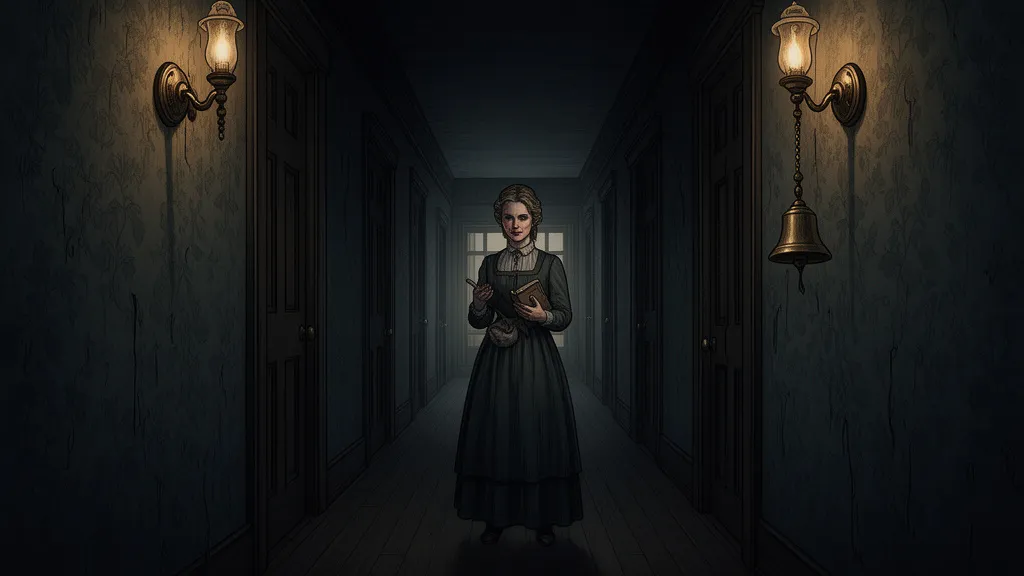
The bell pull rang at half past two in the morning, which was, Mrs. Dorothea Crane reflected, a thoroughly inconvenient hour for any occurrence whatsoever, supernatural or otherwise.
She lay still for a moment in the narrow bed, listening to the silence that followed the bell's single, deliberate note, and told herself that the sound had been a dream. She was, by profession, a woman of scientific disposition — a taxidermist of some local repute, recently widowed, recently arrived at Carrow's End Boarding House for reasons she described to herself as recuperative and to others not at all — and she did not, as a matter of principle, believe in things that rang without visible cause.
The bell rang again.
She rose, wrapped herself in her travelling robe, and opened the door to the corridor.
The passage was empty, as she had known it would be. The gas bracket at the far end burned low and yellow, casting the kind of light that turns familiar objects into approximate versions of themselves. The bell pull — a tasselled brass fixture mounted on the wall opposite the linen closet — hung motionless. The air smelled of damp plaster and, beneath that, something saline and biological that she associated, professionally, with the early stages of preservation.
The carpet, she noticed, was wet.
Not wet uniformly, as it might be from a leak in the ceiling above, but wet in a pattern: a series of small, ovoid impressions, perfectly spaced, running from the window at the corridor's end toward — and then past — the door of the locked room. The impressions were approximately the size of a child's bare foot. They were, if one pressed one's hand to the fibres, warm.
Mrs. Crane stood in the passage for rather longer than she would later admit, her hand pressed flat to the carpet and her professional composure engaged in a silent and losing argument with her instincts. Then she stood, noted the direction of the footprints, and returned to her room.
She did not sleep again before morning.
The boarding house at Carrow's End occupied the last habitable position on a spit of land that had been, in the eighteenth century, considerably more land and was now considerably less. The sea pressed in on three sides. At high tide, one could hear it beneath the floorboards — not loudly, but persistently, with the patient quality of something that had all the time it required.
Mrs. Hatch, the housekeeper, had operated the establishment for longer than anyone in the village seemed able to specify. She was a small woman of indeterminate age, possessed of the particular brightness of eye common to those who have resolved never to explain themselves, and she served an adequate breakfast without once making eye contact with any of her guests.
There were, at present, only two: Mrs. Crane, and a retired solicitor named Fellowes who appeared at meals, ate methodically, and retreated to his room, where he could be heard moving furniture for reasons he did not share.
"The bell pulled itself last night," Mrs. Crane said, over toast, making her tone as casual as the sentence permitted.
Mrs. Hatch refilled the teapot. "The tide turns at half two," she said, as though this were an explanation of a perfectly satisfying kind.
"And the locked room at the end of the passage," Mrs. Crane continued, watching the housekeeper's hands. "I should like to see it."
"It's kept locked," said Mrs. Hatch.
"Yes," said Mrs. Crane. "I had noticed."
There was a pause of the sort that Mrs. Hatch appeared to find entirely comfortable and Mrs. Crane did not.
"The key's on the hook in the kitchen," the housekeeper said at last, and went to see about the washing up.
The key was iron and heavy and had been hung, Mrs. Crane observed, on a hook so positioned that one would need to stand directly before the kitchen window to reach it — the window that faced the sea, where the tide was currently withdrawing across the exposed grey mudflats with a sound like slow, repeated exhalation.
She took the key at eleven o'clock, when Mrs. Hatch had gone to the village, and stood before the locked door at eleven minutes past.
The door was ordinary in every observable respect. It was painted the same institutional cream as the others. Its handle was the same pressed brass. There was nothing written on it, no quality of particular coldness or warmth, no sound issuing from within. Mrs. Crane was mildly disappointed and then, upon reflection, relieved, and then, more slowly, frightened — because the absence of obvious wrongness seemed to her, in the morning's clear light, more deliberate than its presence would have been.
She put the key in the lock and opened the door.
The room smelled of old paper and the sea. It contained a single iron bedstead, a washstand, a wardrobe with its door standing open to reveal nothing, and a writing desk against the far wall. On the desk was a ledger.
It was the kind of ledger one associated with Victorian account-keeping: thick-boarded, cloth-spined, the pages edged in a red that had faded to the colour of old brick. The word GUESTS had been written on the cover in a hand that Mrs. Crane recognised with a slowness that was itself a kind of mercy — because the mind, when it encounters the impossible, tends to negotiate a delay.
The hand was her own.
She stood in the doorway for some time. Then, because she was a woman who had skinned and mounted a great many animals and had long since made a practical accommodation with the unpleasant, she crossed to the desk and opened the ledger.
Each page was divided into columns: Name, Arrival, Room, Duration of Stay. The entries were written in the same careful, slightly leftward-slanting hand that she had used since the age of fourteen and which her late husband had always called unnecessarily architectural.
The entries were not, however, for any guest she recognised.
Miss E. Farrow — 18 September — Room 4 — Indeterminate.
Rev. G. Pallister — 19 September — Room 6 — Indeterminate.
Dr. and Mrs. Auchinleck — 19 September — Room 2 — Indeterminate.
The list continued for eleven pages, the names ordered by arrival date, each marked Indeterminate in the duration column. She turned to the final entry.
Mrs. D. Crane — 14 September — Room 7 — Indeterminate.
She was in Room 7.
She had arrived on the fourteenth of September.
She closed the ledger, placed it precisely where it had been, locked the door behind her, returned the key to its hook in the kitchen, and sat down at the dining room table, where she remained for the better part of an hour without doing anything at all.
High tide was expected at half past seven that evening, which Mrs. Hatch had mentioned at lunch in the same tone one might employ for a train timetable.
At a quarter past six, Mr. Fellowes descended the stairs, greeted Mrs. Crane with a nod of the type that communicates the absolute minimum of social obligation, and took his customary seat at the far end of the dining table. Mrs. Crane, who had been watching the passage from her chair near the window, turned to observe him with the particular attention she had previously reserved for specimens that presented unexpected anatomical features.
"Have you been here long?" she asked.
"Three weeks," he said, unfolding his napkin. "Possibly four."
He said this without any apparent awareness that the distinction between three and four weeks ought to be readily ascertainable by a man in full possession of his faculties, and Mrs. Crane found this, in the circumstances, the most alarming thing she had yet encountered.
At half past six, Mrs. Hatch appeared at the kitchen door with an expression of satisfaction that Mrs. Crane had not previously observed on her face.
"They've arrived," she said.
"I beg your pardon?"
"The other guests. They're downstairs — they came through the garden entrance while the tide was low. They'll be joining you for supper." She began laying additional places, moving with the efficiency of a woman who has set the same table a great number of times. "Six places, I think. Perhaps seven."
"Six—" Mrs. Crane stood. "Mrs. Hatch, I must be quite clear with you. I have seen no one arrive. I have been seated at this window for the past two hours."
"They came through the garden," said Mrs. Hatch serenely.
"The garden," Mrs. Crane said, "is on the seaward side."
Mrs. Hatch set a sixth place with the careful precision of a woman who has not heard this, or has heard it and found it wanting as an objection, and retreated to the kitchen.
Mr. Fellowes, who had watched this exchange with the detached interest of a man at a lecture he did not quite follow, smoothed his napkin across his lap. "She said the same to me when I arrived," he offered. "About other guests."
"And?"
He considered this. "I never saw them at table."
The bell rang at twenty minutes past seven.
Mrs. Crane was already in the corridor. She had positioned herself there deliberately, with the studied calm of a woman whose professional life had required her to be present at moments other people preferred to avoid, and she stood with her back to the linen closet and her eyes on the locked door at the passage's end.
The carpet was wet again. The footprints — she counted them this time, in the low gas-light — were the prints of both feet, left and right in proper alternation, walking toward the locked door and stopping directly before it.
The bell pull hung motionless.
The knock, when it came, was not at the door.
It came from the wall to the left of the locked door — the interior wall, which gave, if the boarding house's dimensions were correctly estimated in Mrs. Crane's mind, onto a space that should not exist. A gap between the locked room and the exterior of the building, perhaps eighteen inches across, running the full height of the wall. A space that served no architectural purpose she could identify and that the original construction would have offered no reason to include.
The knock was the knock of a hand, or something shaped like one. It came three times, evenly spaced, with the patient quality of something that had knocked before and expected to knock again.
Mrs. Crane stood very still and thought about the ledger, and about the column marked Duration of Stay, and about Mr. Fellowes who could not say with certainty whether he had been here three weeks or four, and about the sea, which had been eating the land for centuries and which would, in due course, eat this building as it had eaten everything else, without haste and without malice and without any interest whatsoever in the distinction between those who had arrived and those who had merely been written down as expected.
She thought about the footprints, which were warm.
She thought about her husband, who had died in March, and about the word recuperative, and about the particular honesty of choosing a place at the very edge of things when one was not entirely certain one wished to remain at the centre of them.
The knock came again. Four times now. Still patient. Still interior.
She put her hand on the door of the locked room.
The key was in her pocket — she had taken it again from the kitchen hook after supper, without quite deciding to. Her fingers found it. The lock turned without resistance, as though it had been expecting her.
The room was dark. The ledger was on the desk, as she had left it, and on the cover, in her own hand, the word GUESTS, and the sea was audible beneath the floor, and the knock came again from inside the wall — from the eighteen inches of impossible space — and something in the proportion of that sound told her, with the sudden and very quiet clarity of a fact that has always been present and is only now being acknowledged, that the sound was not requesting entry.
It was asking whether she intended to leave.
In the dining room below, she heard Mrs. Hatch's voice, bright and accommodating, greeting the guests for supper. She heard chairs drawn. She heard, or believed she heard, the particular social sound of a table being settled around, the adjustments of several people arranging themselves comfortably in a space that had been prepared for them.
She heard, beneath all of this, the tide.
Mrs. Crane stood in the doorway of the locked room, her hand on the frame, and understood — not everything, because understanding everything was a comfort available only to the very naive or the very dead, but enough — she understood enough to know that the knock would not stop, and that Mrs. Hatch would continue to lay places, and that Mr. Fellowes would remain unable to say with confidence how long he had been here, and that the ledger would continue in her handwriting, and that the next entry after her own name had already been written, in a hand she had not yet thought to check.
The knock came again, from inside the wall, from inside the space between the room and the sea.
She did not open the wall. There was no mechanism by which she could open the wall. But she understood, standing there with the gas-light behind her and the dark room before her and the tide arriving below, that this was not the point.
The point was whether she stepped back into the corridor, with its warm wet footprints and its ringing bell, and closed this door, or whether she stepped forward into the room that had been written down for her since before she arrived — whether she crossed that threshold fully, and let the door swing shut, and sat down at the desk, and opened the ledger to the next blank page.
The knock did not hurry her.
It was, after all, perfectly accustomed to waiting.