The Pulse Inside the Wardrobe
The Pulse Inside the Wardrobe
The fog had settled over the river by four o'clock, which Dr. Clement Voss considered a meteorological impertinence, and the message requesting his attendance at Sallow House had arrived at half past six, which he considered worse. He was, at that hour, eating a satisfactory supper. He was, furthermore, a physician of fifteen years' standing — a man who had lectured at Guy's on the mechanics of the cardiovascular system and whose monograph on irregular pulse in cases of rheumatic fever had been received with cautious admiration by three separate colleagues — and he did not, in general, appreciate being summoned into fog on a Sunday.
And yet he went. One always goes.
The house stood at the river's edge as though it had been placed there by someone in a hurry and never retrieved. It was a large villa of the Regency period, its stucco the colour of old bone, its gardens reduced to a narrow strip of waterlogged grass that ended abruptly where the bank had, at some point, simply given up. A servant — elderly, silent, possessed of an eye that tended southeast when the other faced forward — admitted Dr. Voss without ceremony and led him up a staircase that breathed damply underfoot.
"The nature of the complaint?" Dr. Voss asked, producing his notebook.
"Mr. Feld will explain," said the servant, and knocked at a door.
The room he entered was large and insufficiently lit. Two candles burned on the mantel and a third stood on a small table beside the bed, its flame suspended above a wide ceramic basin filled with water so dark it might have been drawn from the river itself. The water did not move. The flame did not waver. Dr. Voss, who prided himself on noticing details of significance, noted this and elected, for the moment, to say nothing about it.
The patient was a man of perhaps sixty, thin in the manner of someone who had once been substantially built, lying against pillows that had seen better decades. His name, the servant had said, was Mr. Feld. He was awake and watching the door with an expression of composed — Dr. Voss searched for the word — anticipation.
"You are the physician," said Mr. Feld. It was not a question.
"Dr. Clement Voss. I was asked to call." He set his bag upon the chair and opened it. "If you will allow me to examine you."
"I will," said Mr. Feld, "but I ask that the gas not be lit. The candles only, if you please."
Dr. Voss had examined patients by inferior light before, in circumstances considerably less comfortable than this, and he said so. He drew his chair to the bedside, took Mr. Feld's right wrist between his fingers, positioned his watch, and waited.
Nothing answered him.
He adjusted his grip. He moved his fingers fractionally — a technique he had described in print as digital triangulation and which had never once failed him. He pressed with more authority. He felt the thin tendons of the wrist, the cool skin, the faint warmth of the man's blood moving somewhere distant and private beneath it all.
But no pulse. Not there.
He tried the left wrist. Then the throat. Then, feeling a clinical embarrassment he refused to acknowledge in his expression, the inner wrist again.
"You will not find it there," said Mr. Feld, with a patience that Dr. Voss found, in the moment, intensely irritating.
"The pulse," said Dr. Voss, because clarity was always preferable to inference, "is not presenting in the expected location."
"No," said Mr. Feld.
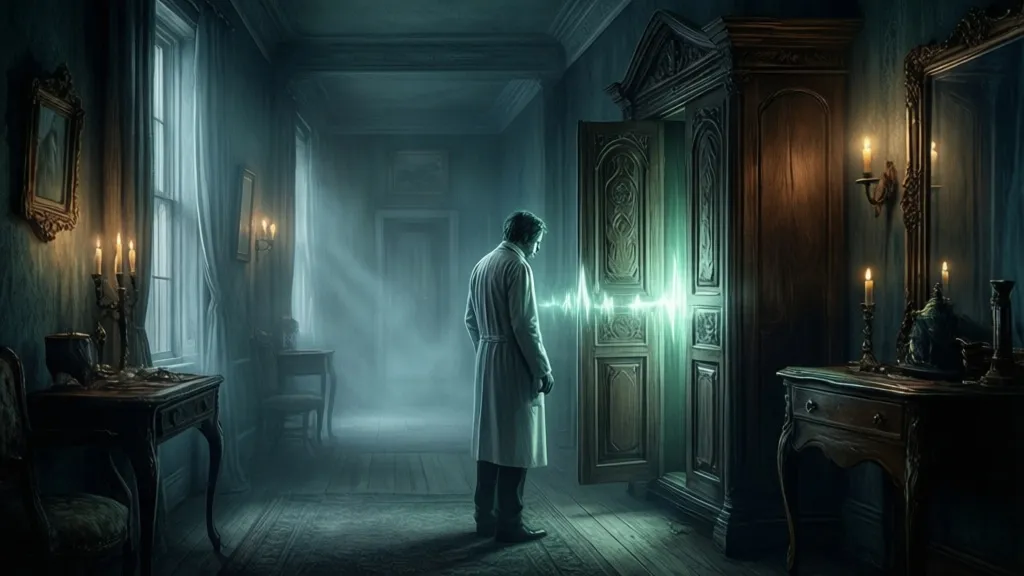
From across the room — from the large wardrobe of dark walnut that occupied most of the far wall, its doors sealed with a length of cord wound twice around both handles — came a sound.
It was rhythmic. It was faint. It came at a rate of approximately seventy beats per minute, which Dr. Voss, even in that moment, could not help but assess as entirely normal.
The household, such as it was, assembled itself in the corridor at Dr. Voss's request. There were three of them: the cross-eyed servant, whose name was Orris; a woman of middle age identified as Mr. Feld's sister, a Mrs. Peel, who had arrived from London that morning and was still wearing her travelling coat; and a younger man, Mr. Feld's nephew, who gave his name as Thomas and who stood with his arms folded and his chin set at an angle that suggested he had formed an opinion and intended to keep it.
"The wardrobe," Dr. Voss said, "must be opened."
"It must not," said Mrs. Peel.
"It must," said Thomas, simultaneously.
Orris said nothing, but his functional eye moved to the door of the bedroom with an expression that Dr. Voss could only describe as precautionary.
"I am the attending physician," Dr. Voss said, drawing upon the full authority of the statement, "and my patient's vital signs are presenting from within a sealed piece of furniture. I think the matter is beyond argument."
"Uncle has asked that it remain closed until midnight," said Mrs. Peel. "He was quite clear."
"He was not clear at all," said Thomas. "He was frightened. He has been frightened for three weeks."
"Of what?" said Dr. Voss.
They looked at him with the expression of people who have been asked a very large question in a very small corridor.
"The house," said Orris, finally, still watching the door, "has been doing this since October."
Dr. Voss returned to his patient and conducted such examination as was possible under the circumstances, which were, he recorded in his notes, irregular. Mr. Feld's breathing was slow and deep — too slow, in fact, for wakefulness, and yet the man's eyes remained open and attentive. His temperature was low. His colour was poor. But he answered questions, and his answers were coherent, and there was nothing in his presentation that permitted Dr. Voss to name a specific complaint.
Except, of course, for the wardrobe.
The scratching from within it had begun perhaps twenty minutes after his arrival — a sound not unlike fingernails drawn lightly across the interior surface of the wood, irregular in rhythm but not in intent, moving from the bottom of the door upward in a slow and deliberate arc. Alongside the scratching, the pulse continued. Dr. Voss had checked it three times with his watch. It had not varied by more than two beats.
He noticed also that the walls of the room were wet.
Not damp — he would have accepted damp; damp was a feature of riverside properties and implied nothing beyond poor drainage — but wet, as though something were being slowly pressed out of the plaster from behind. The moisture gathered in long vertical streaks and ran in thin lines to the skirting board, and when Dr. Voss touched the wall beside the window, his fingers came away with a faint residue, gritty and pale.
Salt.
He stood very still for a moment. He was a man trained in the recognition of symptoms, and he understood, in a way he could not yet articulate, that the salt was a symptom. Of what system it was a symptom, his training declined to specify.
"Mr. Feld," he said carefully, "how long have you been unwell?"
"Since the wardrobe arrived," said Mr. Feld.
"When was that?"
"Three weeks ago. It was my father's. Sent from the estate after he died." He paused. "I should not have accepted delivery."
"And the water?" Dr. Voss indicated the basin.
Mr. Feld looked at it with a weariness that was not entirely of the body. "The flame is steadier above it," he said. "I find it — settling."
Dr. Voss looked at the flame. It was, in fact, perfectly still. He could not account for this, given that two people were breathing in the room and the window frame clearly did not seal adequately. He wrote candle: anomalous stability in his notebook, because one must write something, and because the alternative was to simply stand there in the grip of an unscientific and thoroughly inconvenient sensation that one was being watched.
From the wardrobe: three slow, distinct knocks.
The pulse, for the first time, quickened.
At a quarter to midnight, Thomas opened the wardrobe.
He did so without further consultation, having evidently reached the limit of his patience with collective uncertainty. Dr. Voss was at the bedside. Mrs. Peel stood in the doorway. Orris did not come in at all.
Thomas unwound the cord. He took hold of both handles. He looked back once — not at Dr. Voss, who was watching, and not at Mrs. Peel, but at Mr. Feld, who lay perfectly still against his pillows with his eyes fixed on the ceiling — and then he pulled the doors open.
What was inside the wardrobe was dark.
This is not, Dr. Voss would later concede, an unusual property of wardrobes, particularly those in candlelit rooms. But the darkness inside this one was — he searched, as he always searched, for the precise word — specific. It occupied the interior with a density that the candlelight touched only at its very edge, illuminating the wooden rail, the empty hooks, the bare floor of the wardrobe, and nothing more.
And yet it was not empty. This was the thing he could not write down. This was the thing that resisted his notebook and his training and his fifteen years and his monograph. It was not empty in the way that a room in which someone is standing is not empty, even before one has looked up to see them.
Mr. Feld took one long, slow breath.
His pulse returned to the wrist.
The scratching stopped.
Dr. Voss stood at the bedside with his fingers pressed to that ordinary wrist, feeling that ordinary rhythm, and understood — with a clarity that arrived too late, as understanding always does — that the question had never been whether to open the wardrobe.
The question was what had needed them to.