The Warm Place at the Throat
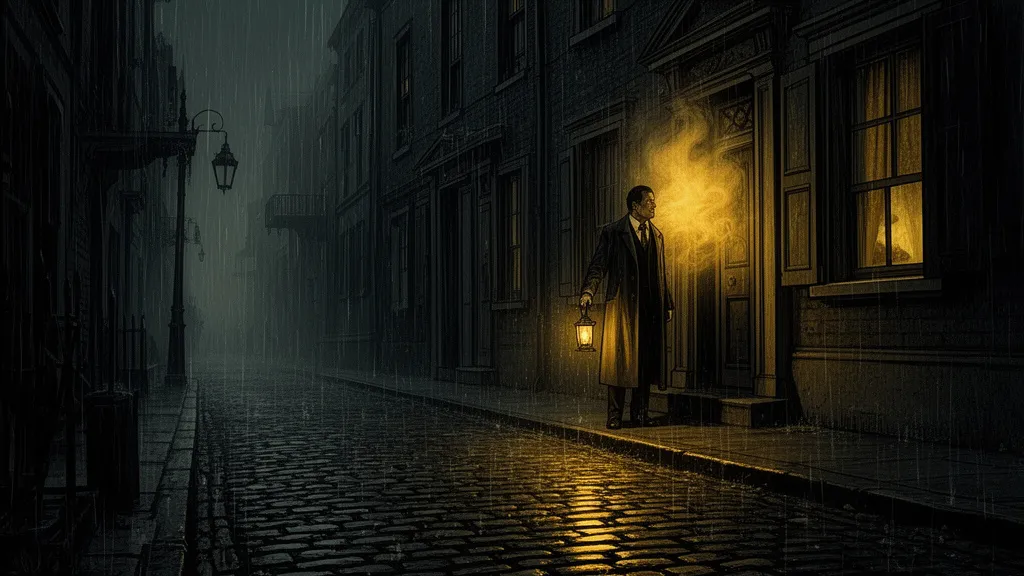
The summons came at half past ten, which Dr. Ashford considered an unconscionable hour for any communication that was not, strictly speaking, a matter of life and death. He was, as he later reflected with some bitterness, correct on both counts.
The note had been brought by a boy of perhaps twelve, who stood in the rain outside Ashford's consulting rooms on Claverton Street with the particular expression of a child who had been told something alarming and instructed not to repeat it. The note itself was brief — Come at once. Parlour Street. Number Eleven. The family requires a physician and there is no time. — and signed only with the initials E.V., which Ashford did not recognise and made no effort to investigate. He had, in his twenty years of practice, learned that the notes which failed to explain themselves were invariably the ones that demanded answering.
He arrived at Number Eleven Parlour Street to find a townhouse of the respectable middle sort, four storeys of pale London brick, its windows dark except for one on the ground floor through which a thin and yellowish gaslight moved in a manner that suggested agitation rather than illumination. The brass knocker was wreathed in black crepe. Ashford noted this without comment. Grief, in his experience, expressed itself in a remarkable variety of textile arrangements, and he had learned not to remark upon them.
The door was opened by a woman in her middle forties who introduced herself as Mrs. Edith Vane, and who had the eyes of a person who had not slept in some time and had begun to suspect she never would again.
"Thank you for coming," she said, and took his coat with hands that shook only a little. "I must ask you to be very quiet. My sister is upstairs."
"I understand," said Ashford. "You wrote that there was no time — "
"She cannot be moved until dawn," said Mrs. Vane, as though this explained everything, and led him into the parlour.
The room had been prepared for death in the traditional fashion, which is to say that it had been draped in black crepe along every cornice and along every picture rail, and the furniture had been pushed toward the walls, and every mirror in the room had been covered with newspaper — the Illustrated London News, Ashford noticed, the September fourteenth edition, which meant that someone had completed this task within the last three days. Every mirror, that is, except one.
The one that had been left uncovered stood between the two front windows, a tall pier glass in a gilt frame that had seen better decades. In it, Ashford observed the reflection of the room — the draped walls, the pushed-back furniture, the small fire burning low in the grate — and, seated in the velvet chair that stood before that fire, a woman.
He turned.
The chair was empty.
He turned back to the mirror.
The woman remained. She was perhaps sixty years of age, dressed in the dark clothing of a previous generation, her hands folded in her lap with an extraordinary stillness that Ashford associated not with repose but with effort. As though she were holding herself very deliberately in place. She did not move. She did not look at him, or at anything he could identify. Her eyes were open and directed at some point in the middle distance that existed only within the glass.
"You see her," said Mrs. Vane. It was not a question.
"I see a reflection," said Ashford, with the measured precision of a man who had spent twenty years constructing sentences that could be retracted if necessary.
"Yes," said Mrs. Vane. "The others didn't. The boy who came for you didn't. My husband went into the street and was sick against the railings and has not returned." She paused. "I have been watching her since eleven o'clock last night."
Ashford looked at the mirror for another moment. Then he looked at Mrs. Vane.
"You said your sister is upstairs," he said.
"Yes."
"I should like to examine her."
The staircase was narrow and the gaslight on the landing was burning low, casting the kind of shadows that seem less like the absence of light than like the presence of something else. Ashford followed Mrs. Vane to the second floor, to a door at the end of a short corridor, which she opened without hesitation and then did not enter.
"Her name was Margaret," said Mrs. Vane. "Is," she corrected herself, in a tone that suggested the correction cost her something.
Ashford went in.
The room was small and neat and smelled of rosewater and of something underneath the rosewater that he did not immediately name. The woman in the bed was perhaps fifty-five, thin-faced, with grey hair arranged carefully on the pillow, and she was, to all appearances, dead. Her face had the particular quality of stillness that Ashford had observed in the dead on many occasions: not sleep, which is animated even in its quietude, but the total cessation of the small and unconscious movements by which we signal our continued participation in the world.
He set down his bag and approached the bed with the professional composure he had spent two decades cultivating, and he placed two fingers at her wrist.
Nothing.
He reached for his stethoscope and held it to her chest.
Nothing.
He noted the rigor of the limbs — pronounced, consistent with a death of some hours previous — and the pallor of the skin, and the slight cyanosis at the fingertips. He noted all of these things and arranged them in the orderly ledger of his medical understanding, and then he placed his hand gently at the side of the woman's throat, beneath the jaw, where the great vessels run close to the surface.
He held it there for five seconds.
Then he held it there for five more.
The skin at her throat was warm.
Not the residual warmth of a body recently deceased, which he had felt many times and would have found unremarkable — but warm in the manner of living tissue, of a pulse that was present in every sense except that it was not beating. Warm in the way that suggested occupancy.
Ashford withdrew his hand and stood very still for a moment.
Then he checked again.
Warm at the throat. Cold at the wrist. Cold at the temple. Cold, when he checked with the same deliberate care, at the sternum. He pressed two fingers to each location in sequence, moving slowly around the bed, and each time the result was the same — the stillness and chill of the dead — until he returned to the throat, where the warmth persisted with a steadiness that struck him as almost aggressive in its refusal to be a coincidence.
He spent eleven minutes in that room. He was not a man given to uncertainty, and he remained, outwardly, composed. He made notes in the small leather-bound book he carried for the purpose. His handwriting, when he reviewed it later, was only slightly less steady than usual.
When he returned to the landing, Mrs. Vane was waiting where he had left her.
"I require an explanation," said Ashford.
"Yes," she said. "So do we."
"The body presents every sign of death. Rigor. Pallor. Absence of pulse and respiration. She has been dead, by my estimation, for eight to twelve hours." He paused. "The throat is warm. The warmth is localised, consistent, and does not diminish on repeated examination."
Mrs. Vane looked at him with the expression of a woman who had hoped that a physician would arrive and make things simpler.
"She could not be moved until dawn," she said again. "She told me so herself."
"Mrs. Vane," said Ashford carefully, "your sister has been dead for the better part of a day."
"I know," said Mrs. Vane. "She told me last night. Before."
From the staircase below them, the gaslight on the ground floor flickered. Ashford turned. He could see the bottom of the stairs and the narrow strip of hallway that opened into the parlour, and he could see that the light in the parlour was changing — not dimming in the ordinary fashion of a failing flame, but dimming in a way that seemed directed, as though something were moving through it.
Moving from the direction of the mirror toward the stairs.
He became aware, with the particular clarity that visits a man only when he has run entirely out of available explanations, that the warmth he had felt at the dead woman's throat had not been uniform. It had been slightly, precisely, inexplicably more concentrated on the left side, which was the side that faced the door, which was the side that faced the corridor, which was the side that faced the stairs.
He stood at the top of those stairs and listened to the gaslight dims below him, one lamp and then the next, as something he could not see and would not describe moved upward through the house toward the room where its body lay, warm at the throat, waiting with a patience that had nothing human left in it except, perhaps, the waiting itself.
"Do not," said Mrs. Vane quietly, from somewhere behind him, "open that door."
Ashford did not open the door.
He stood on the landing with his medical bag in his hand and his notes in his pocket and twenty years of rational training arranged neatly before him like a fence, and he listened to the last gaslight go out at the bottom of the stairs, and he understood — in the way that one understands a thing not through reason but through the sudden and irreversible collapse of every alternative — that the dead, on this particular night in this particular house, had somewhere still to be.